
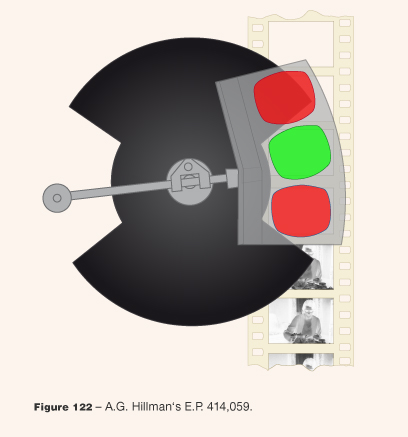
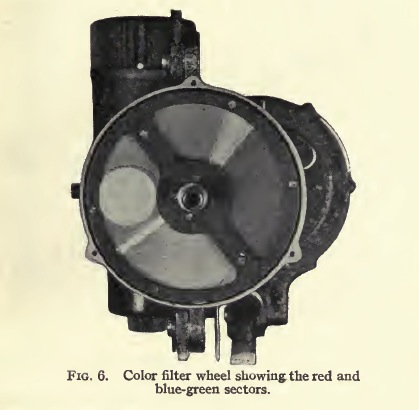
Three black-and-white color separations were printed consecutively on one film strip and projected through the corresponding color filters, thus combining to one color image on screen.
Category: Temporal synthesis (rotary filters)▼×
- All Categories
- Bibliography
- Chromogenic monopack
- Chromolytic multilayer
- Color separation
- Double-coated / bi-pack
- Edge Codes and Identification
- Hand coloring
- Other
- Printing / dye-transfer
- Printing / pigment process
- Screen processes
- Spatial synthesis (multiple lenses, beam splitter)
- Stencil coloring (pochoir, Pathécolor)
- Theory
- Tinting
- Toning
“The first patent that has been found was granted to H. Isensee and he placed in front of the lens, both in taking and projection, a rotary shutter with three 120 degrees sectors in the usual colors.”
(Wall, E.J. (1925): The History of ...
-
![]() Source: D.R.P. 98,799, Dec. 17, 1897
Source: D.R.P. 98,799, Dec. 17, 1897
- Credit: Illustration by Sarah Steinbacher, Multimedia & E-Learning-Services, University of Zurich. Source: D.R.P. 98,799, Dec. 17, 1897

2 Images
“In 1898 William Friese-Greene, a professional portrait photographer by trade, demonstrated in London ‘the first process of true natural-color cinematography.’ His program consisted of ‘a series of animated natural-color pictures,’ and although this demonstration aroused considerable interest at the time, Friese-Greene was unable to exploit this system on a profitable basis. Undaunted, he eventually developed a total of four different color methods.”
-
![]() Credit: Courtesy of BFI National Archive. Photograph by Barbara Flueckiger. Film: Kino the Girl of Colour (GB 1920, William Friese-Greene, Claude Friese-Greene).
Credit: Courtesy of BFI National Archive. Photograph by Barbara Flueckiger. Film: Kino the Girl of Colour (GB 1920, William Friese-Greene, Claude Friese-Greene).
- Credit: Cinémathèque française, conservatoire des techniques, Paris.
- Credit: Paolo Cherchi Usai. Source: Cherchi Usai, Paolo (2000): Silent Cinema. London: BFI.

112 Images in 2 Galleries
“Apparently, associated with W. Friese-Greene, in the same year, Captain William Norman Lascelles-Davidson, also of Brighton, patented a triple lens motion picture camera (E.P. 23,863, 1898). The colour filters revolved either behind the lenses, ...
-
![]() Drawing from E.P. 13,468, 1901.
Drawing from E.P. 13,468, 1901.
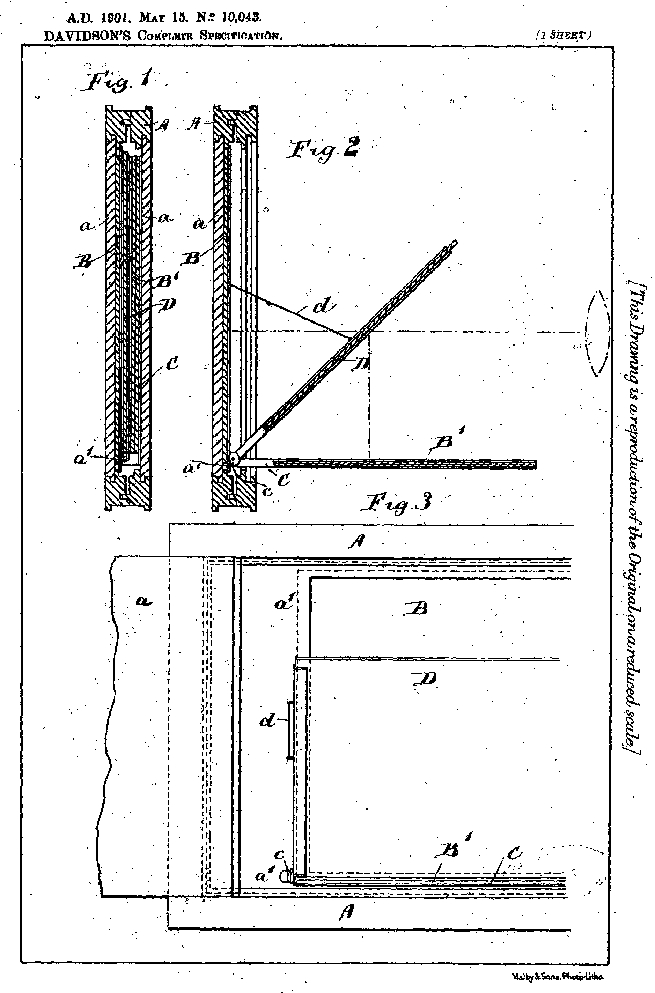
1 Image
“Frederick Marshall Lee, of Walton, and Edward Raymond Turner, of Hounslow, to whom is usually accorded the credit of achieving the first practical results in additive projection. Their experimental work was financed by Charles Urban, a ...
-
![]() „Their projector […] used three lenses and a special filter
wheel which enabled every frame of the film to be projected three times in succession through the appropriate filter as it passed through the triple frame projector aperture. Although it eventually led to the Kinemacolor two colour process, the Lee and Turner patent was not successful“. Source: Coote, Jack H. (1993): The Illustrated History of Colour Photography. Surbiton, Surrey: Fountain Press.
„Their projector […] used three lenses and a special filter
wheel which enabled every frame of the film to be projected three times in succession through the appropriate filter as it passed through the triple frame projector aperture. Although it eventually led to the Kinemacolor two colour process, the Lee and Turner patent was not successful“. Source: Coote, Jack H. (1993): The Illustrated History of Colour Photography. Surbiton, Surrey: Fountain Press.
- "The First Color Moving Pictures", from the YouTube channel of the National Media Museum. [quote id="1"]
- Lee Turner projector in the Media History Museum in Bradford.
- „In 1899 Lee and Turner obtained a patent for a three colour process of cinematography requiring a single lens camera […] making a recurring sequence of red green and blue exposures through a rotating filter cum shutter“. Source: Coote, Jack H. (1993): The Illustrated History of Colour Photography. Surbiton, Surrey: Fountain Press.
- „In 1899 Lee and Turner obtained a patent for a three colour process of cinematography requiring a single lens camera […] making a recurring sequence of red green and blue exposures through a rotating filter cum shutter“. Source: Coote, Jack H. (1993): The Illustrated History of Colour Photography. Surbiton, Surrey: Fountain Press.
- „Their projector […] used three lenses and a special filter wheel which enabled every frame of the film to be projected three times in succession through the appropriate filter as it passed through the triple frame projector aperture. Although it eventually led to the Kinemacolor two colour process, the Lee and Turner patent was not successful“. Source: Coote, Jack H. (1993): The Illustrated History of Colour Photography. Surbiton, Surrey: Fountain Press.
- National Media Museum, UK. Lee and Turner Colour Projector, 1902.
- Source: Klein, Adrian Bernhard (Cornwell-Clyne) (1940): Colour Cinematography. Boston: American Photographic Pub. Co.
- Illustration of the process from National Media Museum's short documentary.
- 38 mm positive of the Lee Turner film showing the three b/w images for the three color records. Credit: Brian Pritchard.

16 Images in 1 Gallery
“Then we come upon the name of George Albert Smith, F.R.A.S., of Laboratory Lodge, Roman Crescent, Southwick, Brighton, who in E.P. 26,671, of 1906, patented the method which eventually was commercialized as Kinemacolor.
In this patent he ...
Kinemacolor was an additive process operated with alternating red and green filters that were applied to the shutter in front of the camera and in front of the projector. With at least 32 fps the frame rate was double the minimal frame rate of 16 fps. Time parallax with small differences between the red and green record resulted in color fringes that became visible when objects or scenes were moving.
-
![]() Kinemacolor projector used for David Cleveland's and Brian Pritchard's reconstruction. Credit: Brian Pritchard.
Kinemacolor projector used for David Cleveland's and Brian Pritchard's reconstruction. Credit: Brian Pritchard.

13 Images in 3 Galleries
“Camera.—An interesting camera has been made by the Société Chromofilm, Paris. An astonishing mechanism moves the entire gate, and film within it, at each exposure, with reference to the normal fixed objective. Three miniature negatives are ...
-
![]() Source: Klein, Adrian Bernhard (Cornwell-Clyne) (1940): Colour Cinematography. Boston: American Photographic Pub. Co.
Source: Klein, Adrian Bernhard (Cornwell-Clyne) (1940): Colour Cinematography. Boston: American Photographic Pub. Co.
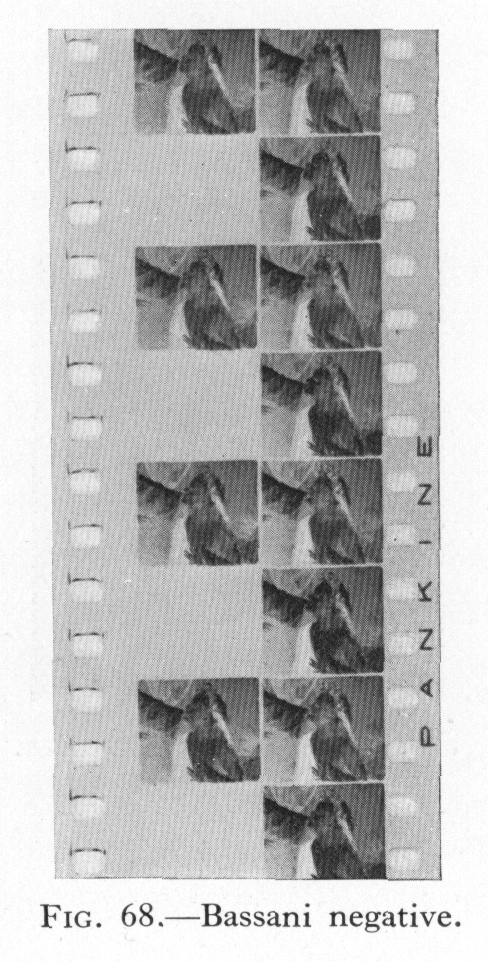
3 Images in 1 Gallery
“Inevitably, the success of Kinemacolor led to the appearance of imitations. One company, Friese Greene Patents Ltd had been formed in 1908 to exploit several patents, mostly impractical, filed by Friese Greene. From this came a new company, ...
-
![]() Source: Coe, Brian (1981): The History of Movie Photography. Westfield, N.J.: Eastview Editions.
Source: Coe, Brian (1981): The History of Movie Photography. Westfield, N.J.: Eastview Editions.

39 Images in 3 Galleries
Based on four primary colors, the process successively recorded two simultaneous images for two primary colors each. In projection, the four images were combined on screen, supposedly via a regular projector.
The film is recorded through alternating red and green filters, creating two color separations. After development, the print is placed in two alternating dye-baths, toning the blacks green and the whites red. Additionally, a black-and-white copy is ...
“[…] pictures were taken side by side, full-size, on double-width film, the film not only being perforated on the edges but also down the centre between the pairs of images.”
(Klein, Adrian Bernhard = Cornwell-Clyne (1940): Colour ...
-
![]() Credit: Courtesy of BFI National Archive. Photograph by Barbara Flueckiger. Film: Cinechrome Colour Test with Soap Boxes and Packets (1920)
Credit: Courtesy of BFI National Archive. Photograph by Barbara Flueckiger. Film: Cinechrome Colour Test with Soap Boxes and Packets (1920)
- Credit: Courtesy of BFI National Archive. Photograph by Barbara Flueckiger. Film: Cinechrome Colour Test with Soap Boxes and Packets (1920)
- Credit: Courtesy of BFI National Archive. Photograph by Barbara Flueckiger. Film: Cinechrome Colour Test with Soap Boxes and Packets (1920)

3 Images
“In the design of apparatus Urban was assisted after 1905 by Henry W. Joy. The Urban-Joy perforator appeared in 1906. The Urban-Joy anti-firing device, a shutter to prevent the firing of inflammable film when projectors broke down, was another ...
“This two-color additive system for color cinematography was invented in 1916 by Leon Forrest Douglass of San Rafael, California. A special beam splitter camera would advance each roll of film two frames per exposure with its double frame pull down ...
-
![]() Source: Ryan, Roderick T. (1977): A History of Motion Picture Color Technology. London: Focal Press. Credit: Illustration by Sarah Steinbacher, Multimedia & E-Learning-Services, University of Zurich.
Source: Ryan, Roderick T. (1977): A History of Motion Picture Color Technology. London: Focal Press. Credit: Illustration by Sarah Steinbacher, Multimedia & E-Learning-Services, University of Zurich.
- Source: Ryan, Roderick T. (1977): A History of Motion Picture Color Technology. London: Focal Press.
- Source: Ryan, Roderick T. (1977): A History of Motion Picture Color Technology. London: Focal Press. Credit: Illustration by Sarah Steinbacher, Multimedia & E-Learning-Services, University of Zurich.
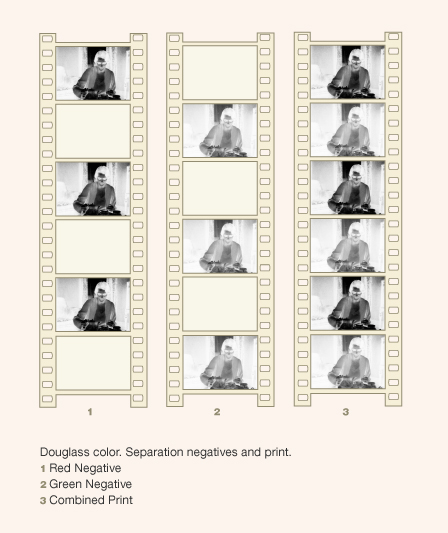
3 Images
“The color experiments were conducted in the basement of a house at 1586 E. Seventeenth St., Brooklyn, N. Y. During this time a double-coated stock and a bleach formula which had much to do with the success of the later Prizma process were ...
”Kelley’s first color process was a four-color additive system introduced in 1913. Called Panchromotion, Kelley formed a company which would exploit the process commercially and, he hoped, provide strong competition for Kinemacolor. He apparently ...
-
![]() Credit: Illustration by Sarah Steinbacher, Multimedia & E-Learning-Services, University of Zurich. Source: Ryan, Roderick T. (1977): A History of Motion Picture Color Technology. London: Focal Press.
Credit: Illustration by Sarah Steinbacher, Multimedia & E-Learning-Services, University of Zurich. Source: Ryan, Roderick T. (1977): A History of Motion Picture Color Technology. London: Focal Press.
- Source: Ryan, Roderick T. (1977): A History of Motion Picture Color Technology. London: Focal Press.
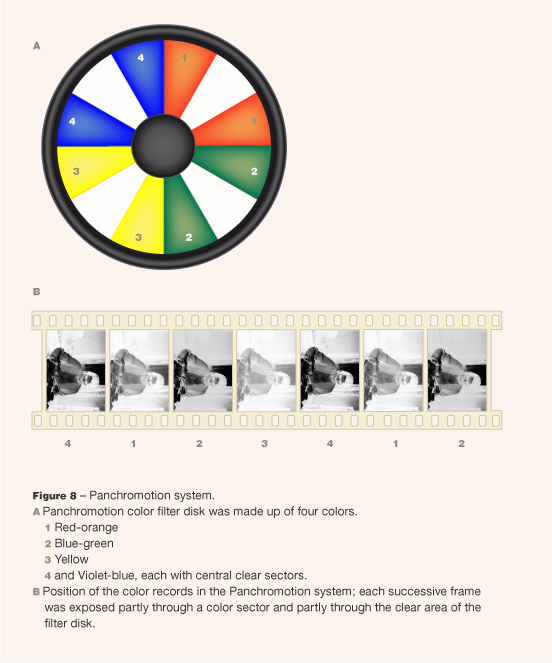
2 Images
“Gilmore’s two-color additive process was based on a patent granted to F. E. Ives in 1918. A unique optical system exposed two images in pairs, and quarter-turned them lengthwise side by side on standard 35 mm film stock. One of the images was ...
-
![]() Source: U.S.P. 1,262,954 (Ives, Frederic Eugene; filed Feb. 18, 1914; granted Apr. 16, 1918)
Source: U.S.P. 1,262,954 (Ives, Frederic Eugene; filed Feb. 18, 1914; granted Apr. 16, 1918)

1 Image
Much like many other additive processes, the Wolff-Heide system was based on three black and white color separations printed consecutively on one film strip and projected through a rotary filter attached to the projector. However, the biggest ...
“The Hérault Trichrome process was demonstrated in Paris on 1 October 1926, with three films made by A. Rodde — a fashion show, a documentary on Brittany and a tableau of the Legend of the King of Ys. Hérault Trichrome was an extension of ...
-
![]() Credit: EYE Film Institute Amsterdam. Photograph by Barbara Flueckiger.
Credit: EYE Film Institute Amsterdam. Photograph by Barbara Flueckiger.

12 Images in 1 Gallery
-
![]() Photograph by Martin Weiss, ERC Adanced Grant FilmColors.
Photograph by Martin Weiss, ERC Adanced Grant FilmColors.

1 Image
“The Rotocolor process was an additive system for color cinematography. The process was announced in 1931 by H. Muller. According to an article in Film Daily, April 12, 1931, and The Motion Picture Herald, April 11, 1931, the process consisted of ...
-
![]() Credit: Illustration by Sarah Steinbacher, Multimedia & E-Learning-Services, University of Zurich. Source: Klein, Adrian Bernhard (Cornwell-Clyne) (1940): Colour Cinematography. Boston: American Photographic Pub. Co.
Credit: Illustration by Sarah Steinbacher, Multimedia & E-Learning-Services, University of Zurich. Source: Klein, Adrian Bernhard (Cornwell-Clyne) (1940): Colour Cinematography. Boston: American Photographic Pub. Co.
- Source: Klein, Adrian Bernhard (Cornwell-Clyne) (1940): Colour Cinematography. Boston: American Photographic Pub. Co.
- Source: Klein, Adrian Bernhard (Cornwell-Clyne) (1940): Colour Cinematography. Boston: American Photographic Pub. Co.
3 Images
-
![]() Source: Dubray, J.A. (1933): The Morgana Process In: Journal of the Society of Motion Picture Engineers 21,5, 1933, pp. 403-412.
Source: Dubray, J.A. (1933): The Morgana Process In: Journal of the Society of Motion Picture Engineers 21,5, 1933, pp. 403-412.
1 Image
-
![]() Source: Klein, Adrian Bernhard (Cornwell-Clyne) (1940): Colour Cinematography. Boston: American Photographic Pub. Co.
Source: Klein, Adrian Bernhard (Cornwell-Clyne) (1940): Colour Cinematography. Boston: American Photographic Pub. Co.
- Source: Klein, Adrian Bernhard (Cornwell-Clyne) (1940): Colour Cinematography. Boston: American Photographic Pub. Co.
- Source: Coe, Brian (1981): The History of Movie Photography. Westfield, N.J.: Eastview Editions.
- Schmidt, Richard / Kochs, Adolf (1943): Farbfilmtechnik. Eine Einführung für Filmschaffende. Berlin: Hesse, pp. 54-72. (Schriftenreihe der Reichsfilmkammer, 10.) (in German) [quote id='5']
- Schmidt, Richard / Kochs, Adolf (1943): Farbfilmtechnik. Eine Einführung für Filmschaffende. Berlin: Hesse, pp. 54-72. (Schriftenreihe der Reichsfilmkammer, 10.) (in German) [quote id='5']

9 Images in 1 Gallery
 Timeline of Historical Film Colors by Barbara Flueckiger is licensed under a Creative Commons Attribution-NonCommercial-NoDerivatives 4.0 International License.
Quote as Flueckiger, Barbara (2012 ff.): Timeline of Historical Film Colors. (= https://filmcolors.org/).
Download BibTex