
-
![]() Credit: Cinémathèque française, conservatoire des techniques, Paris.
- Credit: Cinémathèque française, conservatoire des techniques, Paris.
- Credit: Cinémathèque française, conservatoire des techniques, Paris.
- Credit: Illustration by Sarah Steinbacher, Multimedia & E-Learning-Services, University of Zurich. Source: Ede, François (1994): Jour de fête ou la couleur retrouvée. Cahiers du Cinéma: Paris.
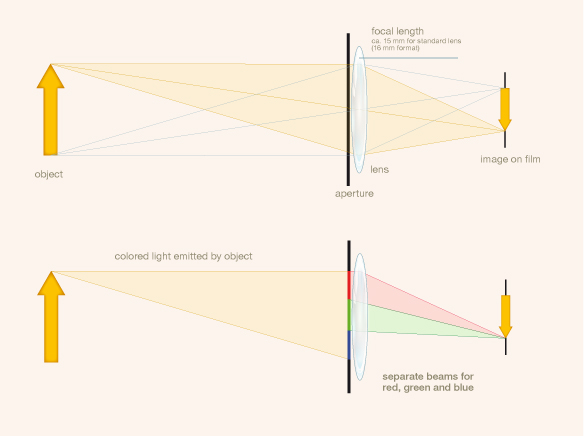
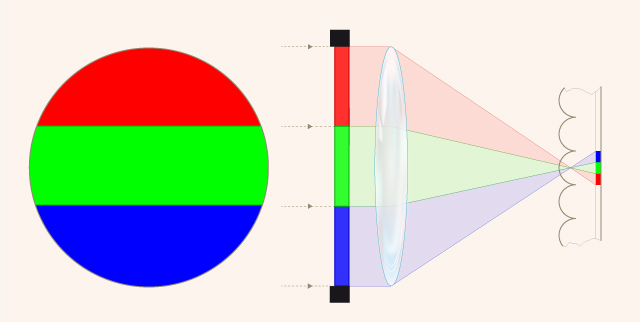
- Principle of capturing and projecting lenticular film. Credit: Joakim Reuteler and Rudolf Gschwind, Digital Humanities Lab, University of Basel, Switzerland. Illustration by Sarah Steinbacher, Multimedia & E-Learning-Services, University of Zurich.
- Principle of capturing and projecting lenticular film. Credit: Joakim Reuteler and Rudolf Gschwind, Digital Humanities Lab, University of Basel, Switzerland. Illustration by Sarah Steinbacher, Multimedia & E-Learning-Services, University of Zurich.
- Principle of capturing and projecting lenticular film. Credit: Joakim Reuteler and Rudolf Gschwind, Digital Humanities Lab, University of Basel, Switzerland. Illustration by Sarah Steinbacher, Multimedia & E-Learning-Services, University of Zurich.
- Microscopic image of a piece of Keller-Dorian lenticular film embedded in epoxide resin. The 3-dimensional structure of the lenticules is visible as well as the thin emulsion layer on the other side of the acetate base. Credit: Sample preparation and imaging by the Center for Microscopy and Image Analysis, University of Zurich.
- Lenticular surface of the acetate plastic base of Keller-Dorian lenticular film. On the back plane of the acetate layer and therefore out of focus in this image, structures defined by the silver image in the emulsion layer can be perceived. Credit: David Pfluger, ERC Advanced Grant FilmColors. Imaging was performed with support of the Center for Microscopy and Image Analysis, University of Zurich.
- Hexagonal structure of the lenticules of Keller-Dorian lenticular film. Credit: David Pfluger, ERC Advanced Grant FilmColors. Imaging was performed with support of the Center for Microscopy and Image Analysis, University of Zurich.
- Microscopic images of the Keller-Dorian lenticular structure with the focus set at different points. The images have been chained to show a travelling through the 3-dimensional structure of the bee-hive shaped lenticules. Credit: David Pfluger, conversion to video by Martin Weiss, ERC Advanced Grant FilmColors. Imaging was performed with support of the Center for Microscopy and Image Analysis, University of Zurich.
Category: Screen processes▼×
- All Categories
- Bibliography
- Chromogenic monopack
- Chromolytic multilayer
- Chromolytic single layer
- Color separation
- Data sheets
- Direct positive
- Double-coated / bi-pack
- Edge Codes and Identification
- Hand coloring
- Instant dye diffusion
- Other
- Printing / Dye-transfer / Pigment
- Spatial synthesis (multiple lenses, beam splitter)
- Stencil coloring (pochoir, Pathécolor)
- Temporal synthesis (rotary filters)
- Theory
- Tinting
- Toning

”The process as illustrated in USP 1431309 was a two-color additive process, but it is stated that it could be a three- or four-color process. For the original photography, the negative was exposed through a line screen composed of alternate bands ...
-
![]() Source: Ryan, Roderick T. (1977): A History of Motion Picture Color Technology. London: Focal Press.

1 Image
“The most successful of all the screen processes was the one initiated by Louis Dufay. Today the product is known as Dufaycolor, but it was first introduced about 1910 as the Dioptichrome plate. The first Dufay patents were assigned to an ...
“During the war, an important new screen plate appeared, based on patents taken out by J. H. Christensen in 1908. He proposed to make a concentrated solution of gum in alcohol. Divided into three parts, the gum solutions were dyed red, green ...
-
![]() Magnification. Source: Coe, Brian (1978): Colour Photography. The First Hundred Years 1840-1940. London: Ash & Grant.
- Source: Coote, Jack H. (1993): The Illustrated History of Colour Photography. Surbiton, Surrey: Fountain Press.
- Source: Heymer, Gerd (1943): Die neuere Entwicklung der Farbphotographie. In: Ergänzungswerk zum Handbuch der wissenschaftlichen und angewandten Photographie. Wien: Julius Springer 1943, pp. 337-463.
- Source: Finger, Ehrhard (1998): Die Pioniere des Wolfener Farbfilms. In: Industrie- und Filmmuseum Wolfen e. V. (ed.), Die Filmfabrik Wolfen. Aus der Geschichte, Heft 2, pp. 16-36. (in German) [quote id='4']
- Source: Finger, Ehrhard (1998): Die Pioniere des Wolfener Farbfilms. In: Industrie- und Filmmuseum Wolfen e. V. (ed.), Die Filmfabrik Wolfen. Aus der Geschichte, Heft 2, pp. 16-36. (in German) [quote id='4']
- Source: Finger, Ehrhard (1998): Die Pioniere des Wolfener Farbfilms. In: Industrie- und Filmmuseum Wolfen e. V. (ed.), Die Filmfabrik Wolfen. Aus der Geschichte, Heft 2, pp. 16-36. (in German) [quote id='4']
- Source: Pénichon, Sylvie (2013): Twentieth Century Colour Photographs. The Complete Guide to Processes, Identification & Preservation. London, Los Angeles: Thames & Hudson, p. 73.
- Source: Pénichon, Sylvie (2013): Twentieth Century Colour Photographs. The Complete Guide to Processes, Identification & Preservation. London, Los Angeles: Thames & Hudson, p. 73.
- Source: Pénichon, Sylvie (2013): Twentieth Century Colour Photographs. The Complete Guide to Processes, Identification & Preservation. London, Los Angeles: Thames & Hudson, p. 72.
- Source: Pénichon, Sylvie (2013): Twentieth Century Colour Photographs. The Complete Guide to Processes, Identification & Preservation. London, Los Angeles: Thames & Hudson, p. 76.
- Source: Pénichon, Sylvie (2013): Twentieth Century Colour Photographs. The Complete Guide to Processes, Identification & Preservation. London, Los Angeles: Thames & Hudson, p. 42.

11 Images
“Paget Color Screen (1913–ca. 1922): lines of red and blue squares alternated with lines of green and blue squares (Fig. 2.52). The lines are at a 45-degree angle from the edge of the plate. The side of the red and green squares measures ...
-
![]() Pénichon, Sylvie (2013): Twentieth Century Colour Photographs. The Complete Guide to Processes, Identification & Preservation. London, Los Angeles: Thames & Hudson, p. 69.

1 Image
“In 1907 the French lawyer Louis Dufay (1874-1936) patented a system whose screen pattern was obtained by the combined use of dichromated colloids, greasy printing inks, and imbibition. To take a photograph, the screen was mounted in a metallic ...
-
![]() Pénichon, Sylvie (2013): Twentieth Century Colour Photographs. The Complete Guide to Processes, Identification & Preservation. London, Los Angeles: Thames & Hudson, p. 33.

1 Image
“To produce the Omnicolore color screen, a sheet of glass was coated with a layer of gelatin on which lines of greasy blue-violet ink were ruled. The space between the lines was dyed yellow. Lines of greasy light blue ink were then ruled at ...
-
![]() Pénichon, Sylvie (2013): Twentieth Century Colour Photographs. The Complete Guide to Processes, Identification & Preservation. London, Los Angeles: Thames & Hudson, p. 29.
- Pénichon, Sylvie (2013): Twentieth Century Colour Photographs. The Complete Guide to Processes, Identification & Preservation. London, Los Angeles: Thames & Hudson, p. 70.

2 Images
“Thames Colour products originated from a 1906 patent by Clare Livingston Finlay (d. 1936) and were introduced commercially in England by the Thames Colour Plate Company of London in 1908 (Fig. 2.10). Color screens were obtained by repeatedly ...
-
![]() Pénichon, Sylvie (2013): Twentieth Century Colour Photographs. The Complete Guide to Processes, Identification & Preservation. London, Los Angeles: Thames & Hudson, p. 30.

1 Image
“In 1907 the French lawyer Louis Dufay (1874-1936) patented a system whose screen pattern was obtained by the combined use of dichromated colloids, greasy printing inks, and imbibition. To take a photograph, the screen was mounted in a metallic ...
-
![]() Pénichon, Sylvie (2013): Twentieth Century Colour Photographs. The Complete Guide to Processes, Identification & Preservation. London, Los Angeles: Thames & Hudson, p. 32.

1 Image
“R. Berthon patented the use of a lens diaphragm with three apertures, covered respectively with red, green and blue-violet filters, and a sensitive surface on a support, the other side of which was impressed with hemi-spherical, transparent, ...
-
![]() Principle of capturing and projecting lenticular film. Credit: Joakim Reuteler and Rudolf Gschwind, Digital Humanities Lab, University of Basel, Switzerland. Illustration by Sarah Steinbacher, Multimedia & E-Learning-Services, University of Zurich.
- Credit: Illustration by Sarah Steinbacher, Multimedia & E-Learning-Services, University of Zurich. Source: Ede, François (1994): Jour de fête ou la couleur retrouvée. Cahiers du Cinéma: Paris.
- Principle of capturing and projecting lenticular film. Credit: Joakim Reuteler and Rudolf Gschwind, Digital Humanities Lab, University of Basel, Switzerland. Illustration by Sarah Steinbacher, Multimedia & E-Learning-Services, University of Zurich.
- Source: Heymer, Gerd (1933): Auflösungsvermögen und Farbwiedergabe in der Farbrasterphotographie. In: Veröffentlichungen des wissenschaftlichen Zentral-Laboratoriums der photographischen Abteilung Agfa, 3, 1933, pp. 188-207.
4 Images
“Thames Colour products originated from a 1906 patent by Clare Livingston Finlay (d. 1936) and were introduced commercially in England by the Thames Colour Plate Company of London in 1908 (Fig. 2.10). Color screens were obtained by repeatedly ...
-
![]() Pénichon, Sylvie (2013): Twentieth Century Colour Photographs. The Complete Guide to Processes, Identification & Preservation. London, Los Angeles: Thames & Hudson, p. 30.
- Pénichon, Sylvie (2013): Twentieth Century Colour Photographs. The Complete Guide to Processes, Identification & Preservation. London, Los Angeles: Thames & Hudson, p. 63.
- Pénichon, Sylvie (2013): Twentieth Century Colour Photographs. The Complete Guide to Processes, Identification & Preservation. London, Los Angeles: Thames & Hudson, p. 69.
3 Images
(see detail page on Dufaycolor)
-
![]() Coote, Jack H. (1993): The Illustrated History of Colour Photography. Surbiton, Surrey: Fountain Press,
- Credit: Cinémathèque française, conservatoire des techniques, Paris.
- Source: Ede, François (1994): Jour de fête ou la couleur retrouvée. Cahiers du Cinéma: Paris.
- Pénichon, Sylvie (2013): Twentieth Century Colour Photographs. The Complete Guide to Processes, Identification & Preservation. London, Los Angeles: Thames & Hudson, p. 71.
- Source: Pénichon, Sylvie (2013): Twentieth Century Colour Photographs. The Complete Guide to Processes, Identification & Preservation. London, Los Angeles: Thames & Hudson, p. 73.
- Pénichon, Sylvie (2013): Twentieth Century Colour Photographs. The Complete Guide to Processes, Identification & Preservation. London, Los Angeles: Thames & Hudson, p. 31.
- Source: Pénichon, Sylvie (2013): Twentieth Century Colour Photographs. The Complete Guide to Processes, Identification & Preservation. London, Los Angeles: Thames & Hudson, p. 48.
- Source: Pénichon, Sylvie (2013): Twentieth Century Colour Photographs. The Complete Guide to Processes, Identification & Preservation. London, Los Angeles: Thames & Hudson, p. 69.
8 Images
Process for still photography in which light is filtered through a screen or transparent plate covered in lines or dots in the primary colors orange, green and violet. For the positive, the process relies on a support material which includes an ...
“The Autochrome process was the first fully practical single-plate colour process to reach the photographic public. It was easy to use. The plate was loaded into a conventional holder, glass to the front. The exposure was made through a yellow ...
-
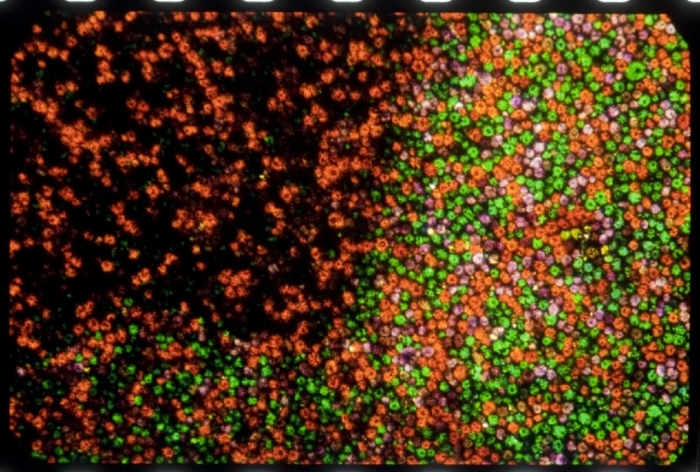
![]() Photomicrograph (50x) of an Autochrome mosaic screen. Credit: Courtesy of George Eastman House, International Museum of Photography and Film.
- Source: Lavédrine, Bertrand (2009): Photographs of the Past. Process and Preservation. Los Angeles: Getty Publications.
- Source: Coote, Jack H. (1993): The Illustrated History of Colour Photography. Surbiton, Surrey: Fountain Press.
- Source: Coote, Jack H. (1993): The Illustrated History of Colour Photography. Surbiton, Surrey: Fountain Press.
- Source: Holme, Charles (1908): Colour Photography, and Other Recent Developments of the Art of the Camera. London, Paris, New York.: Offices of The Studio.
- Source: Holme, Charles (1908): Colour Photography, and Other Recent Developments of the Art of the Camera. London, Paris, New York.: Offices of The Studio.
- Credit: Klosterarchiv Einsiedeln. http://www.klosterarchiv.ch/earchiv_liste.php?Objektyp_physisch=Glasautochrom&start=1
- Credit: Klosterarchiv Einsiedeln. http://www.klosterarchiv.ch/earchiv_liste.php?Objektyp_physisch=Glasautochrom&start=1
- Credit: Klosterarchiv Einsiedeln. http://www.klosterarchiv.ch/earchiv_liste.php?Objektyp_physisch=Glasautochrom&start=1
- Credit: Klosterarchiv Einsiedeln. http://www.klosterarchiv.ch/earchiv_liste.php?Objektyp_physisch=Glasautochrom&start=1
- Pénichon, Sylvie (2013): Twentieth Century Colour Photographs. The Complete Guide to Processes, Identification & Preservation. London, Los Angeles: Thames & Hudson, p. 70.
- Pénichon, Sylvie (2013): Twentieth Century Colour Photographs. The Complete Guide to Processes, Identification & Preservation. London, Los Angeles: Thames & Hudson, p. 26.
- Pénichon, Sylvie (2013): Twentieth Century Colour Photographs. The Complete Guide to Processes, Identification & Preservation. London, Los Angeles: Thames & Hudson, p. 65.
- Pénichon, Sylvie (2013): Twentieth Century Colour Photographs. The Complete Guide to Processes, Identification & Preservation. London, Los Angeles: Thames & Hudson, p. 27.
- Source: Pénichon, Sylvie (2013): Twentieth Century Colour Photographs. The Complete Guide to Processes, Identification & Preservation. London, Los Angeles: Thames & Hudson, p. 235.
- Source: Pénichon, Sylvie (2013): Twentieth Century Colour Photographs. The Complete Guide to Processes, Identification & Preservation. London, Los Angeles: Thames & Hudson, p. 64.
16 Images
“Another method of producing a line screen was patented in 1904 by the German Robert Krayn, and was demonstrated by him in November 1907. Krayn stained very thin celluloid sheets red, green and blue, and cemented them interleaved to form a ...
-
![]() Source: Coe, Brian (1978): Colour Photography. The First Hundred Years 1840-1940. London: Ash & Grant, p. 54.
- Source: Pénichon, Sylvie (2013): Twentieth Century Colour Photographs. The Complete Guide to Processes, Identification & Preservation. London, Los Angeles: Thames & Hudson, p. 34.
- Source: Pénichon, Sylvie (2013): Twentieth Century Colour Photographs. The Complete Guide to Processes, Identification & Preservation. London, Los Angeles: Thames & Hudson, p. 35.
- Source: Pénichon, Sylvie (2013): Twentieth Century Colour Photographs. The Complete Guide to Processes, Identification & Preservation. London, Los Angeles: Thames & Hudson, p. 35.
- Source: Pénichon, Sylvie (2013): Twentieth Century Colour Photographs. The Complete Guide to Processes, Identification & Preservation. London, Los Angeles: Thames & Hudson, p. 36.
- Source: Pénichon, Sylvie (2013): Twentieth Century Colour Photographs. The Complete Guide to Processes, Identification & Preservation. London, Los Angeles: Thames & Hudson, p. 74.
- Source: Pénichon, Sylvie (2013): Twentieth Century Colour Photographs. The Complete Guide to Processes, Identification & Preservation. London, Los Angeles: Thames & Hudson, p. 74.
7 Images
“McDonough Color Screen (1897–1900): sequence of red, yellow-green, and blue continuous lines (Fig. 2.49). Lines are thinner (approximate width 0.08 mm) and sharper than those of the Joly screen but are still visible with the naked eye or a ...
-
![]() Pénichon, Sylvie (2013): Twentieth Century Colour Photographs. The Complete Guide to Processes, Identification & Preservation. London, Los Angeles: Thames & Hudson, p. 25.
- Pénichon, Sylvie (2013): Twentieth Century Colour Photographs. The Complete Guide to Processes, Identification & Preservation. London, Los Angeles: Thames & Hudson, p. 69.

2 Images
“Every element of a cross-lined screen acts as a pinhole camera, and reproduces an image of the aperture of the objective in whose rear focal plane it is placed. Thus, when using a square stop, the dots in the halftone produced will be square ...
-
![]() Credit: Illustration by Sarah Steinbacher, Multimedia & E-Learning-Services, University of Zurich. Source: Ede, François (1994): Jour de fête ou la couleur retrouvée. Cahiers du Cinéma: Paris.
- Principle of capturing and projecting lenticular film. Credit: Joakim Reuteler and Rudolf Gschwind, Digital Humanities Lab, University of Basel, Switzerland. Illustration by Sarah Steinbacher, Multimedia & E-Learning-Services, University of Zurich.
- Principle of capturing and projecting lenticular film. Credit: Joakim Reuteler and Rudolf Gschwind, Digital Humanities Lab, University of Basel, Switzerland. Illustration by Sarah Steinbacher, Multimedia & E-Learning-Services, University of Zurich.
- Principle of capturing and projecting lenticular film. Credit: Joakim Reuteler and Rudolf Gschwind, Digital Humanities Lab, University of Basel, Switzerland. Illustration by Sarah Steinbacher, Multimedia & E-Learning-Services, University of Zurich.
4 Images
“In 1894 Professor John Joly of Dublin patented a process for producing a screen of red, green and blue-violet lines by ruling them on a gelatin-coated glass plate. Joly used ruling machines of great accuracy, with drawing pens trailed across ...
-
![]() Photomicrograph (20x) of a Joly screen. Credit: Courtesy of George Eastman House, International Museum of Photography and Film.
- Credit: Courtesy of George Eastman House, International Museum of Photography and Film.
- Source: Coe, Brian (1978): Colour Photography. The First Hundred Years 1840-1940. London: Ash & Grant.
- Credit: Gawain Weaver, Photograph Conservator, Gawain Weaver Art Conservation, San Anselmo, CA.
- Source: Pénichon, Sylvie (2013): Twentieth Century Colour Photographs. The Complete Guide to Processes, Identification & Preservation. London, Los Angeles: Thames & Hudson, p. 69.
- Source: Pénichon, Sylvie (2013): Twentieth Century Colour Photographs. The Complete Guide to Processes, Identification & Preservation. London, Los Angeles: Thames & Hudson, p. 22.
- Source: Pénichon, Sylvie (2013): Twentieth Century Colour Photographs. The Complete Guide to Processes, Identification & Preservation. London, Los Angeles: Thames & Hudson, p. 23.
7 Images
“The launching of a combined version of the product called Finlaychrome was announced in 1931 but was still unavailable three years later; it is unclear if it was ever marketed.28 Instead, it seems that the company produced a viewing screen ...
-
![]() Source: Pénichon, Sylvie (2013): Twentieth Century Colour Photographs. The Complete Guide to Processes, Identification & Preservation. London, Los Angeles: Thames & Hudson, p. 235.
- Pénichon, Sylvie (2013): Twentieth Century Colour Photographs. The Complete Guide to Processes, Identification & Preservation. London, Los Angeles: Thames & Hudson, p. 39.
- Pénichon, Sylvie (2013): Twentieth Century Colour Photographs. The Complete Guide to Processes, Identification & Preservation. London, Los Angeles: Thames & Hudson, p. 40.

3 Images
 Timeline of Historical Film Colors by Barbara Flueckiger is licensed under a Creative Commons Attribution-NonCommercial-NoDerivatives 4.0 International License.
Quote as Flueckiger, Barbara (2012 ff.): Timeline of Historical Film Colors. (= https://filmcolors.org/).
Download BibTex