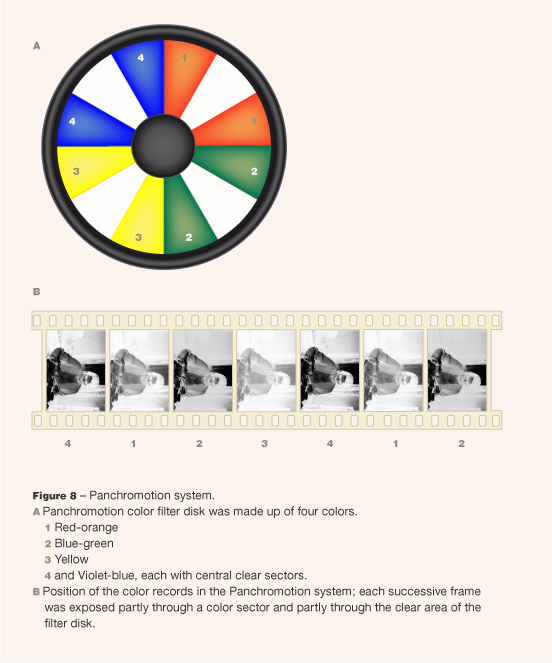
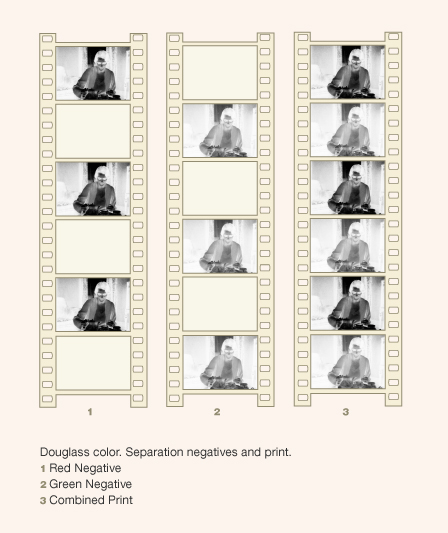
Rota Farbenfilm Samples (Kodak Film Samples Collection). Credit: National Science and Media Museum Bradford. Photographs of the Rotacolor Prints by Josephine Diecke, SNSF project Film Colors. Technologies, Cultures, Institutions and Joëlle Kost, ERC Advanced Grant FilmColors.
Magnification of an image area. Source: Eggert, John (1932): Kurzer Überblick über den Stand der Farbenkinematographie. Bericht über den VIII. Internationalen Kongress für wissenschaftliche und angewandte Photographie, Dresden 1931, pp. 214-222. Leipzig: J. A. Barth.
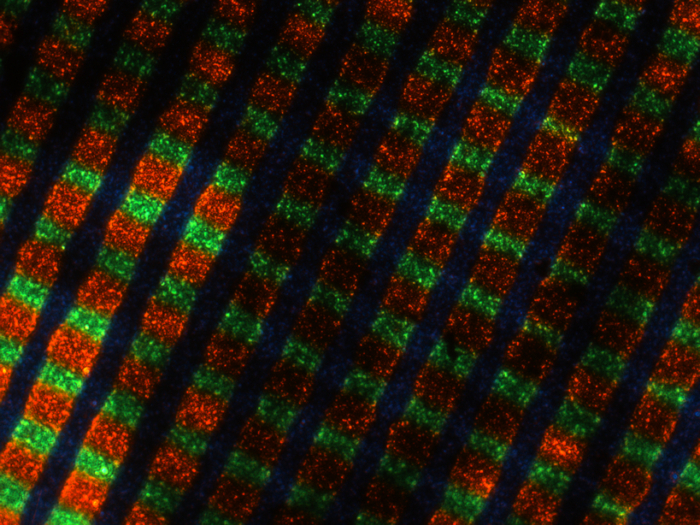
Color chart. Credit: Guido Seeber Nachlass, Deutsche Kinemathek, Berlin. Source: Goergen, Jeanpaul (2010): Rotorange und blaugrün. Das Zweifarbenverfahren Ufacolor 1931-1940. In: Filmblatt, no. 43, pp. 77-92.
Credit: Guido Seeber Nachlass, Deutsche Kinemathek, Berlin. Source: Goergen, Jeanpaul (2010): Rotorange und blaugrün. Das Zweifarbenverfahren Ufacolor 1931-1940. In: Filmblatt, no. 43, pp. 77-92.
Source: Eggert, John (1932): Kurzer Überblick über den Stand der Farbenkinematographie. Bericht über den VIII. Internationalen Kongress für wissenschaftliche und angewandte Photographie, Dresden 1931, pp. 214-222. Leipzig: J. A. Barth.
Credit: Bundesarchiv-Filmarchiv, photo: Marian Stefanowski. Source: Goergen, Jeanpaul (2010): Rotorange und blaugrün. Das Zweifarbenverfahren Ufacolor 1931-1940. In: Filmblatt, no. 43, pp. 77-92. Film: Bunte Tierwelt. Studien in Hagebecks Tierpark in Stellingen (1931).
Credit: Bundesarchiv-Filmarchiv, photo: Marian Stefanowski. Source: Goergen, Jeanpaul (2010): Rotorange und blaugrün. Das Zweifarbenverfahren Ufacolor 1931-1940. In: Filmblatt, no. 43, pp. 77-92. Film: Karneval (1936).
Credit: Bundesarchiv-Filmarchiv, photo: Jeanpaul Goergen. Source: Goergen, Jeanpaul (2010): Rotorange und blaugrün. Das Zweifarbenverfahren Ufacolor 1931-1940. In: Filmblatt, no. 43, pp. 77-92. Film: Bunte Fischwelt (1936).
Credit: Bundesarchiv-Filmarchiv, photo: Marian Stefanowski. Source: Goergen, Jeanpaul (2010): Rotorange und blaugrün. Das Zweifarbenverfahren Ufacolor 1931-1940. In: Filmblatt, no. 43, pp. 77-92. Film: Karneval (1936).
Credit: Deutsches Filminstitut DIF (Vicas Nachlass), photo: Jeanpaul Goergen. Source: Goergen, Jeanpaul (2010): Rotorange und blaugrün. Das Zweifarbenverfahren Ufacolor 1931-1940. In: Filmblatt, no. 43, pp. 77-92. Film: Potsdam (1934).
Credit: Bundesarchiv-Filmarchiv, photo: Marian Stefanowski. Source: Goergen, Jeanpaul (2010): Rotorange und blaugrün. Das Zweifarbenverfahren Ufacolor 1931-1940. In: Filmblatt, no. 43, pp. 77-92. Film: Farben machen froh (1938).
Magnification 5x. Credit: photomicrograph by Silvana Konermann.
Magnification 10x. Credit: photomicrograph by Silvana Konermann.
Magnification 20x. Credit: photomicrograph by Silvana Konermann.
Source: Eggert, John (1932): Kurzer Überblick über den Stand der Farbenkinematographie. In:Bericht über den VIII. Internationalen Kongress für wissenschaftliche und angewandte Photographie, Dresden 1931, pp. 214-222. Leipzig: J. A. Barth.
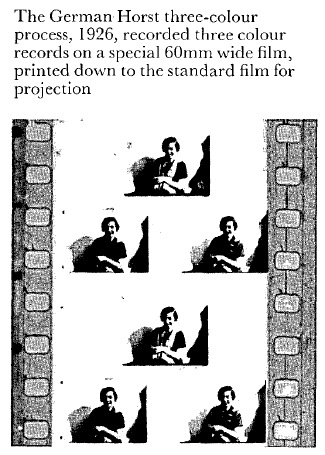
Magnification of an image area. Source: Eggert, John (1932): Kurzer Überblick über den Stand der Farbenkinematographie. In:Bericht über den VIII. Internationalen Kongress für wissenschaftliche und angewandte Photographie, Dresden 1931, pp. 214-222. Leipzig: J. A. Barth.
Reflection on Ufacolor film. Source: Eggert, John (1932): Kurzer Überblick über den Stand der Farbenkinematographie. In:Bericht über den VIII. Internationalen Kongress für wissenschaftliche und angewandte Photographie, Dresden 1931, pp. 214-222. Leipzig: J. A. Barth.
An opened splice of an Ufacolor positive shows the two colors used in the process. Credit: David Pfluger. Source: David Pfluger’s collection.
Additive 3 color: mosaic screen, combined system, still photography
“Lumière Filmcolor (1931–1953): sheet films (only) on celluloid base (Fig. 2.69). Individual colored grains cannot be seen with the naked eye, but clumps of grains of the same color give the image a pointillist effect. Filmcolor starch ...
Pénichon, Sylvie (2013): Twentieth Century Colour Photographs. The Complete Guide to Processes, Identification & Preservation. London, Los Angeles: Thames & Hudson, p. 74.
“An American two-colour subtractive process still worked by the Consolidated Film Industries division of Republic Pictures Corporation. This concern was licensed by the owners of the “Prizma” patents, which it will be remembered was ...
“The Rotocolor process was an additive system for color cinematography. The process was announced in 1931 by H. Muller. According to an article in Film Daily, April 12, 1931, and The Motion Picture Herald, April 11, 1931, the process consisted of ...
“Public showings of the work done at this plant in Hollywood have been given to Los Angeles audiences.
The release prints are made on double sided film. Both sides are developed at one time and then toned red on one side and bluegreen on the ...
Principle of capturing and projecting lenticular film. Credit: Joakim Reuteler and Rudolf Gschwind, Digital Humanities Lab, University of Basel, Switzerland. Illustration by Sarah Steinbacher, Multimedia & E-Learning-Services, University of Zurich.
Subtractive 2 or 3 color: Perforated mirror as beam-splitter, duplitized film
“The Brewster Process.
(U.S.P. 1,752,477. 1930-)
Camera. – P. D. Brewster, an American inventor, who was one of the first to apply the bipack system to colour cinematography, has a number of patents to his credit covering various cameras and ...
Unlike other additive systems invented in previous years, Gualtierotti tried to avoid the phenomenon of chromatic aberration inherent in the use of multiple lenses or the creation of successive separation records. The proposed solution was based on ...
Rotating filters permitting to adjust tonality and intensity of the colors. Source: Pierotti, Federico (2016): Un'archeologia del colore nel cinema italiano. Dal Technicolor ad Antonioni. Pisa: Edizioni ETS, p. 62
Subtractive 3 color: dye imbibition process, still photography
“Uvatype was yet another variation of the dye imbibition process, introduced by the Uvachrome Company of Germany in 1929 (Fig. 4.12). Its inventor, the German chemist Arthur Traube, worked diligently to improve the then-available imbibition ...
Pénichon, Sylvie (2013): Twentieth Century Colour Photographs. The Complete Guide to Processes, Identification & Preservation. London, Los Angeles: Thames & Hudson, p. 138.
Subtractive 3 color: pigment process, still photography and film
“Duxochrome, introduced around 1930 by the Johannes Herzog Company of Bremen, Germany, combined the colored gelatin layers of pigment processes with the tanning development procedure of dye imbibition. Exposures from three separation negatives ...
Pénichon, Sylvie (2013): Twentieth Century Colour Photographs. The Complete Guide to Processes, Identification & Preservation. London, Los Angeles: Thames & Hudson, p. 106.
Subtractive 3 color: dye imbibition process, still photography
“In 1929 the London firm Colour Snapshots Limited introduced Colorsnap, a printing service based on the dye imbibition process for a tripack roll film called Colorsnap and manufactured by Ilford Ltd. (Monopolies Commission 1966). The tripack ...
Pénichon, Sylvie (2013): Twentieth Century Colour Photographs. The Complete Guide to Processes, Identification & Preservation. London, Los Angeles: Thames & Hudson, p. 137.
“Harriscolor
In this method as in other methods of color photography, independent color value negatives are first obtained. The Harriscolor process can employ one of the following two methods: Either a camera wherein the dividing light prisms ...
AGFA BIPACK FILM
The front film is orthochromatic and sensitive, therefore, to green and blue. The rear film is panchromatic and records red-orange only, there being a red-orange filter on the orthochromatic emulsion. In fact, this is a bipack of the ...
Source: Pénichon, Sylvie (2013): Twentieth Century Colour Photographs. The Complete Guide to Processes, Identification & Preservation. London, Los Angeles: Thames & Hudson, p. 70.
Photomicrograph (20x) of a Finlay screen. Credit: Courtesy of George Eastman House, International Museum of Photography and Film.
Finlay box. Photograph by Barbara Flueckiger.
Source: Pénichon, Sylvie (2013): Twentieth Century Colour Photographs. The Complete Guide to Processes, Identification & Preservation. London, Los Angeles: Thames & Hudson, p. 39.
Pénichon, Sylvie (2013): Twentieth Century Colour Photographs. The Complete Guide to Processes, Identification & Preservation. London, Los Angeles: Thames & Hudson, p. 39.
Source: Pénichon, Sylvie (2013): Twentieth Century Colour Photographs. The Complete Guide to Processes, Identification & Preservation. London, Los Angeles: Thames & Hudson, p. 40.
“The Dutch Sirius Color process (1929) used a camera with a beamsplitting system behind the lens to expose a single film, the film passing through two gates at right angles to each other. The double-coated print film was dye-toned. The process ...
Magnification, 20x. Credit: photomicrograph by Silvana Konermann.
Magnification, 10x. Credit: Photomicrograph by Silvana Konermann.
Magnification, 5x. Credit: Photomicrograph by Silvana Konermann.
Source: Eggert, John (1932): Kurzer Überblick über den Stand der Farbenkinematographie. In: Bericht über den VIII. Internationalen Kongress für wissenschaftliche und angewandte Photographie, Dresden 1931, pp. 214-222. Leipzig: J. A. Barth.
Source: Eggert, John (1932): Kurzer Überblick über den Stand der Farbenkinematographie. Bericht über den VIII. Internationalen Kongress für wissenschaftliche und angewandte Photographie, pp. 214-222. Leipzig: J. A. Barth.
Magnification of an image area. Source: Eggert, John (1932): Kurzer Überblick über den Stand der Farbenkinematographie. Bericht über den VIII. Internationalen Kongress für wissenschaftliche und angewandte Photographie, pp. 214-222. Leipzig: J. A. Barth.
Reflection on the Sirius film, front. Source: Eggert, John (1932): Kurzer Überblick über den Stand der Farbenkinematographie. Bericht über den VIII. Internationalen Kongress für wissenschaftliche und angewandte Photographie, pp. 214-222. Leipzig: J. A. Barth.
Reflection on the Sirius film, back. Source: Eggert, John (1932): Kurzer Überblick über den Stand der Farbenkinematographie. Bericht über den VIII. Internationalen Kongress für wissenschaftliche und angewandte Photographie, pp. 214-222. Leipzig: J. A. Barth.
Dr. Douglas Arthur Spencer (Color Photographs Limited of London)
Subtractive 3 color: pigment process, still photography
“Vivex prints were introduced by Color Photographs Limited of London in 1928. One of the most important features of this printing method, invented by Douglas Arthur Spencer (1902–1980), was the introduction in 1929 of cellophane, instead of ...
Pénichon, Sylvie (2013): Twentieth Century Colour Photographs. The Complete Guide to Processes, Identification & Preservation. London, Los Angeles: Thames & Hudson, p. 105.
“LENTICULAR PROCESS
In 1896 R. E. Liesegang (Ahriman, 1896) suggested a photographic color process based upon the use of banded filters in the camera aperture.
[…]
In 1909 R. Berthon (British Patent 10,611; see also Berthon, 1910a, b) ...
Kodacolor lenticular filter for the projector. Lichtspiel / Kinemathek Bern.
Credit: Rudolf Gschwind, Imaging and Media Lab, University of Basel.
Magnification of an area. Credit: Rudolf Gschwind, Imaging and Media Lab, University of Basel.
Color reconstruction test. Credit: Rudolf Gschwind, Imaging and Media Lab, University of Basel.
Source: Klein, Adrian Bernhard (Cornwell-Clyne) (1940): Colour Cinematography. Boston: American Photographic Pub. Co.
Microscopic linear lens structure of Kodacolor lenticular film.
Credit: David Pfluger, ERC Advanced Grant FilmColors. Imaging was performed with support of the Center for Microscopy and Image Analysis, University of Zurich.
Acetate plastic base of Kodacolor lenticular film embedded in epoxide resin. The emulsion layer usually placed on the opposite side of the acetate base has been removed beforehand and is therefore not visible.
Credit: David Pfluger, ERC Advanced Grant FilmColors. Imaging was performed with support of the Center for Microscopy and Image Analysis, University of Zurich.Credit: David Pfluger, ERC Advanced Grant FilmColors. Imaging was performed with support of the Center for Microscopy and Image Analysis, University of Zurich.
Focal travelling through the 3-dimensional structure of Kodacolor lenticular film. In the beginning the linear lenticular structure is visible and towards the end the emulsion layer comes into focus and the granular structure defined by the density of the silver is visible. In this shot the lenticules were showing towards the light source and the emulsion towards the camera. This enables an undistorted recording of the emulsion layer.
Credit: David Pfluger, editing by Martin Weiss, ERC Advanced Grant FilmColors. Imaging was performed with support of the Center for Microscopy and Image Analysis, University of Zurich.
Focal travelling through the 3-dimensional structure of Kodacolor lenticular film. In the beginning the linear lenticular structure is visible and towards the end the emulsion layer comes into focus. In this shot the lenticules were allocated towards the lens of the microscope and the light source at the side of the emulsion similar to the configuration in projection. As a consequence the graininess of the emulsion is not visible as with the film flipped to the other side. The structure is optically distorted perpendicular to the linear structure of the lenticules.
Credit: David Pfluger, editing by Martin Weiss, ERC Advanced Grant FilmColors. Imaging was performed with support of the Center for Microscopy and Image Analysis, University of Zurich.
Several attempts were made to apply the Autochrome process invented by the Lumière brothers to motion pictures.
Transparent potato starch grains with a diameter of 15–20 micrometer were colored in the additive primaries red, green and blue. The ...
Source: Eggert, John (1932): Kurzer Überblick über den Stand der Farbenkinematographie. Bericht über den VIII. Internationalen Kongress für wissenschaftliche und angewandte Photographie, Dresden 1931, pp. 214-222. Leipzig: J. A. Barth.
Cinécolor, mosaic screen, ca. 1929. Credit: Gert Koshofer Collection. Sample No. 68. Photograph by Barbara Flueckiger.
Credit: Cinémathèque française, conservatoire des techniques, Paris.
Magnification of an image area. Source: Eggert, John (1932): Kurzer Überblick über den Stand der Farbenkinematographie. Bericht über den VIII. Internationalen Kongress für wissenschaftliche und angewandte Photographie, Dresden 1931, pp. 214-222. Leipzig: J. A. Barth.
Source: Eggert, John (1932): Kurzer Überblick über den Stand der Farbenkinematographie. Bericht über den VIII. Internationalen Kongress für wissenschaftliche und angewandte Photographie, Dresden 1931, pp. 214-222. Leipzig: J. A. Barth.
“In the Multicolor (two-color) subtractive process, two negative films are run simultaneously through any standard camera with their emulsion surfaces in contact. The front negative is orthochromatic, with the surface layer dyed orange-red to ...
Iridescence on Multicolor print, reflection properties. Credit: Library of Congress. Photograph by Barbara Flueckiger
Magnification 20x. Credit: photomicrograph by Silvana Konermann.
Magnification 10x. Credit: photomicrograph by Silvana Konermann.
Magnification 5x. Credit: photomicrograph by Silvana Konermann.
Source: Eggert, John (1932): Kurzer Überblick über den Stand der Farbenkinematographie. Bericht über den VIII. Internationalen Kongress für wissenschaftliche und angewandte Photographie, Dresden 1931, pp. 214-222. Leipzig: J. A. Barth.
Credit: Geo. Willeman, Nitrate Film Vault Manager, Library of Congress. Film: Fox Movietone Follies of 1929.
Source: Coe, Brian (1981): The History of Movie Photography. Westfield, N.J.: Eastview Editions.
Source: Cornwell-Clyne, Adrian (1951): Colour Cinematography. London: Chapman & Hall.
Credit: Illustration by Sarah Steinbacher, Multimedia & E-Learning-Services, University of Zurich. Source: Cornwell-Clyne, Adrian (1951): Colour Cinematography. London: Chapman & Hall.
Source: Eggert, John (1932): Kurzer Überblick über den Stand der Farbenkinematographie. Bericht über den VIII. Internationalen Kongress für wissenschaftliche und angewandte Photographie, Dresden 1931, pp. 214-222. Leipzig: J. A. Barth.
Magnification of an area. Source: Eggert, John (1932): Kurzer Überblick über den Stand der Farbenkinematographie. Bericht über den VIII. Internationalen Kongress für wissenschaftliche und angewandte Photographie, Dresden 1931, pp. 214-222. Leipzig: J. A. Barth.
Reflection properties. Source: Eggert, John (1932): Kurzer Überblick über den Stand der Farbenkinematographie. Bericht über den VIII. Internationalen Kongress für wissenschaftliche und angewandte Photographie, Dresden 1931, pp. 214-222. Leipzig: J. A. Barth.