
-
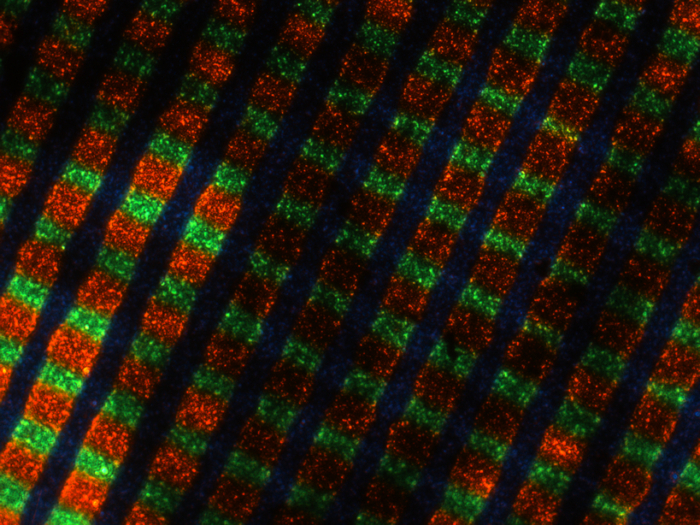
![]() Skleněné varhany (Stěklanna je garmonika, Andrej Chržanovskij, USSR 1968). Credit: Národní filmový archiv / National Film Archive, Prague. Photograph by Barbara Flueckiger
Skleněné varhany (Stěklanna je garmonika, Andrej Chržanovskij, USSR 1968). Credit: Národní filmový archiv / National Film Archive, Prague. Photograph by Barbara Flueckiger
Select Category▼×
- All Categories
- Bibliography
- Chromogenic monopack
- Chromolytic multilayer
- Color separation
- Double-coated / bi-pack
- Edge Codes and Identification
- Hand coloring
- Other
- Printing / dye-transfer
- Printing / pigment process
- Screen processes
- Spatial synthesis (multiple lenses, beam splitter)
- Stencil coloring (pochoir, Pathécolor)
- Temporal synthesis (rotary filters)
- Theory
- Tinting
- Toning

For a description of Spicer-Dufay see detail page on Dufaycolor)
-
![]() Magnification 20x. Credit: photomicrograph by Silvana Konermann. Source: Eggert, John (1932): Kurzer Überblick über den Stand der Farbenkinematographie. Bericht über den VIII. Internationalen Kongress für wissenschaftliche und angewandte Photographie, Dresden 1931, pp. 214-222. Leipzig: J. A. Barth.
Magnification 20x. Credit: photomicrograph by Silvana Konermann. Source: Eggert, John (1932): Kurzer Überblick über den Stand der Farbenkinematographie. Bericht über den VIII. Internationalen Kongress für wissenschaftliche und angewandte Photographie, Dresden 1931, pp. 214-222. Leipzig: J. A. Barth.
- Magnification 10x. Credit: photomicrograph by Silvana Konermann. Source: Eggert, John (1932): Kurzer Überblick über den Stand der Farbenkinematographie. Bericht über den VIII. Internationalen Kongress für wissenschaftliche und angewandte Photographie, Dresden 1931, pp. 214-222. Leipzig: J. A. Barth.
- Magnification 5x. Credit: photomicrograph by Silvana Konermann. Source: Eggert, John (1932): Kurzer Überblick über den Stand der Farbenkinematographie. Bericht über den VIII. Internationalen Kongress für wissenschaftliche und angewandte Photographie, Dresden 1931, pp. 214-222. Leipzig: J. A. Barth.
- Source: Eggert, John (1932): Kurzer Überblick über den Stand der Farbenkinematographie. In: Bericht über den VIII. Internationalen Kongress für wissenschaftliche und angewandte Photographie, Dresden 1931, pp. 214-222. Leipzig: J. A. Barth.
- Source: Coe, Brian (1981): The History of Movie Photography. Westfield, N.J.: Eastview Editions.
- Magnification of an image area. Source: Eggert, John (1932): Kurzer Überblick über den Stand der Farbenkinematographie. Bericht über den VIII. Internationalen Kongress für wissenschaftliche und angewandte Photographie, Dresden 1931, pp. 214-222. Leipzig: J. A. Barth.
- Source: Eggert, John (1932): Kurzer Überblick über den Stand der Farbenkinematographie. Bericht über den VIII. Internationalen Kongress für wissenschaftliche und angewandte Photographie, Dresden 1931, pp. 214-222. Leipzig: J. A. Barth.
78 Images in 2 Galleries
See Anscochrome and Super Anscochrome Tungsten, type 226.
See Anscochrome and Super Anscochrome Daylight, type 225.
“The process of J. Szczepanik in 1925 was impracticable. He used a non-intermittent camera having a chain of eighteen lenses moving together with the film behind a collimating lens, three pictures being simultaneously exposed.”
(Klein, ...
“Two-colour additive process
Talkicolor was developed by Percy James Pearce along with Dr Anthony Bernardi who was also involved in the development of Raycol. The process was funded mainly by the author Elinor Glyn through her company Elinor ...
-
![]() Knowing Men (GB 1930, Elinor Glyn), negative. Credit: Courtesy of BFI National Archive. Photograph by Barbara Flueckiger.
Knowing Men (GB 1930, Elinor Glyn), negative. Credit: Courtesy of BFI National Archive. Photograph by Barbara Flueckiger.

3 Images in 1 Gallery
-
![]() Technichrome, three-color print of bi-pack negatives, 1948. Credit: Gert Koshofer Collection. Sample No. 89. Photograph by Barbara Flueckiger
Technichrome, three-color print of bi-pack negatives, 1948. Credit: Gert Koshofer Collection. Sample No. 89. Photograph by Barbara Flueckiger

4 Images in 1 Gallery
During the 1940s Kodachrome was used as camera material for films that were blown up to 35mm Technicolor projection prints. Technicolor used this technology from 1942 until the mid-1950s when Eastman Kodak introduced the Eastmancolor ...
During the capturing of the film a beam-splitter in combination with filters in the camera divided the incoming light into a red and a green separation negative on black-and-white stock. When projected in the cinema the two images were combined simultaneously by additive mixture through corresponding red and green filters into one picture consisting of red and green colored light. The reduction of the whole color range to two colors (and their additive combinations) was necessary because of the complex optical arrangement.
-
![]() The beam-splitter prism. Source: Coote, Jack H. (1993): The Illustrated History of Colour Photography. Surbiton, Surrey: Fountain Press.
The beam-splitter prism. Source: Coote, Jack H. (1993): The Illustrated History of Colour Photography. Surbiton, Surrey: Fountain Press.

6 Images in 1 Gallery
The first subtractive 2 color process introduced by Technicolor captured the incoming light through a beam splitter with red and green filters also. However, in contrast to the first Technicolor process, the two b/w images were recorded on one negative strip. This was achieved by the pull-down of two frames simultaneously, a process that required the double speed in the camera. These two frames were arranged in pairs, whereby the green record was inverted up-side down (see image).
-
![]() The Phantom of the Opera (USA 1925, Rupert Julian). Credit: UCLA Film & Television Archive. Photographs of the nitrate print by Barbara Flueckiger.
The Phantom of the Opera (USA 1925, Rupert Julian). Credit: UCLA Film & Television Archive. Photographs of the nitrate print by Barbara Flueckiger.
- Credit: Images courtesy of the Margaret Herrick Library. Photograph by Barbara Flueckiger.
- Source: Coe, Brian (1981): The History of Movie Photography. Westfield, N.J.: Eastview Editions.
- Apparently test pieces, these clippings may well be the oldest surviving samples of the process in existence. Ruedel (2009: 55). Credit: George Eastman House Motion Picture Department Collection. Source: Ruedel, Ulrich (2009): The Technicolor Notebooks at the George Eastman House. In: Film History, Volume 21, Number 1, 2009, pp. 47-60.
- Apparently test pieces, these clippings may well be the oldest surviving samples of the process in existence. Ruedel (2009: 55); color reconstruction of the images shown above. Credit: George Eastman House Motion Picture Department Collection. Source: Ruedel, Ulrich (2009): The Technicolor Notebooks at the George Eastman House. In: Film History, Volume 21, Number 1, 2009, pp. 47-60.
- Apparently test pieces, these clippings may well be the oldest surviving samples of the process in existence. Ruedel (2009: 55). Credit: George Eastman House Motion Picture Department Collection. Source: Ruedel, Ulrich (2009): The Technicolor Notebooks at the George Eastman House. In: Film History, Volume 21, Number 1, 2009, pp. 47-60.
- Arrangement of the two records on the camera negative. Credit: Geo. Willeman, Nitrate Film Vault Manager, Library of Congress.
- Film: Stage Struck (USA 1925, Allan Dwan). Credit: Nitrate Frame Collection. George Eastman House Moving Image Collection. Photograph by Barbara Flueckiger.
- Film: Irene (USA 1926, Alfred E. Green). Credit: Nitrate Frame Collection. George Eastman House Moving Image Collection. Photograph by Barbara Flueckiger.
- Film: Irene (USA 1926, Alfred E. Green). Credit: Library of Congress. Photograph by Barbara Flueckiger.
- Film: Irene (USA 1926, Alfred E. Green). Credit: Library of Congress. Photograph by Barbara Flueckiger.
- Film: Irene (USA 1926, Alfred E. Green). Credit: Library of Congress. Photograph by Barbara Flueckiger.
- Film: Irene (USA 1926, Alfred E. Green). Credit: Library of Congress. Photograph by Barbara Flueckiger.
- Film: Irene (USA 1926, Alfred E. Green). Credit: Library of Congress. Photograph by Barbara Flueckiger.

133 Images in 8 Galleries
 Timeline of Historical Film Colors by Barbara Flueckiger is licensed under a Creative Commons Attribution-NonCommercial-NoDerivatives 4.0 International License.
Quote as Flueckiger, Barbara (2012 ff.): Timeline of Historical Film Colors. (= https://filmcolors.org/).
Download BibTex