Multicolor

Subtractive 2 color: Bi-pack, duplitized
“In the Multicolor (two-color) subtractive process, two negative films are run simultaneously through any standard camera with their emulsion surfaces in contact. The front negative is orthochromatic, with the surface layer dyed orange-red to ...

72 Images in 6 Galleries

Splendicolor

Subtractive 3 color: Beam-splitter, double-coated film, bichromated gelatin, Pinatype

Color Cinema Corporation

Subtractive 2 color: Bi-pack, double-coated

2 Images

Technicolor No. III

Subtractive 2 color: Beam-splitter, dye transfer

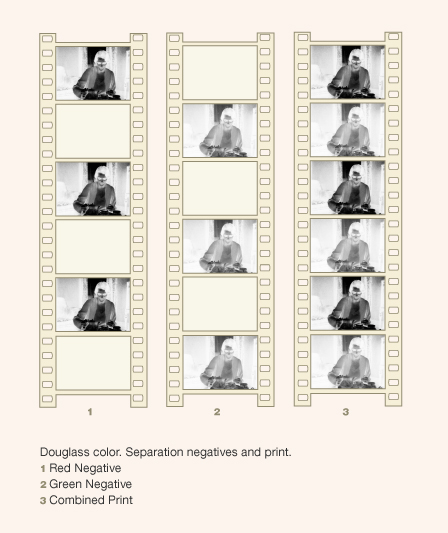
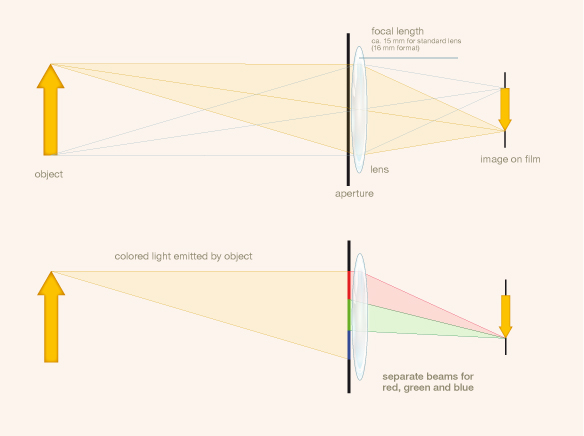
The third Technicolor process used the same camera as process no. II to combine a pair of frames of the red and green record respectively on the b/w negative (see image). In contrast to the former process, however, the two images were printed on one side of the positive by the dye transfer or imbibition process.

1298 Images in 38 Galleries

Lignose Naturfarbenfilm

Additive 3 color: mosaic screen, still photography and film

2 Images

Busch Farbenfilm

Additive 2 color: Beam-splitter, red-green

5 Images in 1 Gallery

Duplex Screen Plate

Additive 3 color: regular mosaic screen, still photography
“Paget plates were discontinued in the early 1920s. Apparently production costs had risen to an almost prohibitive amount after World War I due to the difficulties of producing screen plates without defect (Offer 1926). The product reemerged ...

Hérault Trichrome

Additive 3 color: Alternately stained in red, green and blue
“The Hérault Trichrome process was demonstrated in Paris on 1 October 1926, with three films made by A. Rodde — a fashion show, a documentary on Brittany and a tableau of the Legend of the King of Ys. Hérault Trichrome was an extension of ...

12 Images in 1 Gallery

Cox Multicolor

Additive 2 color: Rotary filter

Spicer-Dufay

Additive 3 color: Line screen (réseau), 35 mm reversal
For a description of Spicer-Dufay see detail page on Dufaycolor)

78 Images in 2 Galleries

Auto Natural Color / Bernardi

Additive 3 color: Beam-splitter, substandard

Technic-Colour

Subtractive 2 color: Beam-splitter, duplitized

Gevaert Positif Color

Applied colors: Pretinted film

Cinecolor additive 2 color / Cinecolour

Additive 2 color: Beam-splitter, substandard

2 Images

Szczepanik

Additive 3 color: Moving lenses
“The process of J. Szczepanik in 1925 was impracticable. He used a non-intermittent camera having a chain of eighteen lenses moving together with the film behind a collimating lens, three pictures being simultaneously exposed.” (Klein, ...

Thornton

Additive two-color or four-color process: beam splitter and mosaic screen, films
In this process, two positives, one orange-red one blue-green, were cemented together. Several specifications and modifications exist, for instance the strengthening of the perforated film margins via a second exposure, in an attempt to overcome wear ...

Jos-Pé

Subtractive 3 color: dye imbibition process, still photography
“Invented by G. Koppmann and introduced in Hamburg in 1924 by the German financier Josef-Peter Welker, from whom the product took its name (Wall and Jordan 1940: 330), Jos-Pé was a complete color system that included a one-exposure camera, ...

1 Image

Warner-Powrie

Additive 3 color: Line screen
“The Warner-Powrie process patented in 1905 was the earliest commercial process using a screen made with bichromated colloid. A glass plate was thinly coated with bichromated gelatin or fish glue and exposed to light through a screen having ...

Wolff-Heide

additive three-color: Integrated filters and rotary filter
Much like many other additive processes, the Wolff-Heide system was based on three black and white color separations printed consecutively on one film strip and projected through a rotary filter attached to the projector. However, the biggest ...

Horst

Additive 3 color: Beam-splitter, 65 mm negative

4 Images in 1 Gallery

New Agfa Color Plate

Additive 3 color: mosaic screen, combined system, still photography
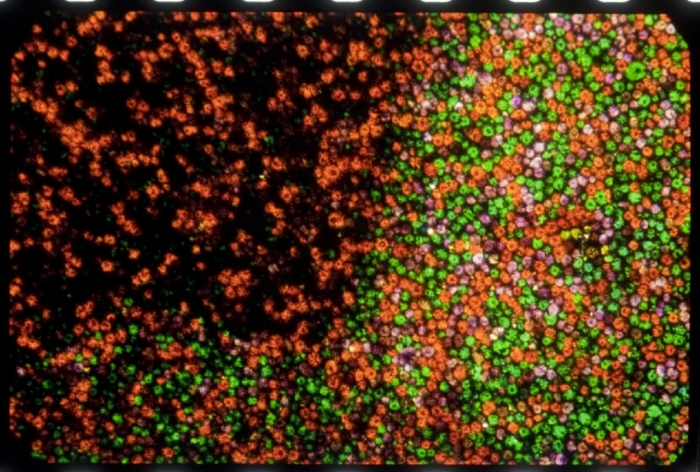
“New Agfa Color Plate (1923–1932): colored particles very small and not visible to the naked eye, but clumps of particles of the same color give the image a pointillist effect (Fig. 2.62). Unlike with the autochromes, in which the grains ...

1 Image

Kelleycolor

Subtractive 2 color: Dye transfer
“In 1919 Kelley produced a series of coloured cartoons which were drawn by Pinto Colvig. In 1924 he introduced “Kelleycolor,” which was an imbibition process. Two colours were imbibed on a black-and-white key image. In 1926 he ...

1 Image

Chromo-Film

Additive 3 color: Double-sized film, rotary filter

Colorcraft

Additive 2 color: Bi-pack, double-coated

21 Images in 1 Gallery

Keller-Dorian

Additive 3 color: Lenticular screen

14 Images in 2 Galleries

Technicolor No. II

Subtractive 2 color: 2 toned films cemented

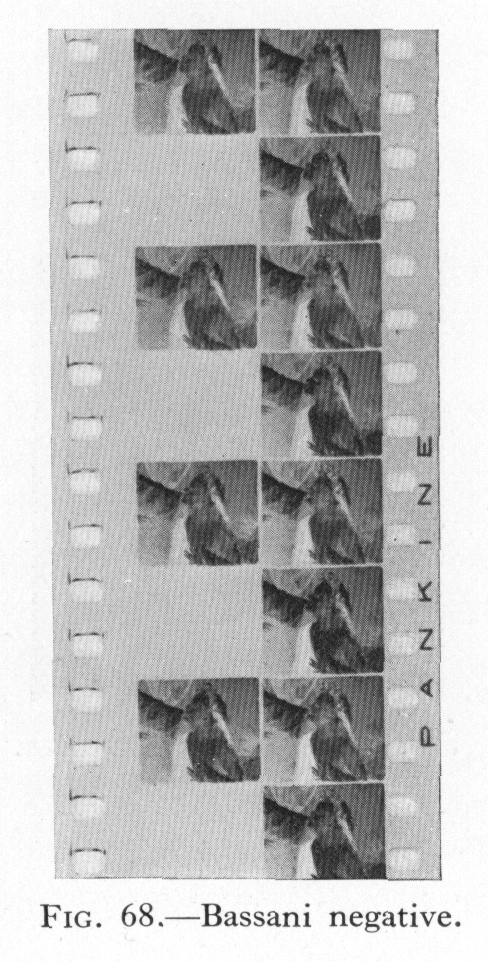
The first subtractive 2 color process introduced by Technicolor captured the incoming light through a beam splitter with red and green filters also. However, in contrast to the first Technicolor process, the two b/w images were recorded on one negative strip. This was achieved by the pull-down of two frames simultaneously, a process that required the double speed in the camera. These two frames were arranged in pairs, whereby the green record was inverted up-side down (see image).

133 Images in 8 Galleries

Traube / Uvachrome

Subtractive 3 color: mordanting, dye transfer, wash-off relief, still photography and film
“In 1916 Traube found that copper toning baths were especially suitable for dye mordanting and patented the Uvachrome process. At the time, Germany was at war with most of Europe, and little commercial progress was made until the end of ...

3 Images

Triadochrome

Subtractive 3 color: dye mordanting and silver toning process, still photography
“After the war, in 1921, J. F. Shepherd introduced in England a printing method called the Triadochrome Color Process, which was very similar to Hamburger’s Polychromide. To make a print, a cyan impression obtained from an iron-toned ...

Gorsky Process

Autotype Trichrome Carbro

Subtractive 3 color: pigment process, still photography
“As in previous versions of the process, pigment papers were soaked in a sensitizing bath and then squeegeed firmly onto the surface of wet bromide prints to harden the pigmented gelatin in proportion to the amount of silver contained in the ...

1 Image