
- All Categories
- Bibliography
- Chromogenic monopack
- Chromolytic multilayer
- Chromolytic single layer
- Color separation
- Data sheets
- Direct positive
- Double-coated / bi-pack
- Edge Codes and Identification
- Hand coloring
- Instant dye diffusion
- Other
- Printing / Dye-transfer / Pigment
- Screen processes
- Spatial synthesis (multiple lenses, beam splitter)
- Stencil coloring (pochoir, Pathécolor)
- Temporal synthesis (rotary filters)
- Theory
- Tinting
- Toning
-
![]() Knowing Men (GB 1930, Elinor Glyn), negative. Credit: Courtesy of BFI National Archive. Photograph by Barbara Flueckiger.

3 Images in 1 Gallery
-
![]() Technichrome, three-color print of bi-pack negatives, 1948. Credit: Gert Koshofer Collection. Sample No. 89. Photograph by Barbara Flueckiger

4 Images in 1 Gallery
During the capturing of the film a beam-splitter in combination with filters in the camera divided the incoming light into a red and a green separation negative on black-and-white stock. When projected in the cinema the two images were combined simultaneously by additive mixture through corresponding red and green filters into one picture consisting of red and green colored light. The reduction of the whole color range to two colors (and their additive combinations) was necessary because of the complex optical arrangement.
-
![]() The beam-splitter prism. Source: Coote, Jack H. (1993): The Illustrated History of Colour Photography. Surbiton, Surrey: Fountain Press.

6 Images in 1 Gallery
The first subtractive 2 color process introduced by Technicolor captured the incoming light through a beam splitter with red and green filters also. However, in contrast to the first Technicolor process, the two b/w images were recorded on one negative strip. This was achieved by the pull-down of two frames simultaneously, a process that required the double speed in the camera. These two frames were arranged in pairs, whereby the green record was inverted up-side down (see image).
-
![]() The Phantom of the Opera (USA 1925, Rupert Julian). Credit: UCLA Film & Television Archive. Photographs of the nitrate print by Barbara Flueckiger.
- Credit: Images courtesy of the Margaret Herrick Library. Photograph by Barbara Flueckiger.
- Source: Coe, Brian (1981): The History of Movie Photography. Westfield, N.J.: Eastview Editions.
- Apparently test pieces, these clippings may well be the oldest surviving samples of the process in existence. Ruedel (2009: 55). Credit: George Eastman House Motion Picture Department Collection. Source: Ruedel, Ulrich (2009): The Technicolor Notebooks at the George Eastman House. In: Film History, Volume 21, Number 1, 2009, pp. 47-60.
- Apparently test pieces, these clippings may well be the oldest surviving samples of the process in existence. Ruedel (2009: 55); color reconstruction of the images shown above. Credit: George Eastman House Motion Picture Department Collection. Source: Ruedel, Ulrich (2009): The Technicolor Notebooks at the George Eastman House. In: Film History, Volume 21, Number 1, 2009, pp. 47-60.
- Apparently test pieces, these clippings may well be the oldest surviving samples of the process in existence. Ruedel (2009: 55). Credit: George Eastman House Motion Picture Department Collection. Source: Ruedel, Ulrich (2009): The Technicolor Notebooks at the George Eastman House. In: Film History, Volume 21, Number 1, 2009, pp. 47-60.
- Arrangement of the two records on the camera negative. Credit: Geo. Willeman, Nitrate Film Vault Manager, Library of Congress.
- Film: Stage Struck (USA 1925, Allan Dwan). Credit: Nitrate Frame Collection. George Eastman House Moving Image Collection. Photograph by Barbara Flueckiger.
- Film: Irene (USA 1926, Alfred E. Green). Credit: Nitrate Frame Collection. George Eastman House Moving Image Collection. Photograph by Barbara Flueckiger.
- Film: Irene (USA 1926, Alfred E. Green). Credit: Library of Congress. Photograph by Barbara Flueckiger.
- Film: Irene (USA 1926, Alfred E. Green). Credit: Library of Congress. Photograph by Barbara Flueckiger.
- Film: Irene (USA 1926, Alfred E. Green). Credit: Library of Congress. Photograph by Barbara Flueckiger.
- Film: Irene (USA 1926, Alfred E. Green). Credit: Library of Congress. Photograph by Barbara Flueckiger.
- Film: Irene (USA 1926, Alfred E. Green). Credit: Library of Congress. Photograph by Barbara Flueckiger.

133 Images in 8 Galleries
The third Technicolor process used the same camera as process no. II to combine a pair of frames of the red and green record respectively on the b/w negative (see image). In contrast to the former process, however, the two images were printed on one side of the positive by the dye transfer or imbibition process.
-
![]() King of Jazz (USA 1930, John Murray Anderson). Credit: Library of Congress. Photographs of the Technicolor No. III dye-tranfer nitrate print from 1930 and 1931 by Olivia Kristina Stutz, ERC Advanced Grant FilmColors.
- Credit: Images courtesy of the Margaret Herrick Library. Film: Corrine Griffith in The Garden of Eden. Photograph: Barbara Flueckiger.
- Credit: George Eastman House Motion Picture Department Collection. Film: Buffalo Bill’s Last Fight (USA 1927, John W. Noble).
- Technicolor ad in Photoplay, 1930. Source: Photoplay, 1930, see Media History Digital Library
- Technicolor ad in Photoplay, 1930. Source: Photoplay, 1930, see Media History Digital Library
- Photomicrograph, 10x. Credit: Silvana Konermann.
- Photomicrograph, 20x. Credit: Silvana Konermann.
- Doctor X (USA 1932, Michael Curtiz). Credit: UCLA Film & Television Archive. Photographs of the Technicolor No. III dye-tranfer nitrate print by Barbara Flueckiger.
- Doctor X (USA 1932, Michael Curtiz). Credit: UCLA Film & Television Archive. Photographs of the Technicolor No. III dye-tranfer nitrate print by Barbara Flueckiger.

1298 Images in 38 Galleries
-
![]() Credit: Image courtesy of the Academy Film Archive. Film: Gone with the Wind (USA 1939, Victor Fleming). Photograph by Barbara Flueckiger.
- Film: Samson and Delilah (US 1949, Cecil B. DeMille), trailer.
- Photomicrograph, 50x. Credit: Norbert Wey, Institute of Pathology, University of Zurich.
- Photomicrograph, 100x. Credit: Norbert Wey, Institute of Pathology, University of Zurich.

1887 Images in 65 Galleries
-
![]() Written on the Wind (1956). Credit: Harvard Film Archive, item no. 3663. Photograph by Barbara Flueckiger.
- Credit: Harvard Film Archive, item no. 1781. Film: Le Ballon rouge (1956). Photograph by Barbara Flueckiger.
- Credit: Harvard Film Archive, item no. 1781. Film: Le Ballon rouge (1956). Photograph by Barbara Flueckiger.
- Surface emulsion side, raking light (tungsten). Credit: Carsta Knaack, HTW Berlin. Film: Robin Hood, 1973.
- Photomicrograph 16x, raking light. Credit: Carsta Knaack, HTW Berlin. Film: Robin Hood, 1973.
- Photomicrograph, toplight on white background. Credit: Carsta Knaack, HTW Berlin. Film: Robin Hood, 1973.
- Photomicrograph 6,4x, top light on white background: picture and perforation area with spots of dye, yellow edge. Credit: Carsta Knaack, HTW Berlin. Film: Ssssss (1973).
- Photomicrograph 10x, top light on white background: picture and perforation area with spots of dye, yellow edge, yellow dye in frame line. Credit: Carsta Knaack, HTW Berlin. Film: Ssssss (1973).
- Photomicrograph 16x, top light on white background: sound track and perforation area with spots of dye, yellow edge. Credit: Carsta Knaack, HTW Berlin. Film: Ssssss (1973).
- Raking light: surface of picture and perforation area with small spots of dye, yellow edge. Credit: Carsta Knaack, HTW Berlin. Film: Ssssss (1973).
- Surface emulsion side, raking light (tungsten). Credit: Carsta Knaack, HTW Berlin. Film: Robin Hood, 1973.
- Vertigo (USA 1958, Alfred Hitchcock). Credit: Harvard Film Archive, item no. 246. HDR photograph by Barbara Flueckiger.
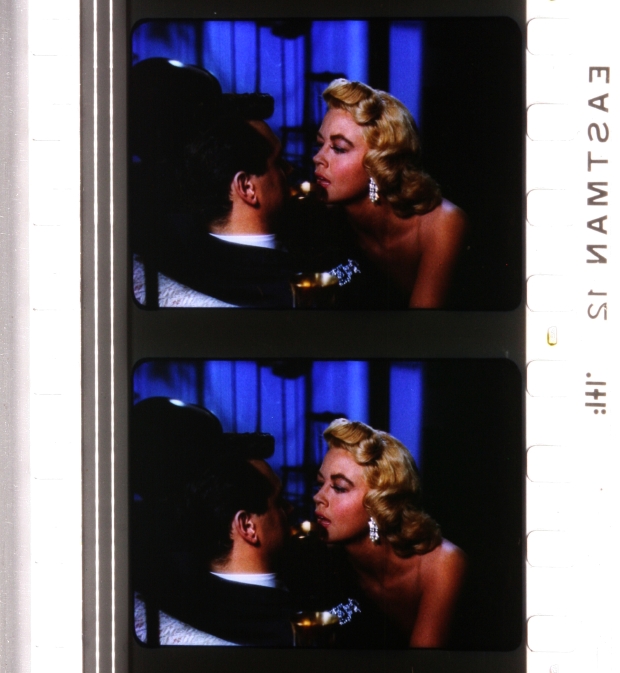
2180 Images in 41 Galleries
-
![]() Source: Ryan, Roderick T. (1977): A History of Motion Picture Color Technology. London: Focal Press.
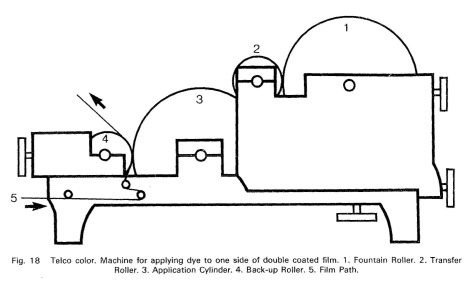
1 Image
-
![]() Pénichon, Sylvie (2013): Twentieth Century Colour Photographs. The Complete Guide to Processes, Identification & Preservation. London, Los Angeles: Thames & Hudson, p. 30.

1 Image
-
![]() Pénichon, Sylvie (2013): Twentieth Century Colour Photographs. The Complete Guide to Processes, Identification & Preservation. London, Los Angeles: Thames & Hudson, p. 30.
- Pénichon, Sylvie (2013): Twentieth Century Colour Photographs. The Complete Guide to Processes, Identification & Preservation. London, Los Angeles: Thames & Hudson, p. 63.
- Pénichon, Sylvie (2013): Twentieth Century Colour Photographs. The Complete Guide to Processes, Identification & Preservation. London, Los Angeles: Thames & Hudson, p. 69.
3 Images
-
![]() Source: Jacobson, Egbert (1942): The Color Harmony Manual and How to Use It. Chicago: Color Laboratories Division, Container Corp. of America. Credit: Faber Birren Collection, Yale University. Photograph by Barbara Flueckiger.
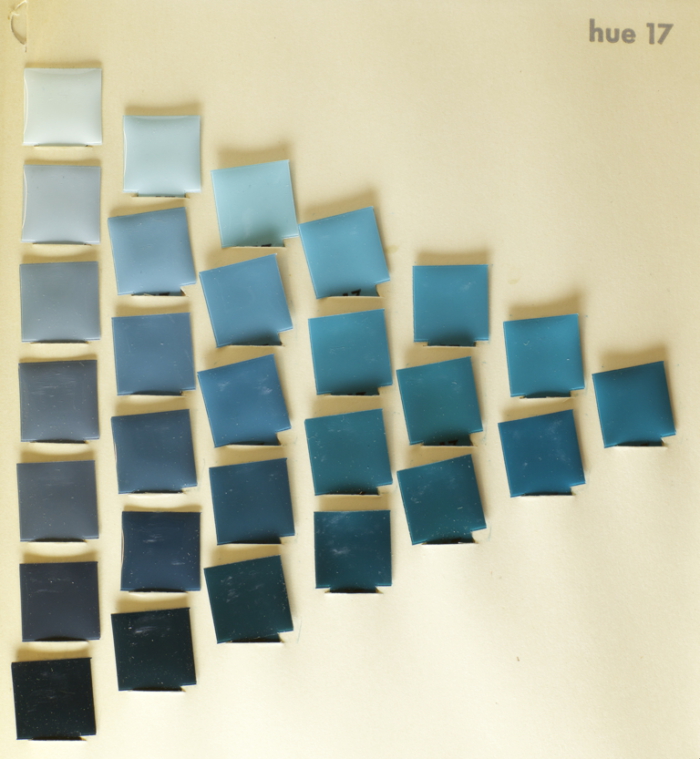
1 Image
-
![]() Source: Hübl, Arthur Freiherr von (1904): Die Dreifarbenphotographie mit besonderer Berücksichtigung des Dreifarbendruckes und der photographischen Pigmentbilder in natürlichen Farben. Halle a. S.: Druck und Verlang von Wilhelm Knapp. Photograph by Martin Weiss, ERC Advanced Grant FilmColors.
- Source: Hübl, Arthur Freiherr von (1904): Die Dreifarbenphotographie mit besonderer Berücksichtigung des Dreifarbendruckes und der photographischen Pigmentbilder in natürlichen Farben. Halle a. S.: Druck und Verlang von Wilhelm Knapp. Photograph by Martin Weiss, ERC Advanced Grant FilmColors.
- Source: Hübl, Arthur Freiherr von (1904): Die Dreifarbenphotographie mit besonderer Berücksichtigung des Dreifarbendruckes und der photographischen Pigmentbilder in natürlichen Farben. Halle a. S.: Druck und Verlang von Wilhelm Knapp. Photograph by Martin Weiss, ERC Advanced Grant FilmColors.
- Source: Hübl, Arthur Freiherr von (1904): Die Dreifarbenphotographie mit besonderer Berücksichtigung des Dreifarbendruckes und der photographischen Pigmentbilder in natürlichen Farben. Halle a. S.: Druck und Verlang von Wilhelm Knapp. Photograph by Martin Weiss, ERC Advanced Grant FilmColors.
- Source: Hübl, Arthur Freiherr von (1904): Die Dreifarbenphotographie mit besonderer Berücksichtigung des Dreifarbendruckes und der photographischen Pigmentbilder in natürlichen Farben. Halle a. S.: Druck und Verlang von Wilhelm Knapp. Photograph by Martin Weiss, ERC Advanced Grant FilmColors.
- Source: Hübl, Arthur Freiherr von (1904): Die Dreifarbenphotographie mit besonderer Berücksichtigung des Dreifarbendruckes und der photographischen Pigmentbilder in natürlichen Farben. Halle a. S.: Druck und Verlang von Wilhelm Knapp. Photograph by Martin Weiss, ERC Advanced Grant FilmColors.
- Source: Hübl, Arthur Freiherr von (1904): Die Dreifarbenphotographie mit besonderer Berücksichtigung des Dreifarbendruckes und der photographischen Pigmentbilder in natürlichen Farben. Halle a. S.: Druck und Verlang von Wilhelm Knapp. Photograph by Martin Weiss, ERC Advanced Grant FilmColors.
- Source: Hübl, Arthur Freiherr von (1904): Die Dreifarbenphotographie mit besonderer Berücksichtigung des Dreifarbendruckes und der photographischen Pigmentbilder in natürlichen Farben. Halle a. S.: Druck und Verlang von Wilhelm Knapp. Photograph by Martin Weiss, ERC Advanced Grant FilmColors.
- Source: Hübl, Arthur Freiherr von (1904): Three-Colour Photography. Three-Colour Printing and the Production of Photographic Pigment Pictures in Natural Colours. London: W.A. Penrose.
- Source: Hübl, Arthur Freiherr von (1904): Die Dreifarbenphotographie mit besonderer Berücksichtigung des Dreifarbendruckes und der photographischen Pigmentbilder in natürlichen Farben. Halle a. S.: Druck und Verlang von Wilhelm Knapp. Photograph by Martin Weiss, ERC Advanced Grant FilmColors.

11 Images
-
![]() Credit: Illustration by Sarah Steinbacher, Multimedia & E-Learning-Services, University of Zurich. Source: Ryan, Roderick T. (1977): A History of Motion Picture Color Technology. London: Focal Press.
- Source: Ryan, Roderick T. (1977): A History of Motion Picture Color Technology. London: Focal Press.
- Source: Kistler, L. R. (1945): The Projection of Thomascolor Motion Pictures. In: International Projectionist, 20,7, Jul., pp. 12–14.
- Source: Kistler, L. R. (1945): The Projection of Thomascolor Motion Pictures. In: International Projectionist, 20,7, Jul., pp. 12–14.
- Left: Thomascolor camera lens mount for converting standard motion picture camera into Thomascolor. Right: A closeup of the Thomascolor projector lens mount for standard film projectors. The inventor points out that this is all that is needed to convert a standard projector to Thomascolor. Source: Anonymous (1944): Thomascolor. Four-Color Process For Motion Pictures. In: International Projectionist, 19,10, Oct., pp. 7–9.

5 Images
-
![]() Credit: Cinémathèque française, conservatoire des techniques, Paris. Film: Test for Jour de Fête.
- Principle of capturing and projecting lenticular film. Credit: Joakim Reuteler and Rudolf Gschwind, Digital Humanities Lab, University of Basel, Switzerland. Illustration by Sarah Steinbacher, Multimedia & E-Learning-Services, University of Zurich.
- Principle of capturing and projecting lenticular film. Credit: Joakim Reuteler and Rudolf Gschwind, Digital Humanities Lab, University of Basel, Switzerland. Illustration by Sarah Steinbacher, Multimedia & E-Learning-Services, University of Zurich.

3 Images
 Timeline of Historical Film Colors by Barbara Flueckiger is licensed under a Creative Commons Attribution-NonCommercial-NoDerivatives 4.0 International License.
Quote as Flueckiger, Barbara (2012 ff.): Timeline of Historical Film Colors. (= https://filmcolors.org/).
Download BibTex