
-
![]() Faded Ferraniacolor positive from Eastmancolor negative, anamorphic (1:2,35). Credit: Národní filmový archiv / National Film Archive, Prague. Film: Smrt v sedle (Jindřich Polák, Czechoslovakia 1958).
Faded Ferraniacolor positive from Eastmancolor negative, anamorphic (1:2,35). Credit: Národní filmový archiv / National Film Archive, Prague. Film: Smrt v sedle (Jindřich Polák, Czechoslovakia 1958).
- Faded Ferraniacolor positive from Eastmancolor negative, anamorphic (1:2,35). Credit: Národní filmový archiv / National Film Archive, Prague. Film: Smrt v sedle (Jindřich Polák, Czechoslovakia 1958).
- Faded Ferraniacolor positive from Eastmancolor negative, anamorphic (1:2,35). Credit: Národní filmový archiv / National Film Archive, Prague. Film: Smrt v sedle (Jindřich Polák, Czechoslovakia 1958).
- Faded Ferraniacolor positive from Eastmancolor negative, anamorphic (1:2,35). Credit: Národní filmový archiv / National Film Archive, Prague. Film: Smrt v sedle (Jindřich Polák, Czechoslovakia 1958).
- Faded Ferraniacolor positive from Eastmancolor negative, anamorphic (1:2,35). Credit: Národní filmový archiv / National Film Archive, Prague. Film: Smrt v sedle (Jindřich Polák, Czechoslovakia 1958).
- Faded Ferraniacolor positive from Eastmancolor negative, anamorphic (1:2,35). Credit: Národní filmový archiv / National Film Archive, Prague. Film: Smrt v sedle (Jindřich Polák, Czechoslovakia 1958).
- Faded Ferraniacolor positive from Eastmancolor negative, anamorphic (1:2,35). Credit: Národní filmový archiv / National Film Archive, Prague. Film: Smrt v sedle (Jindřich Polák, Czechoslovakia 1958).
Select Category▼×
- All Categories
- Bibliography
- Chromogenic monopack
- Chromolytic multilayer
- Color separation
- Double-coated / bi-pack
- Edge Codes and Identification
- Hand coloring
- Other
- Printing / dye-transfer
- Printing / pigment process
- Screen processes
- Spatial synthesis (multiple lenses, beam splitter)
- Stencil coloring (pochoir, Pathécolor)
- Temporal synthesis (rotary filters)
- Theory
- Tinting
- Toning

-
![]() Ansco Color, positives of Ansco Color negative, ca. 1952. Credit: Gert Koshofer Collection. Sample No. 10. Photograph by Barbara Flueckiger.
Ansco Color, positives of Ansco Color negative, ca. 1952. Credit: Gert Koshofer Collection. Sample No. 10. Photograph by Barbara Flueckiger.
- Source: Schultze, Werner (1953): Farbenphotographie und Farbenfilm. Wissenschaftliche Grundlagen und technische Gestaltung. Berlin/Göttingen /Heidelberg: Springer.
- Source: Schultze, Werner (1953): Farbenphotographie und Farbenfilm. Wissenschaftliche Grundlagen und technische Gestaltung. Berlin/Göttingen /Heidelberg: Springer.
- Source: Society of Motion Picture and Television Engineers; ed. (1957): The Elements of Color in Professional Motion Pictures. Prepared by a special committee of the Society. Wilton R. Holm, chairman. New York: The Society.
- Credit: Cinémathèque française, conservatoire des techniques, Paris.
- Source: Schultze, Werner (1953): Farbenphotographie und Farbenfilm. Wissenschaftliche Grundlagen und technische Gestaltung. Berlin/Göttingen /Heidelberg: Springer-Verlag. Photograph by Martin Weiss, ERC Advanced Grant FilmColors.
- Source: Schultze, Werner (1953): Farbenphotographie und Farbenfilm. Wissenschaftliche Grundlagen und technische Gestaltung. Berlin/Göttingen /Heidelberg: Springer-Verlag. Photograph by Martin Weiss, ERC Advanced Grant FilmColors.

30 Images in 2 Galleries
Not to be confused with the Eastman Color Print Film 5381 / 7381 from 1970.
“The Eastman Colour Films are multilayer films of the type in which the layers are not separated after exposure. Films of this class are known as Multilayer, Monopack or Integral Tripack. “Multilayer” is descriptive not only of this ...
-
![]() Alien (USA 1979, Ridley Scott). Credit: Library of Congress. Photographs of the Eastman Color Print Film from 1979 by Joëlle Kost, ERC Advanced Grant FilmColors.
Alien (USA 1979, Ridley Scott). Credit: Library of Congress. Photographs of the Eastman Color Print Film from 1979 by Joëlle Kost, ERC Advanced Grant FilmColors.
- Photomicrograph of modern chromogenic stock, . Credit: Silvana Konermann.
- Eastman Color chromogenic monopack. Source: Craig, G.J. (1953): Eastman Colour Films for Professional Motion Picture Work. In: British Kinematography, 22,5, 1953, pp. 146-158.
- Color fading of Eastmancolor stock. Credit: Collection Gert Koshofer, Bergisch Gladbach (Germany). Source: Schultze, Werner (1953): Farbenphotographie und Farbenfilm. Wissenschaftliche Grundlagen und technische Gestaltung. Berlin: Springer.
- Color reconstruction by Rudolf Gschwind, University of Basel. Credit: Collection Gert Koshofer, Bergisch Gladbach (Germany).
- Color fading of Eastmancolor stock.
- Source: Schultze, Werner (1953): Farbenphotographie und Farbenfilm. Wissenschaftliche Grundlagen und technische Gestaltung. Berlin/Göttingen /Heidelberg: Springer-Verlag. Photograph by Martin Weiss, ERC Advanced Grant FilmColors.
- Source: Schultze, Werner (1953): Farbenphotographie und Farbenfilm. Wissenschaftliche Grundlagen und technische Gestaltung. Berlin/Göttingen /Heidelberg: Springer-Verlag. Photograph by Martin Weiss, ERC Advanced Grant FilmColors.

707 Images in 23 Galleries
L stands for the Leverkusen brand of Agfacolor. N for negative, K for tungsten (Kunstlicht) and T for daylight (Tageslicht).
-
![]() Credit: By courtesy of Deutsche Kinemathek, Berlin. Photograph by Barbara Flueckiger. Film: Commercial Denkt rechtzeitig daran (GER 1952).
Credit: By courtesy of Deutsche Kinemathek, Berlin. Photograph by Barbara Flueckiger. Film: Commercial Denkt rechtzeitig daran (GER 1952).
- Credit: By courtesy of Deutsche Kinemathek, Berlin. Photograph by Barbara Flueckiger. Film: 1/50 Sekunde, commercial for Niggemeyer Foto/Kino (1952).

13 Images in 2 Galleries
-
![]() Source: Cornwell-Clyne, Adrian (1951): Colour Cinematography. London: Chapman & Hall.
Source: Cornwell-Clyne, Adrian (1951): Colour Cinematography. London: Chapman & Hall.

1 Image
-
![]() Cross section scheme of Eastman Color Type 5248. Scource: Hanson, W. T., Jr.; Kisner, W. I. (1953): Improved Color Films for Color Motion-Picture Production. In: Journal SMPTE, Vol. 61, Dec. 1953, p. 699.
Cross section scheme of Eastman Color Type 5248. Scource: Hanson, W. T., Jr.; Kisner, W. I. (1953): Improved Color Films for Color Motion-Picture Production. In: Journal SMPTE, Vol. 61, Dec. 1953, p. 699.
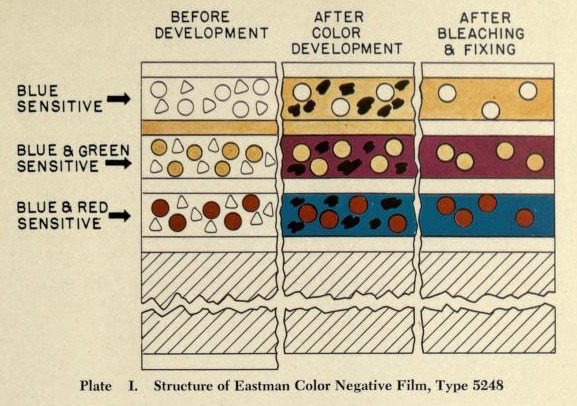
1 Image
-
![]() Cross section scheme, Agfacolor Positive Type 5. Scource: Brune, Wolfgang (1955): Ein neues Agfacolor-Positivmaterial (Agfacolor-Positivfilm Typ 5).
Cross section scheme, Agfacolor Positive Type 5. Scource: Brune, Wolfgang (1955): Ein neues Agfacolor-Positivmaterial (Agfacolor-Positivfilm Typ 5).

1 Image
With the introduction of the chromogenic Eastmancolor negative/positive process it became possible to shoot with a normal one-strip camera. Three b/w color separations were produced from the Eastmancolor negative and printed by dye transfer on blank ...
-
![]() Written on the Wind (1956). Credit: Harvard Film Archive, item no. 3663. Photograph by Barbara Flueckiger.
Written on the Wind (1956). Credit: Harvard Film Archive, item no. 3663. Photograph by Barbara Flueckiger.
- Credit: Harvard Film Archive, item no. 1781. Film: Le Ballon rouge (1956). Photograph by Barbara Flueckiger.
- Credit: Harvard Film Archive, item no. 1781. Film: Le Ballon rouge (1956). Photograph by Barbara Flueckiger.
- Surface emulsion side, raking light (tungsten). Credit: Carsta Knaack, HTW Berlin. Film: Robin Hood, 1973.
- Photomicrograph 16x, raking light. Credit: Carsta Knaack, HTW Berlin. Film: Robin Hood, 1973.
- Photomicrograph, toplight on white background. Credit: Carsta Knaack, HTW Berlin. Film: Robin Hood, 1973.
- Photomicrograph 6,4x, top light on white background: picture and perforation area with spots of dye, yellow edge. Credit: Carsta Knaack, HTW Berlin. Film: Ssssss (1973).
- Photomicrograph 10x, top light on white background: picture and perforation area with spots of dye, yellow edge, yellow dye in frame line. Credit: Carsta Knaack, HTW Berlin. Film: Ssssss (1973).
- Photomicrograph 16x, top light on white background: sound track and perforation area with spots of dye, yellow edge. Credit: Carsta Knaack, HTW Berlin. Film: Ssssss (1973).
- Raking light: surface of picture and perforation area with small spots of dye, yellow edge. Credit: Carsta Knaack, HTW Berlin. Film: Ssssss (1973).
- Surface emulsion side, raking light (tungsten). Credit: Carsta Knaack, HTW Berlin. Film: Robin Hood, 1973.
- Vertigo (USA 1958, Alfred Hitchcock). Credit: Harvard Film Archive, item no. 246. HDR photograph by Barbara Flueckiger.
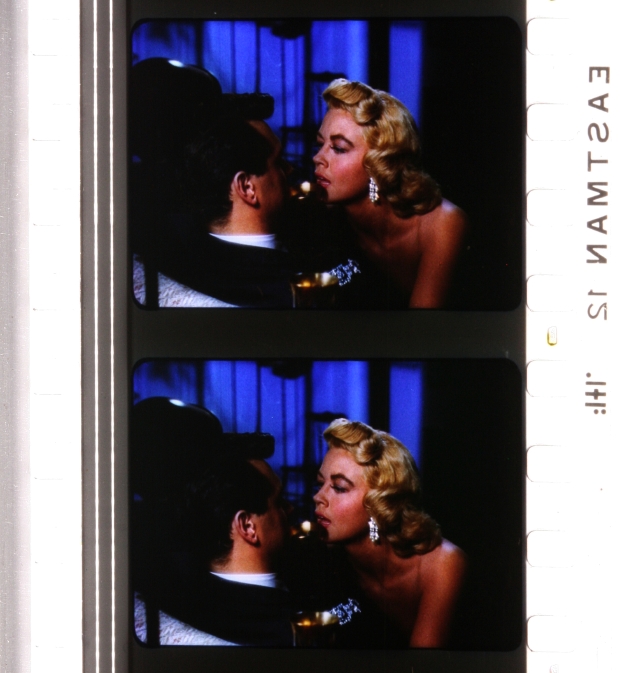
2261 Images in 41 Galleries
For more information on the Agfacolor chromogenic process see Agfacolor Neu / Agfacolor.
-
![]() Negative. Credit: Národní filmový archiv / National Film Archive, Prague. Film: Princezna se zlatou hvězdou (Martin Frič, Czechoslovakia 1959).
Negative. Credit: Národní filmový archiv / National Film Archive, Prague. Film: Princezna se zlatou hvězdou (Martin Frič, Czechoslovakia 1959).
- Negative. Credit: Národní filmový archiv / National Film Archive, Prague. Film: Princezna se zlatou hvězdou (Martin Frič, Czechoslovakia 1959).
- Negative. Credit: Národní filmový archiv / National Film Archive, Prague. Film: Princezna se zlatou hvězdou (Martin Frič, Czechoslovakia 1959).
- Negative. Credit: Národní filmový archiv / National Film Archive, Prague. Film: Princezna se zlatou hvězdou (Martin Frič, Czechoslovakia 1959).
- Princezna se zlatou hvězdou (CZE 1959, Martin Frič). Credit: Národní filmový archiv / National Film Archive, Prague. Photographs of the Agfacolor B negative on Orwocolor positive by Barbara Flueckiger.
- Princezna se zlatou hvězdou (CZE 1959, Martin Frič). Credit: Národní filmový archiv / National Film Archive, Prague. Photographs of the Agfacolor B negative on Orwocolor positive by Barbara Flueckiger.
- Princezna se zlatou hvězdou (CZE 1959, Martin Frič). Credit: Národní filmový archiv / National Film Archive, Prague. Photographs of the Agfacolor B negative on Orwocolor positive by Barbara Flueckiger.
- Princezna se zlatou hvězdou (CZE 1959, Martin Frič). Credit: Národní filmový archiv / National Film Archive, Prague. Photographs of the Agfacolor B negative on Orwocolor positive by Barbara Flueckiger.
- Princezna se zlatou hvězdou (CZE 1959, Martin Frič). Credit: Národní filmový archiv / National Film Archive, Prague. Photographs of the Agfacolor B negative on Orwocolor positive by Barbara Flueckiger.
- Princezna se zlatou hvězdou (CZE 1959, Martin Frič). Credit: Národní filmový archiv / National Film Archive, Prague. Photographs of the Agfacolor B negative on Orwocolor positive by Barbara Flueckiger.
- Princezna se zlatou hvězdou (CZE 1959, Martin Frič). Credit: Národní filmový archiv / National Film Archive, Prague. Photographs of the Agfacolor B negative on Orwocolor positive by Barbara Flueckiger.

11 Images
-
![]() Cross section scheme of Anscochrome. Scource: Forrest; John L. (1955): Processing Anscochrome Motion-Picture Films for Industrial and Scientific Applications. In: Journal SMPTE, Vol. 64, Dec. 1955, p. 679.
Cross section scheme of Anscochrome. Scource: Forrest; John L. (1955): Processing Anscochrome Motion-Picture Films for Industrial and Scientific Applications. In: Journal SMPTE, Vol. 64, Dec. 1955, p. 679.

3 Images in 1 Gallery
-
![]() Recording of a color video signal onto lenticular film.
Recording of a color video signal onto lenticular film.
- Playback of the color image on the lenticular film as a television signal.
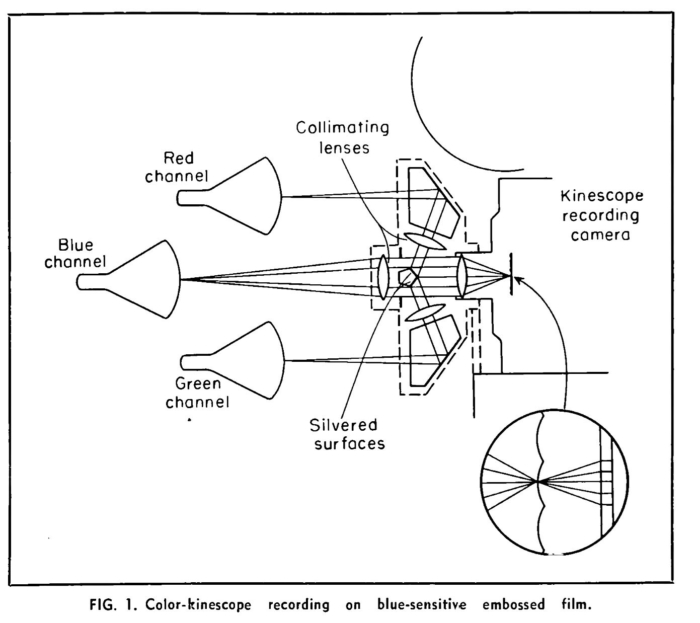
2 Images
Eastman Kodak reversal film duplication stock for (semi)professional use. Replaced Type 5265. Type 7387 introduced in 1964 as improved version. Difficult to see the difference (BL).
See Anscochrome and Super Anscochrome Tungsten, type 226.
A chromogenic process based on Agfacolor, see detail page Agfacolor Neu / Agfacolor.
-
![]() Credit: Národní filmový archiv / National Film Archive, Prague. Film: Jen počkej X (Nu, pogodi!) (Vjačeslav Kotěnočkin, USSR, 1976).
Credit: Národní filmový archiv / National Film Archive, Prague. Film: Jen počkej X (Nu, pogodi!) (Vjačeslav Kotěnočkin, USSR, 1976).
- Credit: Národní filmový archiv / National Film Archive, Prague. Film: Jen počkej X (Nu, pogodi!) (Vjačeslav Kotěnočkin, USSR, 1976).
- Credit: Národní filmový archiv / National Film Archive, Prague. Film: Jen počkej X (Nu, pogodi!) (Vjačeslav Kotěnočkin, USSR, 1976).
- Credit: Národní filmový archiv / National Film Archive, Prague. Film: Jen počkej X (Nu, pogodi!) (Vjačeslav Kotěnočkin, USSR, 1976).
- Credit: Národní filmový archiv / National Film Archive, Prague. Film: Jen počkej X (Nu, pogodi!) (Vjačeslav Kotěnočkin, USSR, 1976).
- Credit: Národní filmový archiv / National Film Archive, Prague. Film: Jen počkej X (Nu, pogodi!) (Vjačeslav Kotěnočkin, USSR, 1976).
- Credit: Národní filmový archiv / National Film Archive, Prague. Film: Jak se Žofka postarala o svatbu (Adolf Born, Jaroslav Doubrava, Miloš Macourek, Czechoslovakia 1988).
- Credit: Národní filmový archiv / National Film Archive, Prague. Film: Jak se Žofka postarala o svatbu (Adolf Born, Jaroslav Doubrava, Miloš Macourek, Czechoslovakia 1988).
- Credit: Národní filmový archiv / National Film Archive, Prague. Film: Jak se Žofka postarala o svatbu (Adolf Born, Jaroslav Doubrava, Miloš Macourek, Czechoslovakia 1988).
- Credit: Národní filmový archiv / National Film Archive, Prague. Film: Jak se Žofka postarala o svatbu (Adolf Born, Jaroslav Doubrava, Miloš Macourek, Czechoslovakia 1988).
- Credit: Národní filmový archiv / National Film Archive, Prague. Film: Jak se Žofka postarala o svatbu (Adolf Born, Jaroslav Doubrava, Miloš Macourek, Czechoslovakia 1988).
- Credit: Národní filmový archiv / National Film Archive, Prague. Film: Jak se Žofka postarala o svatbu (Adolf Born, Jaroslav Doubrava, Miloš Macourek, Czechoslovakia 1988).
- Credit: Národní filmový archiv / National Film Archive, Prague. Film: Jak se Žofka postarala o svatbu (Adolf Born, Jaroslav Doubrava, Miloš Macourek, Czechoslovakia 1988).
- Eastmancolor negative on Fomacolor positive. Credit: Národní filmový archiv / National Film Archive, Prague. Film: Slunečná laguna (Mirko Kačena, Czechoslovakia 1990).
- Eastmancolor negative on Fomacolor positive. Credit: Národní filmový archiv / National Film Archive, Prague. Film: Slunečná laguna (Mirko Kačena, Czechoslovakia 1990).
- Eastmancolor negative on Fomacolor positive. Credit: Národní filmový archiv / National Film Archive, Prague. Film: Slunečná laguna (Mirko Kačena, Czechoslovakia 1990).
- Eastmancolor negative on Fomacolor positive. Credit: Národní filmový archiv / National Film Archive, Prague. Film: Slunečná laguna (Mirko Kačena, Czechoslovakia 1990).
- Eastmancolor negative on Fomacolor positive. Credit: Národní filmový archiv / National Film Archive, Prague. Film: Slunečná laguna (Mirko Kačena, Czechoslovakia 1990).

18 Images
See Anscochrome and Super Anscochrome Daylight, type 225.
-
![]() Cross section of Ektachrome Commercial, Type 7255. Scource: Groet, N. H./Liberman, M./ Richey, F. (1959): An Improved Professional 16mm Reversal Camera Film. In: JSMPTE, Vol. 68, January 1959, p. 9.
Cross section of Ektachrome Commercial, Type 7255. Scource: Groet, N. H./Liberman, M./ Richey, F. (1959): An Improved Professional 16mm Reversal Camera Film. In: JSMPTE, Vol. 68, January 1959, p. 9.

1 Image
-
![]() Cross section scheme of Eastman Color Negative, Type 5250. Scource: Dundon, Merle L./Zwick, Daan M. (1959): A High Speed Color Negative Film. In: JSMPTE Vol 68, p. 736.
Cross section scheme of Eastman Color Negative, Type 5250. Scource: Dundon, Merle L./Zwick, Daan M. (1959): A High Speed Color Negative Film. In: JSMPTE Vol 68, p. 736.

1 Image
-
![]() cross section scheme of Ektachrome Type 5257 (and 5258). Scource: Groet, N.H./Murray, T.J./Osborne, C.E. (1960): Two High-Speed Color Films and a Reversal Print Film for Motion Picture Use. In: JSMPTE Vol. 69, p. 816.
cross section scheme of Ektachrome Type 5257 (and 5258). Scource: Groet, N.H./Murray, T.J./Osborne, C.E. (1960): Two High-Speed Color Films and a Reversal Print Film for Motion Picture Use. In: JSMPTE Vol. 69, p. 816.

1 Image
Kodachrome II was introduced in 1961. It was the first film stock since 1936 that was specifically meant for amateur use. Eastman Kodak presented the material as superior to the ‘regular Kodachrome’. It supposedly had a higher speed of 25 ...
-
![]() La perception et l'imaginaire (FRA 1964, Éric Duvivier). Credit: Image'Est. Photographs of the Kodachrome II camera material by Bregt Lameris, ERC Advanced Grant FilmColors.
La perception et l'imaginaire (FRA 1964, Éric Duvivier). Credit: Image'Est. Photographs of the Kodachrome II camera material by Bregt Lameris, ERC Advanced Grant FilmColors.
- Les autopathes (FRA 1971, Éric Duvivier). Credit: Image'Est. Photographs of the kodachrome reversal by Bregt Lameris, ERC Advanced Grant FilmColors.
- Hallucinations: Images du monde visionnaire (FRA 1963, Éric Duvivier). Credit: Image'Est. Photographs of undated Kodachrome II projection print by Bregt Lameris, ERC Advanced Grant FilmColors.

84 Images in 5 Galleries
-
![]() Credit: Gert Koshofer Collection. Photograph by Barbara Flueckiger
Credit: Gert Koshofer Collection. Photograph by Barbara Flueckiger

11 Images in 1 Gallery
-
![]() Photomicrograph 1000x, Agfachrome cross section. Credit: Carsta Knaack.
Photomicrograph 1000x, Agfachrome cross section. Credit: Carsta Knaack.
- Photomicrograph 500x, Agfachrome cross section. Credit: Carsta Knaack.

2 Images
“Polacolor was commercialized in 1963 and became an immediate success. It was acclaimed as the “most outstanding single advance in photographic science made during this century” (Crawley 1963). Indeed, Polacolor introduced important new ...
-
![]() Source: Pénichon, Sylvie (2013): Twentieth Century Colour Photographs. The Complete Guide to Processes, Identification & Preservation. London, Los Angeles: Thames & Hudson, p. 235.
Source: Pénichon, Sylvie (2013): Twentieth Century Colour Photographs. The Complete Guide to Processes, Identification & Preservation. London, Los Angeles: Thames & Hudson, p. 235.
- Source: Pénichon, Sylvie (2013): Twentieth Century Colour Photographs. The Complete Guide to Processes, Identification & Preservation. London, Los Angeles: Thames & Hudson, p. 235.
- Source: Pénichon, Sylvie (2013): Twentieth Century Colour Photographs. The Complete Guide to Processes, Identification & Preservation. London, Los Angeles: Thames & Hudson, p. 235.
- Source: Pénichon, Sylvie (2013): Twentieth Century Colour Photographs. The Complete Guide to Processes, Identification & Preservation. London, Los Angeles: Thames & Hudson, p. 258.

4 Images
-
![]() Frauenschicksale (GDR 1952, Slatan Dudow). Credit: Bundesarchiv Filmarchiv. Photographs of the Orwocolor safety print by Michelle Beutler, ERC Advanced Grant FilmColors.
Frauenschicksale (GDR 1952, Slatan Dudow). Credit: Bundesarchiv Filmarchiv. Photographs of the Orwocolor safety print by Michelle Beutler, ERC Advanced Grant FilmColors.
- Cross section of Orwo positive print. Credit: Carsta Knaack, HTW Berlin. Film: L'Ours (J.-J. Annaud, 1988).
- Cross section schemes of different materials by Orwo. Source: Kaufmann, Siegfried (1976): Vom ersten Farbumkehrfilm zum Orwochrom-System. In: Bild und Ton, 3/1976, p. 88-93.

1026 Images in 27 Galleries
-
![]() Werbung Ansco, 4 Typen, in JSMPTE 1965
Werbung Ansco, 4 Typen, in JSMPTE 1965

1 Image
“In 1956, after the failure of the French venture, Gaspar resumed his own production of printing materials and chemicals (Koshofer 1981a). In the late 1950s he entered into an agreement with 3M Company of St. Paul, Minnesota, to explore the ...
-
![]() NEW!
Soon negative color FOTON daylight films will be available.
FOTONKOLOR NS
roll film 120
FOTONKOLOR NS
roll film 620
FOTONCOLOR NS
roll film 127
FOTONCOLOR NS
35mm (in cartridge)
FOTONCOLOR NS
sheet film
Fotoncolor NS will be possible to expose like 16° DIN, 32 ASA black and white negative film.
NEW!
Soon negative color FOTON daylight films will be available.
FOTONKOLOR NS
roll film 120
FOTONKOLOR NS
roll film 620
FOTONCOLOR NS
roll film 127
FOTONCOLOR NS
35mm (in cartridge)
FOTONCOLOR NS
sheet film
Fotoncolor NS will be possible to expose like 16° DIN, 32 ASA black and white negative film.

1 Image
 Timeline of Historical Film Colors by Barbara Flueckiger is licensed under a Creative Commons Attribution-NonCommercial-NoDerivatives 4.0 International License.
Quote as Flueckiger, Barbara (2012 ff.): Timeline of Historical Film Colors. (= https://filmcolors.org/).
Download BibTex