Crawford Flexichrome 1940–1942, after 1949 Kodak Flexichrome

Subtractive 3 color: hybrid dye imbibition process, still photography and film
“In the 1940s a product called Crawford Flexichrome appeared on the market. It allowed photographers to obtain prints or transparencies in full color by simply applying dyes of various colors by hand to a gelatin relief image. Results obtained ...

1 Image

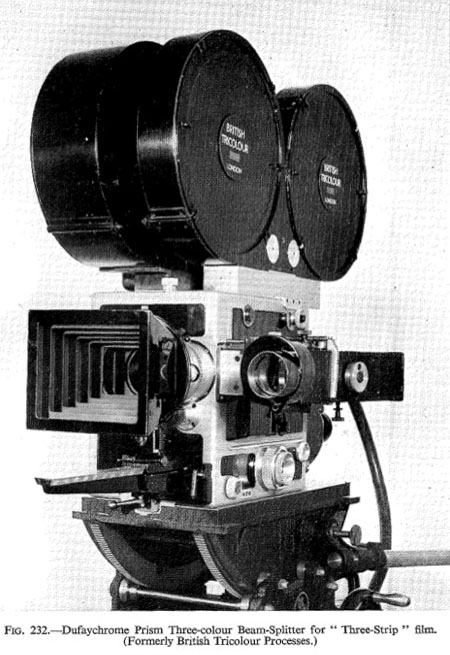
British Tricolour / Dufaychrome

Subtractive 3 color: Beam-splitter, three-strip, multiple printing

19 Images in 3 Galleries

Harriscolor

Subtractive 2 color: Beam-splitter, single-coated
“Harriscolor In this method as in other methods of color photography, independent color value negatives are first obtained. The Harriscolor process can employ one of the following two methods: Either a camera wherein the dividing light prisms ...

3 Images

Triadochrome

Subtractive 3 color: dye mordanting and silver toning process, still photography
“After the war, in 1921, J. F. Shepherd introduced in England a printing method called the Triadochrome Color Process, which was very similar to Hamburger’s Polychromide. To make a print, a cyan impression obtained from an iron-toned ...

Ilford Colour Print

Subtractive 3 color: dye destruction process, silver dye-bleach, still photography
“In November 1953 Ilford Limited of London launched a mail-order service to supply color prints from 35mm transparencies using Ilford Colour Print, a silver dye-bleach printing material on white-pigmented cellulose triacetate support (Fig. ...

1 Image

Raylo

Subtractive 3 color: pigment process, still photography
“Raylo was a material developed by Hiram Codd Joseph Deeks (1880−1952) of the American Raylo Corporation, New York. It was introduced in 1922 for a printing service for users of the Raylo Camera, a one-shot camera that made three negatives ...

1 Image

Orthochromatic stock

b/w photography: orthochromatic b/w stock, still photography
“In 1873 Dr Vogel discovered that by adding dyes to the sensitive material, its sensitivity could be extended, so that it would record green as well as blue. The new ‘orthochromatic’ plates were available commercially from 1882. The ...

2 Images

Sensitizing theory

Color theory
“Dr. H. W. Vogel, the discoverer of colour sensitizers, made three-colour photography possible, and has been the first to recognise the relation between colour sensitiveness of plate and printing colour in the following principle made known in ...

Isensee

Additive 3 color: Rotary filter
“The first patent that has been found was granted to H. Isensee and he placed in front of the lens, both in taking and projection, a rotary shutter with three 120 degrees sectors in the usual colors.” (Wall, E.J. (1925): The History of ...

2 Images

Technicolor No. I

Additive 2 color: Beam-splitter

During the capturing of the film a beam-splitter in combination with filters in the camera divided the incoming light into a red and a green separation negative on black-and-white stock. When projected in the cinema the two images were combined simultaneously by additive mixture through corresponding red and green filters into one picture consisting of red and green colored light. The reduction of the whole color range to two colors (and their additive combinations) was necessary because of the complex optical arrangement.

6 Images in 1 Gallery

Urban-Joy Process, improvement of Kinemacolor, later called Kinekrom

Additive 2 color: Rotary filter
“In the design of apparatus Urban was assisted after 1905 by Henry W. Joy. The Urban-Joy perforator appeared in 1906. The Urban-Joy anti-firing device, a shutter to prevent the firing of inflammable film when projectors broke down, was another ...

Rotocolor

Additive 2 color: Rotary filter
“The Rotocolor process was an additive system for color cinematography. The process was announced in 1931 by H. Muller. According to an article in Film Daily, April 12, 1931, and The Motion Picture Herald, April 11, 1931, the process consisted of ...

Carbro-Chromatone

Subtractive 3 color: pigment process, still photography
“References to Carbro-Chromatone prints are sometimes found in the literature on early color photography. These prints were made using a combination of the two processes they were named after. The method was described by Harlan L. Baumbach in ...

Chromart Simplex

Subtractive 2 color: Chromogenic monopack

Chromart Tricolor

Subtractive 3 color: Chromogenic monopack

Autotype Trichrome Carbro

Subtractive 3 color: pigment process, still photography
“As in previous versions of the process, pigment papers were soaked in a sensitizing bath and then squeegeed firmly onto the surface of wet bromide prints to harden the pigmented gelatin in proportion to the amount of silver contained in the ...

1 Image

Gualtierotti or Cicona e Gualtierotti

Additive two-color: optical system, filters, 64mm negative.
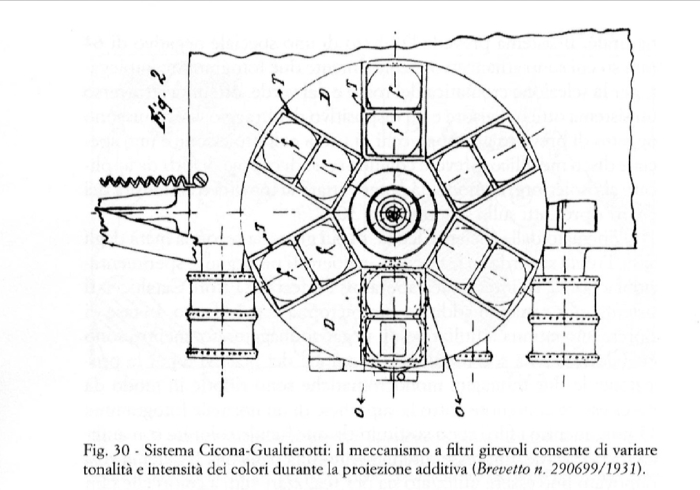
Unlike other additive systems invented in previous years, Gualtierotti tried to avoid the phenomenon of chromatic aberration inherent in the use of multiple lenses or the creation of successive separation records. The proposed solution was based on ...

1 Image

Agfacolor lenticular / Agfacolor Linsenrasterfilm

Additive 3 color: Lenticular screen
The basic idea of the lenticular film was developed by the German Raphaël Liesegang in 1896 and applied to still photography by the French Rodolphe Berthon in 1908. The lenticular process applies tiny cylindrical lenses embossed on the film support ...

15 Images

Belcolor

Subtractive 3 color: pigment process, still photography
“Introduced in the mid-1930s by George Murphy, Inc., of New York City, Belcolor was considered one of the simplest ways to obtain color transparencies, as it required no special equipment or expert technique and could be used successfully ...

Hirlicolor

Subtractive 2 color: Bi-pack

2 Images

Kinemacolor

Additive 2 color: Rotary filter

Kinemacolor was an additive process operated with alternating red and green filters that were applied to the shutter in front of the camera and in front of the projector. With at least 32 fps the frame rate was double the minimal frame rate of 16 fps. Time parallax with small differences between the red and green record resulted in color fringes that became visible when objects or scenes were moving.

13 Images in 3 Galleries

Predecessor of Kinemacolor

Additive 2 color: Rotary filter
“Then we come upon the name of George Albert Smith, F.R.A.S., of Laboratory Lodge, Roman Crescent, Southwick, Brighton, who in E.P. 26,671, of 1906, patented the method which eventually was commercialized as Kinemacolor. In this patent he ...

Paget Color Screen

Additive 3 color: regular mosaic screen, separate system, still photography
“Paget Color Screen (1913–ca. 1922): lines of red and blue squares alternated with lines of green and blue squares (Fig. 2.52). The lines are at a 45-degree angle from the edge of the plate. The side of the red and green squares measures ...

1 Image

3M Posi-Tone

Subtractive 3 color: dye destruction process, silver dye-bleach, still photography
“In 1956, after the failure of the French venture, Gaspar resumed his own production of printing materials and chemicals (Koshofer 1981a). In the late 1950s he entered into an agreement with 3M Company of St. Paul, Minnesota, to explore the ...

Lippmann

Direct color photography: interference, still photography
“In 1891, Professor Gabriel Lippmann demonstrated to the French Académie des Sciences interference colour photographs of the spectrum and of stained glass windows, taken by a modification of Wiener’s method. An exceedingly fine grained, ...

5 Images

Crosene Process

Additive 4 color: Bi-pack, substandard

Jos-Pé

Subtractive 3 color: dye imbibition process, still photography
“Invented by G. Koppmann and introduced in Hamburg in 1924 by the German financier Josef-Peter Welker, from whom the product took its name (Wall and Jordan 1940: 330), Jos-Pé was a complete color system that included a one-exposure camera, ...

1 Image

Fujifilm integral films

Subtractive 3 color: dye diffusion process, still photography
“The chemistry and structure layer of Fuji FI-10 integral film were very similar to those of Kodak PR-10, with the film being exposed on one side and viewed on the opposite side. However, its layers were much thinner than those of Kodak and ...

1 Image

Fujifilm peel-apart films

Subtractive 3 color: dye diffusion process, still photography
“The company also launched its first peel-apart color print films, Fuji FP-100 and Fuji FP-800, which were compatible with Polaroid cameras and camera backs. The image formation of the new peel-apart films was similar to that of Fuji integral ...

Fujichrome

Subtractive 3 color: chromogenic monopack reversal
Fujichrome is the collective brand name for colour reversal films produced by the Fujifilm Corporation. The brand was also used for Single 8 film, the production of which ceased in 2019. The launch of “Fujicolor Reversal Film” (with an ...

Fujichrome 64T Type II Professional [RTP II]

Subtractive 3 color: chromogenic monopack, reversal, 35 mm
Fujichrome 64T Type II Professional [RTP II] is a tungsten-type color reversal film with a speed of ISO 64 by the Fujifilm Corporation. It is no longer in production.

1 Image

Fujichrome Provia 100F Professional [RDP III]

Subtractive 3 color: chromogenic monopack, reversal, 35 mm
Fujichrome Provia 100F Professional (RDP III) is a daylight-type, ISO 100–color reversal film with an RMS granularity value of 8 produced by the Fujifilm Corporation. It is the successor to Fujichrome Provia 100.

1 Image

Fujichrome Provia 400F Professional [RHP III]

Subtractive 3 color: chromogenic monopack, reversal, 35 mm
Fujichrome Provia 400F Professional (RHP III) is an ISO 400 daylight color reversal film manufactured by the Fujifilm Corporation. It is the successor to Fujichrome Provia 400 (RHP II) and the predecessor to Fujichrome Provia 400X.

1 Image

Fujichrome Sensia 200 [RM]

Subtractive 3 color: chromogenic monopack, reversal, 35 mm
Fujichrome Sensia 200 RM is a daylight ISO 200 color reversal film produced by the Fujifilm Corporation. Production of the Sensia series ceased in 2011 with the discontinuation of the Sensia III 100.

1 Image

Fujichrome Sensia 400 [RH]

Subtractive 3 color: chromogenic monopack, reversal, 35 mm
Fujichrome Sensia 400 [RH] is a daylight reversal film with a sensitivity of ISO 400 by the Fujifilm Corporation. Production of the Sensia series ceased in 2011 with the discontinuation of the Sensia III 100.

1 Image

Fujichrome Velvia 100F Professional [RVP 100F]

Subtractive 3 color: chromogenic monopack, reversal, 35 mm
Fujichrome Velvia 100F Professional [RVP 100F] is a daylight-type color reversal film with an ISO speed of 100 by Fujifilm Corporation intended for professional use. It has an RMS granularity value of 8. It is no longer in production.

1 Image

Fujichrome Astia 100F Professional [RAP 100F]

Subtractive 3 color: chromogenic monopack, reversal, 35 mm
Fujichrome Astia 100F Professional [RAP 100F] is a daylight-type color reversal film with an ISO speed of 100 by the Fujifilm Corporation intended for professional use. It was the final product in the Astia series, with production ending in March ...

1 Image

Fujichrome Sensia 100 [RA]

Subtractive 3 color: chromogenic monopack, reversal, 35 mm
Fujichrome Sensia 100 [RA] is a daylight-type color reversal film with an ISO speed of 100 by the Fujifilm Corporation. It has an RMS granularity value of 8. Production of the Sensia series ceased in 2011 with the discontinuation of the Sensia III ...

1 Image

Fujichrome T64 Professional [RTP]

Subtractive 3 color: chromogenic monopack, reversal, 35 mm
Fujichrome T64 Professional [RTP] is an ISO 64 tungsten-type color reversal film produced by the Fujifilm Corporation. It is the successor of Fujichrome 64 Professional T.

1 Image

Fujichrome Provia 400X Professional [RXP]

Subtractive 3 color: chromogenic monopack, reversal, 35 mm
Fujichrome Provia 400X Professional [RXP] is a daylight-type color reversal film with an ISO sensitivity of 400 by the Fujifilm Corporation. It is the successor of Fujichrome Provia 400F (RHP III).

5 Images

Fujichrome Velvia 50 Professional [RVP 50]

Subtractive 3 color: chromogenic monopack, reversal, 35 mm
Fujichrome Velvia 50 Professional [RVP 50] is a daylight-type color reversal film with a speed of ISO 50 by the Fujifilm Corporation for professional use. It is the successor to Fujichrome Velvia, which was discontinued in February 2006.

1 Image

Fujichrome Velvia 100 Professional [RVP 100]

Subtractive 3 color: chromogenic monopack, reversal, 35 mm
Fujichrome Velvia 100 Professional [RVP 100] is a daylight-type color reversal film with an ISO speed of 100 produced by the Fujifilm Corporation. Its RMS granularity value is 8.

Fujichrome Provia 100 Professional [RDP II]

Subtractive 3 color: chromogenic monopack, reversal, 35 mm
Fujichrome Provia 100 Professional [RDP II] is a daylight-type, ISO 100 color reversal film produced by the Fujifilm Corporation. It succeeded the Fujichrome 100 Professional D [RDP], released in March 1983. Its successor is Fujichrome Provia 100F ...

1 Image

Fujichrome Provia 1600 Professional [RSP]

Subtractive 3 color: chromogenic monopack, reversal, 35 mm
Fujichrome Provia 1600 Professional [RSP] is a daylight-type color reversal film by the Fujifilm Corporation, designed exclusively for push-processing, with a nominal speed of ISO 1600. It is intended for effective speeds of EI 1600 and EI 3200. It ...

1 Image

Fujichrome Velvia RVP for Professionals

Subtractive 3 color: chromogenic monopack, reversal, 35 mm
Fujichrome Velvia [RVP] is a daylight-type color reversal film with a speed of ISO 50 by the Fujifilm Corporation. Its successor is Fujichrome Velvia 50, which was released in March 2007.

1 Image

Fujichrome MS 100/1000 Professional [RMS]

Subtractive 3 color: chromogenic monopack, reversal, 35 mm
Fujichrome MS 100/1000 Professional [RMS] is a multi-speed daylight-type color reversal film by the Fujifilm Corporation for professional use. It is usable at its normal rating of EI 100 as well as push-processed up to EI 1000 (+3 1/3 stops). It is ...

1 Image

Fujicolor

Subtractive 3 color: chromogenic monopack reversal (from 1949), negative/positive process (from 1955)
“The Fujicolor process is a three-color subtractive negative/positive process introduced in 1955 by the Fuji Photo Film Co., Ltd., Tokyo, Japan. When the process was introduced it consisted of two elements that could be used singly or together. ...

141 Images in 7 Galleries

Lee and Turner

Additive 3 color: Rotary filter
“Frederick Marshall Lee, of Walton, and Edward Raymond Turner, of Hounslow, to whom is usually accorded the credit of achieving the first practical results in additive projection. Their experimental work was financed by Charles Urban, a ...

16 Images in 1 Gallery

Gilmore Color

Additive 2 color: Rotary filter
“Gilmore’s two-color additive process was based on a patent granted to F. E. Ives in 1918. A unique optical system exposed two images in pairs, and quarter-turned them lengthwise side by side on standard 35 mm film stock. One of the images was ...

1 Image

Hicrography / Hicrome

Subtractive 3 color: dye imbibition process, still photography
“In 1915 the company launched a hybrid dye imbibition color printing system called Hicrography. From the separation negatives, positive impressions were made through the base on the presensitized dichromated film (Hicro Film), which also ...

1 Image