
-
![]() Source: Cornwell-Clyne, Adrian (1951): Colour Cinematography. London: Chapman & Hall.
Source: Cornwell-Clyne, Adrian (1951): Colour Cinematography. London: Chapman & Hall.
- Source: Cornwell-Clyne, Adrian (1951): Colour Cinematography. London: Chapman & Hall.
Select Category▼×
- All Categories
- Bibliography
- Chromogenic monopack
- Chromolytic multilayer
- Color separation
- Double-coated / bi-pack
- Edge Codes and Identification
- Hand coloring
- Other
- Printing / dye-transfer
- Printing / pigment process
- Screen processes
- Spatial synthesis (multiple lenses, beam splitter)
- Stencil coloring (pochoir, Pathécolor)
- Temporal synthesis (rotary filters)
- Theory
- Tinting
- Toning
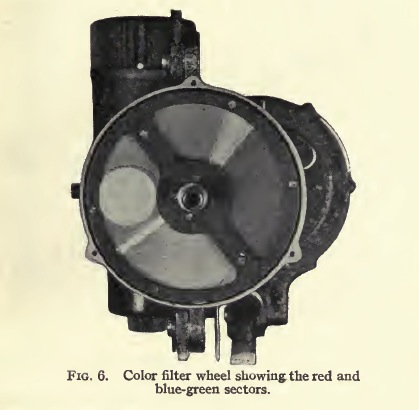
“An American two-colour subtractive process still worked by the Consolidated Film Industries division of Republic Pictures Corporation. This concern was licensed by the owners of the “Prizma” patents, which it will be remembered was ...
-
![]() Mysore Yesterday and Tomorrow Credit: Image courtesy of the 20th Century Fox Collection at the Academy Film Archive. Photograph: Barbara Flueckiger.
Mysore Yesterday and Tomorrow Credit: Image courtesy of the 20th Century Fox Collection at the Academy Film Archive. Photograph: Barbara Flueckiger.

23 Images in 2 Galleries
“The Rotocolor process was an additive system for color cinematography. The process was announced in 1931 by H. Muller. According to an article in Film Daily, April 12, 1931, and The Motion Picture Herald, April 11, 1931, the process consisted of ...
-
![]() Screenshot from Mayorov, Nikolai (2012): Soviet Colours. Translated by Birgit Beumers. In: Studies in Russian & Soviet Cinema, 6:2, pp. 241–255. doi: 10.1386/srsc.6.2.241_1 Courtesy of Nikolai Mayorov.
Screenshot from Mayorov, Nikolai (2012): Soviet Colours. Translated by Birgit Beumers. In: Studies in Russian & Soviet Cinema, 6:2, pp. 241–255. doi: 10.1386/srsc.6.2.241_1 Courtesy of Nikolai Mayorov.

1 Image
“Coloratura. This is the process of Pathé Exchange at Bound Brook, N. J. Negatives are made by the bi-pack method. Prints are made on double-sided film and are dye-toned on one side and metallic-toned on the other. The double-sided film, ...
-
![]() Rota Farbenfilm Samples (Kodak Film Samples Collection). Credit: National Science and Media Museum Bradford. Photographs of the Rotacolor Prints by Josephine Diecke, SNSF project Film Colors. Technologies, Cultures, Institutions and Joëlle Kost, ERC Advanced Grant FilmColors.
Rota Farbenfilm Samples (Kodak Film Samples Collection). Credit: National Science and Media Museum Bradford. Photographs of the Rotacolor Prints by Josephine Diecke, SNSF project Film Colors. Technologies, Cultures, Institutions and Joëlle Kost, ERC Advanced Grant FilmColors.

13 Images in 2 Galleries
The basic idea of the lenticular film was developed by the German Raphaël Liesegang in 1896 and applied to still photography by the French Rodolphe Berthon in 1908.
The lenticular process applies tiny cylindrical lenses embossed on the film support ...
-
![]() Color reconstruction. Credit: Gisela Harich-Hamburger, Diplomrestauratorin (FH).
Color reconstruction. Credit: Gisela Harich-Hamburger, Diplomrestauratorin (FH).
- Source: Heymer, Gerd (1933): Auflösungsvermögen und Farbwiedergabe in der Farbrasterphotographie. In: Veröffentlichungen des wissenschaftlichen Zentral-Laboratoriums der photographischen Abteilung Agfa, 3, 1933, pp. 188-207.
- Source: Weil, F. (1933): The Optical-Photographic Principles of the Agfacolor Process. In: Journal of the Society of Motion Picture Engineers, 20, (April, 1933), No. 4, p. 301-308.
- Both the Kodak and Agfa lenticular processes required the correct banded filter to be used with each different batch of panchromatic film. These two filters were for different batches of Agfacolor used in a Leica camera.. Source: Coote, Jack H. (1993): The Illustrated History of Colour Photography. Surbiton, Surrey: Fountain Press.
- Credit: Illustration by Sarah Steinbacher, Multimedia & E-Learning-Services, University of Zurich. Source: Ede, François (1994): Jour de fête ou la couleur retrouvée. Cahiers du Cinéma: Paris.
- Principle of capturing and projecting lenticular film. Credit: Joakim Reuteler and Rudolf Gschwind, Digital Humanities Lab, University of Basel, Switzerland. Illustration by Sarah Steinbacher, Multimedia & E-Learning-Services, University of Zurich.
- Principle of capturing and projecting lenticular film. Credit: Joakim Reuteler and Rudolf Gschwind, Digital Humanities Lab, University of Basel, Switzerland. Illustration by Sarah Steinbacher, Multimedia & E-Learning-Services, University of Zurich.
- Principle of capturing and projecting lenticular film. Credit: Joakim Reuteler and Rudolf Gschwind, Digital Humanities Lab, University of Basel, Switzerland. Illustration by Sarah Steinbacher, Multimedia & E-Learning-Services, University of Zurich.
- Magnification 5x, front. Credit: photomicrograph by Silvana Konermann.
- Magnification 10x, back. Credit: photomicrograph by Silvana Konermann.
- Magnification 20x, front. Credit: photomicrograph by Silvana Konermann.
- Reflection on Agfacolor lenticular film. Source: Eggert, John (1932): Kurzer Überblick über den Stand der Farbenkinematographie. In: Bericht über den VIII. Internationalen Kongress für wissenschaftliche und angewandte Photographie, Dresden 1931, pp. 214-222. Leipzig: J. A. Barth.
- Reconstruction of lenticular film by Joakim Reuteler and Rudolf Gschwind, Digital Humanities Lab, University of Basel, Switzerland in the framework of their research project doLCE
- Agfacolor Lenticular sample from the Kodak Film Samples Collection at the National Science and Media Museum in Bradford. Credit: National Science and Media Museum Bradford. Photographs by Barbara Flueckiger in collaboration with Noemi Daugaard.
- Analog reconstruction by Giorgio Trumpy, ERC Advanced Grant FilmColors

15 Images
-
![]() Credit: Harvard Film Archive, George Huizinga Collection, item no. 10454. Film: Prehistoric Women (1951).
Credit: Harvard Film Archive, George Huizinga Collection, item no. 10454. Film: Prehistoric Women (1951).
- Credit: Harvard Film Archive, George Huizinga Collection, item no. 10454. Film: Prehistoric Women (1951).
- Source: Coe, Brian (1981): The History of Movie Photography. Westfield, N.J.: Eastview Editions.
- Reflection on Cinecolor print. Credit: Image courtesy of the 20th Century Fox Collection at the Academy Film Archive. Photograph by Barbara Flueckiger
- Reflection on Cinecolor 16 mm print. Credit: Library of Congress. Photograph by Barbara Flueckiger

93 Images in 9 Galleries
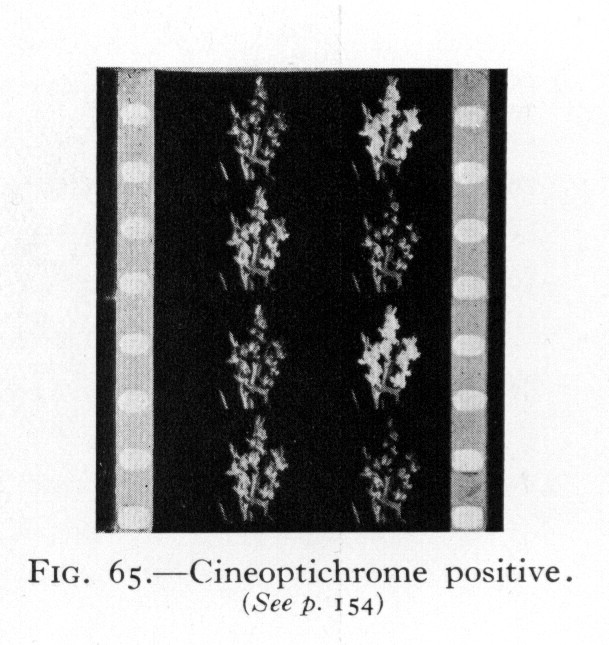
The Roncarolo system required a camera capable of recording two panchromatic negatives (which became three or four in subsequent patents) through the use of a beam splitter and red and green filters.
The chromatic information registered on the two or ...
-
![]() Source: Klein, Adrian Bernhard (Cornwell-Clyne) (1940): Colour Cinematography. Boston: American Photographic Pub. Co.
Source: Klein, Adrian Bernhard (Cornwell-Clyne) (1940): Colour Cinematography. Boston: American Photographic Pub. Co.
- Source: Klein, Adrian Bernhard (Cornwell-Clyne) (1940): Colour Cinematography. Boston: American Photographic Pub. Co.
2 Images
“Agfacolor Plate (1932-1938): colored particles very small and not visible to the naked eye; clumps of particles of the same color give the image a pointillist effect (Fig. 2.63). Unlike with the autochromes, in which the grains are remarkably ...
-
![]() Source: Pénichon, Sylvie (2013): Twentieth Century Colour Photographs. The Complete Guide to Processes, Identification & Preservation. London, Los Angeles: Thames & Hudson, p. 72.
Source: Pénichon, Sylvie (2013): Twentieth Century Colour Photographs. The Complete Guide to Processes, Identification & Preservation. London, Los Angeles: Thames & Hudson, p. 72.

1 Image
“Agfacolor Film (1932–1934): individual colored particles cannot be seen with the naked eye, but clumps of grains of the same color give the image a pointillist effect (Fig. 2.70). There is no black pigment filler. The film has a thick base ...
-
![]() Source: Pénichon, Sylvie (2013): Twentieth Century Colour Photographs. The Complete Guide to Processes, Identification & Preservation. London, Los Angeles: Thames & Hudson, p. 76.
Source: Pénichon, Sylvie (2013): Twentieth Century Colour Photographs. The Complete Guide to Processes, Identification & Preservation. London, Los Angeles: Thames & Hudson, p. 76.

1 Image
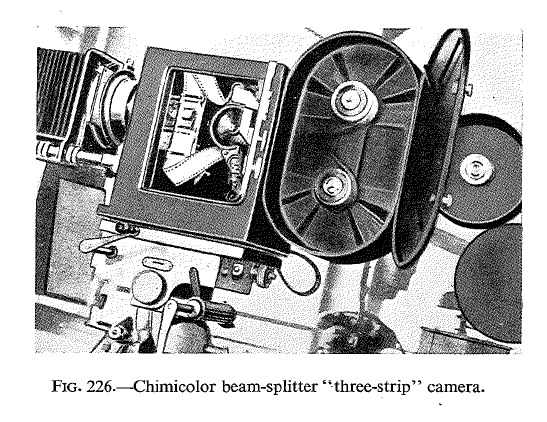
“Chemicoior was the name under which the German Ufacolor Process was marketed in Britain. Ufacolor was also marketed under the name Spectracolor. The process used Agfa bipack negatives loaded with the emulsion sides facing and separated by a ...
-
![]() Source: Coe, Brian (1981): The History of Movie Photography. Westfield, N.J.: Eastview Editions. Film: Pagliacci (1937).
Source: Coe, Brian (1981): The History of Movie Photography. Westfield, N.J.: Eastview Editions. Film: Pagliacci (1937).
9 Images in 2 Galleries
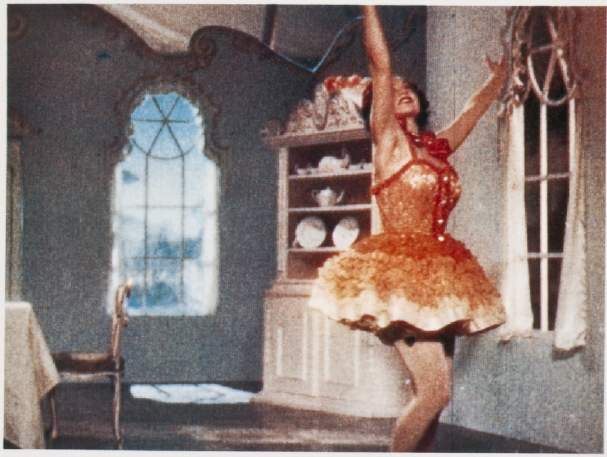
With the fourth Technicolor process the company dominated the market for color films from the mid-1930s to the 1950s.
In a special camera, three b/w negative films were exposed through a beam-splitter that consisted of two prisms to form a cube. One ...
-
![]() Credit: Image courtesy of the Academy Film Archive. Film: Gone with the Wind (USA 1939, Victor Fleming). Photograph by Barbara Flueckiger.
Credit: Image courtesy of the Academy Film Archive. Film: Gone with the Wind (USA 1939, Victor Fleming). Photograph by Barbara Flueckiger.
- Film: Samson and Delilah (US 1949, Cecil B. DeMille), trailer.
- Photomicrograph, 50x. Credit: Norbert Wey, Institute of Pathology, University of Zurich.
- Photomicrograph, 100x. Credit: Norbert Wey, Institute of Pathology, University of Zurich.

1881 Images in 65 Galleries
-
![]() Credit: Geo. Willeman, Nitrate Film Vault Manager, Library of Congress. Film: The Magic Isle.
Credit: Geo. Willeman, Nitrate Film Vault Manager, Library of Congress. Film: The Magic Isle.
- Credit: Geo. Willeman, Nitrate Film Vault Manager, Library of Congress. Film: The Magic Isle.
- Credit: Geo. Willeman, Nitrate Film Vault Manager, Library of Congress. Film: The Magic Isle.
- Credit: Geo. Willeman, Nitrate Film Vault Manager, Library of Congress. Film: The Magic Isle.
- Credit: Geo. Willeman, Nitrate Film Vault Manager, Library of Congress. Film: The Magic Isle.
- Credit: Geo. Willeman, Nitrate Film Vault Manager, Library of Congress. Film: The Magic Isle.
- Credit: Geo. Willeman, Nitrate Film Vault Manager, Library of Congress. Film: The Magic Isle.
- Credit: Geo. Willeman, Nitrate Film Vault Manager, Library of Congress. Film: The Magic Isle.
- Credit: Geo. Willeman, Nitrate Film Vault Manager, Library of Congress. Film: The Magic Isle.
- Credit: Geo. Willeman, Nitrate Film Vault Manager, Library of Congress. Film: The Magic Isle.
- Credit: Geo. Willeman, Nitrate Film Vault Manager, Library of Congress. Film: The Magic Isle.
- Credit: Geo. Willeman, Nitrate Film Vault Manager, Library of Congress. Film: The Magic Isle.
- Credit: Geo. Willeman, Nitrate Film Vault Manager, Library of Congress. Film: The Magic Isle.
- Credit: Geo. Willeman, Nitrate Film Vault Manager, Library of Congress. Film: The Magic Isle.
- Credit: Geo. Willeman, Nitrate Film Vault Manager, Library of Congress. Film: The Magic Isle.
- Credit: Geo. Willeman, Nitrate Film Vault Manager, Library of Congress. Film: The Magic Isle.
- Credit: Geo. Willeman, Nitrate Film Vault Manager, Library of Congress. Film: The Magic Isle.
- Credit: Geo. Willeman, Nitrate Film Vault Manager, Library of Congress. Film: The Magic Isle.
- Credit: Geo. Willeman, Nitrate Film Vault Manager, Library of Congress. Film: The Magic Isle.
- Credit: Geo. Willeman, Nitrate Film Vault Manager, Library of Congress. Film: The Magic Isle.
- Credit: Geo. Willeman, Nitrate Film Vault Manager, Library of Congress. Film: The Magic Isle.
- Credit: Geo. Willeman, Nitrate Film Vault Manager, Library of Congress. Film: The Magic Isle.
- Credit: Geo. Willeman, Nitrate Film Vault Manager, Library of Congress. Film: The Magic Isle.
- Credit: Geo. Willeman, Nitrate Film Vault Manager, Library of Congress. Film: The Magic Isle.
- Credit: Geo. Willeman, Nitrate Film Vault Manager, Library of Congress. Film: The Magic Isle.
- Credit: Geo. Willeman, Nitrate Film Vault Manager, Library of Congress. Film: The Magic Isle.
- Credit: Geo. Willeman, Nitrate Film Vault Manager, Library of Congress. Film: The Magic Isle.
- Credit: Geo. Willeman, Nitrate Film Vault Manager, Library of Congress. Film: The Magic Isle.
- Credit: Geo. Willeman, Nitrate Film Vault Manager, Library of Congress. Film: The Magic Isle.
- Credit: Geo. Willeman, Nitrate Film Vault Manager, Library of Congress. Film: The Magic Isle.
- Credit: Geo. Willeman, Nitrate Film Vault Manager, Library of Congress. Film: The Magic Isle.
- Credit: Geo. Willeman, Nitrate Film Vault Manager, Library of Congress. Film: The Magic Isle.
- Credit: Geo. Willeman, Nitrate Film Vault Manager, Library of Congress. Film: The Magic Isle.
- Credit: Geo. Willeman, Nitrate Film Vault Manager, Library of Congress. Film: The Magic Isle.
- Credit: Geo. Willeman, Nitrate Film Vault Manager, Library of Congress. Film: The Magic Isle.
- Credit: Geo. Willeman, Nitrate Film Vault Manager, Library of Congress. Film: The Magic Isle.
- Credit: Geo. Willeman, Nitrate Film Vault Manager, Library of Congress. Film: The Magic Isle.
- Credit: Geo. Willeman, Nitrate Film Vault Manager, Library of Congress. Film: The Magic Isle.
- Credit: Geo. Willeman, Nitrate Film Vault Manager, Library of Congress. Film: The Magic Isle.
- Credit: Geo. Willeman, Nitrate Film Vault Manager, Library of Congress. Film: The Magic Isle.

40 Images
Gasparcolor was the first three-color multi-layer monopack film available for practical use. It was a double-coated print film with a cyan layer on one side and two layers dyed magenta and yellow on the other side (see illustrations).
-
![]() Uit het rijk der kristallen (NDL 1927?, J.C. Mol). Credit: EYE Film Museum. Photographs of the Dufaycolor and Gasparcolor nitrate print by Barbara Flueckiger.
Uit het rijk der kristallen (NDL 1927?, J.C. Mol). Credit: EYE Film Museum. Photographs of the Dufaycolor and Gasparcolor nitrate print by Barbara Flueckiger.
- Kreise (English title Circles) (Oskar Fischinger, GER 1933-34) Oskar Fischinger's own nitrate print. Credit: Library of Congress, (c) Fischinger Trust, courtesy Center for Visual Music. Photograph Fischinger's own nitrate print by Barbara Flueckiger.
- Credit: (c) Fischinger Trust, courtesy Center for Visual Music. Film: Allegretto by Oskar Fischinger (1936-1943).
- Credit: (c) Fischinger Trust, courtesy Center for Visual Music. Film: Gasparcolor tests by Oskar Fischinger, c. 1933-34.
- Credit: Cinémathèque suisse. Film: Komposition in Blau (Composition in Blue) AKA Lichtkonzert Nr. 1 (Light-Concert No. 1) (GER 1935, Oskar Fischinger).
- Credit: Cinémathèque suisse. © Fischinger Trust, courtesy Center for Visual Music. Film: Komposition in Blau (Composition in Blue) AKA Lichtkonzert Nr. 1 (Light-Concert No. 1) (GER 1935, Oskar Fischinger).
- Credit: Cinémathèque suisse. © Fischinger Trust, courtesy Center for Visual Music. Film: Komposition in Blau (Composition in Blue) AKA Lichtkonzert Nr. 1 (Light-Concert No. 1) (GER 1935, Oskar Fischinger).
- Source: Coe, Brian (1981): The History of Movie Photography. Westfield, N.J.: Eastview Editions.
- Color chart on Agfa Tripofilm. This was the raw stock used for Gasparcolor in Germany until about 1939. Source: Arens, Hans; Heymer, Gerd (1939): Die „Agfa-Farbentafel für Farbenphotographie“. In: Veröffentlichungen des wissenschaftlichen Zentral-Laboratoriums der photographischen Abteilung Agfa, Vol. 6, 1939, pp. 225-229. Leipzig: Hirzel. Photograph by Barbara Flueckiger.
- Source: Pénichon, Sylvie (2013): Twentieth Century Colour Photographs. The Complete Guide to Processes, Identification & Preservation. London, Los Angeles: Thames & Hudson, p. 213.

398 Images in 24 Galleries
The procedure for obtaining the lenticular elements in relief required a series of steps: starting from three black and white positive color separations, obtained with any of the available methods, three matrices were printed, from which the film to ...
-
![]() Projection of lenticular film in Bocca-Rudatis. Refraction of light beams through lens. Source: Pierotti, Federico (2016): Un'archeologia del colore nel cinema italiano. Dal Technicolor ad Antonioni. Pisa: Edizioni ETS, p. 81.
Projection of lenticular film in Bocca-Rudatis. Refraction of light beams through lens. Source: Pierotti, Federico (2016): Un'archeologia del colore nel cinema italiano. Dal Technicolor ad Antonioni. Pisa: Edizioni ETS, p. 81.

1 Image
Three matrices in the subtractive primary colors are printed on the gelatin of the final print. Supposedly, the used dyes were particularly fast and able to prevent color bleeding. Pokorny started working on color cinematography in the 1920s, often ...
Dufaycolor was a regular line screen process whereby the incident light was filtered through a pattern of tiny color patches created by lines in red, green and blue, the so called réseau.
-
![]() Reversal Colour Positive. Credit: Courtesy of BFI National Archive. Photograph by Barbara Flueckiger. Film: A Colour Box (GB 1935, Len Lye).
Reversal Colour Positive. Credit: Courtesy of BFI National Archive. Photograph by Barbara Flueckiger. Film: A Colour Box (GB 1935, Len Lye).
- Microscopic image of the filter structure of a Dufaycolor film. The Emulsion has been removed. The visible structures are not silver grain but the structure of the filter layers. Credit: David Pfluger, ERC Advanced Grant FilmColors. Imaging was performed with support of the Center for Microscopy and Image Analysis, University of Zurich.
- Microscopic images of Dufaycolor film with the focus set at different points within the emulsion and filter layers. The images have been chained to show a travelling through the 3-dimensional structure of the layers. Credit: David Pfluger, conversion to video by Martin Weiss, ERC Advanced Grant FilmColors. Imaging was performed with support of the Center for Microscopy and Image Analysis, University of Zurich.

231 Images in 9 Galleries
-
![]() Credit: Illustration by Sarah Steinbacher, Multimedia & E-Learning-Services, University of Zurich. Source: Klein, Adrian Bernhard (Cornwell-Clyne) (1940): Colour Cinematography. Boston: American Photographic Pub. Co.
Credit: Illustration by Sarah Steinbacher, Multimedia & E-Learning-Services, University of Zurich. Source: Klein, Adrian Bernhard (Cornwell-Clyne) (1940): Colour Cinematography. Boston: American Photographic Pub. Co.
- Source: Klein, Adrian Bernhard (Cornwell-Clyne) (1940): Colour Cinematography. Boston: American Photographic Pub. Co.
- Source: Klein, Adrian Bernhard (Cornwell-Clyne) (1940): Colour Cinematography. Boston: American Photographic Pub. Co.
3 Images
-
![]() Source: Dubray, J.A. (1933): The Morgana Process In: Journal of the Society of Motion Picture Engineers 21,5, 1933, pp. 403-412.
Source: Dubray, J.A. (1933): The Morgana Process In: Journal of the Society of Motion Picture Engineers 21,5, 1933, pp. 403-412.
1 Image
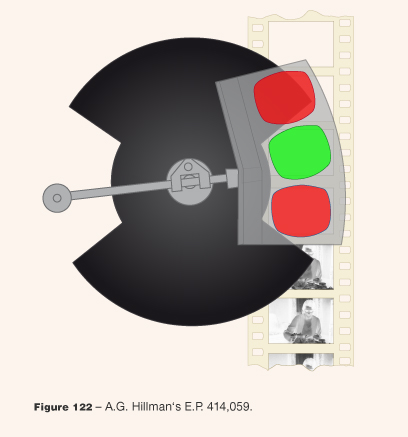
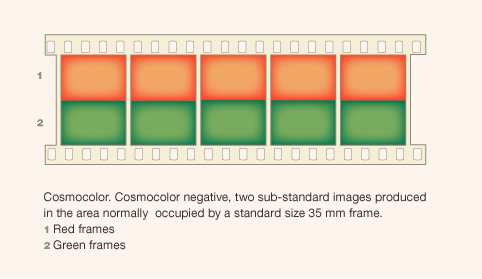
For this four-color process, the light beam was decomposed into four parts, each of which simultaneously exposed an area equal to one quarter of the 35mm frame of a black and white negative. This was obtained optically by placing a diaphragm and a ...
-
![]() Cross-section of the optical system displaying the different lenses, the prism and the four filters. Source: Pierotti, Federico (2016): Un'archeologia del colore nel cinema italiano. Dal Technicolor ad Antonioni. Pisa: Edizioni ETS, p. 71.
Cross-section of the optical system displaying the different lenses, the prism and the four filters. Source: Pierotti, Federico (2016): Un'archeologia del colore nel cinema italiano. Dal Technicolor ad Antonioni. Pisa: Edizioni ETS, p. 71.
- 35mm black and white film strip with four equal-sized images (left) and 16mm projector with Cristiani-Mascarini optical system. Source: Pierotti, Federico (2016): Un'archeologia del colore nel cinema italiano. Dal Technicolor ad Antonioni. Pisa: Edizioni ETS, p. 71.

2 Images
-
![]() Credit: Illustration by Sarah Steinbacher, Multimedia & E-Learning-Services, University of Zurich. A History of Motion Picture Color Technology.
Credit: Illustration by Sarah Steinbacher, Multimedia & E-Learning-Services, University of Zurich. A History of Motion Picture Color Technology.
- Source: Ryan, Roderick T. (1977): A History of Motion Picture Color Technology. London: Focal Press.

2 Images
-
![]() Credit: Illustration by Sarah Steinbacher, Multimedia & E-Learning-Services, University of Zurich. Source: Ryan, Roderick T. (1977): A History of Motion Picture Color Technology. London: Focal Press.
Credit: Illustration by Sarah Steinbacher, Multimedia & E-Learning-Services, University of Zurich. Source: Ryan, Roderick T. (1977): A History of Motion Picture Color Technology. London: Focal Press.
- Source: Ryan, Roderick T. (1977): A History of Motion Picture Color Technology. London: Focal Press.
- Source: Kistler, L. R. (1945): The Projection of Thomascolor Motion Pictures. In: International Projectionist, 20,7, Jul., pp. 12–14.
- Source: Kistler, L. R. (1945): The Projection of Thomascolor Motion Pictures. In: International Projectionist, 20,7, Jul., pp. 12–14.
- Left: Thomascolor camera lens mount for converting standard motion picture camera into Thomascolor. Right: A closeup of the Thomascolor projector lens mount for standard film projectors. The inventor points out that this is all that is needed to convert a standard projector to Thomascolor. Source: Anonymous (1944): Thomascolor. Four-Color Process For Motion Pictures. In: International Projectionist, 19,10, Oct., pp. 7–9.

5 Images
“In 1930 Mannes and Godowsky were invited to join the staff of the Kodak Research Laboratory, where they concentrated on methods of processing multilayer films, while their colleagues worked out ways of manufacturing them. The result was the new Kodachrome film, launched in 1935. Three very thin emulsion layers were coated on film base, the emulsions being sensitised with non-wandering dyes to red, green and blue light, the red-sensitive layer being at the bottom.” (Coe, Brian (1978): Colour Photography. The First Hundred Years 1840-1940. London: Ash & Grant, pp. 121 ff.)
-
![]() Credit: Lichtspiel / Kinemathek Bern. Film: New York, Taufe und Ausflug (CH 1954, Donald Brun).
Credit: Lichtspiel / Kinemathek Bern. Film: New York, Taufe und Ausflug (CH 1954, Donald Brun).
- Surface emulsion side, raking light. Credit: Carsta Knaack, HTW Berlin. Film: Regular 8mm home movie, anonymous 1975.

92 Images in 6 Galleries
-
![]() Credit: Illustration by Sarah Steinbacher, Multimedia & E-Learning-Services, University of Zurich. Source: Ryan, Roderick T. (1977): A History of Motion Picture Color Technology. London: Focal Press.
Credit: Illustration by Sarah Steinbacher, Multimedia & E-Learning-Services, University of Zurich. Source: Ryan, Roderick T. (1977): A History of Motion Picture Color Technology. London: Focal Press.
- Source: Ryan, Roderick T. (1977): A History of Motion Picture Color Technology. London: Focal Press.
2 Images
 Timeline of Historical Film Colors by Barbara Flueckiger is licensed under a Creative Commons Attribution-NonCommercial-NoDerivatives 4.0 International License.
Quote as Flueckiger, Barbara (2012 ff.): Timeline of Historical Film Colors. (= https://filmcolors.org/).
Download BibTex