Subtractive 3 color: chromogenic monopack, still photography
Fujicolor Superia X-TRA 800 [CZ] is a daylight color negative film with an ISO speed of 800. It is designed for processing using Fujifilm Processes CN-16, CN-16Q, CN-16FA, or CN-16L, as well as Kodak Process C-41.
Subtractive 3 color: chromogenic monopack, still photography
Fujicolor Superia X-TRA 400 [CH] is a daylight color negative film with an ISO speed of 400. It features 4th Color Layer and Super Fine-∑(Sigma) Grain Technology to achieve high image quality. The film is designed for processing using Fujifilm ...
Subtractive 3 color: chromogenic monopack, still photography
Fujicolor Nexia 800 is an Advanced Photo System daylight color negative film with an ISO speed of 800. It features a PEN (polyethylene naphthalate) base for increased durability, a fourth color sensitivity layer, and FINE-Σ technology. It is also ...
Subtractive 3 color: chromogenic monopack, still photography
Fujicolor Nexia A 200 is an Advanced Photo System daylight color negative film with an ISO speed of 200. It features a PEN (polyethylene naphthalate) base for increased durability. It is designed for processing using Fujifilm Processes CN-16X, ...
Subtractive 3 color: chromogenic monopack, still photography
Fujicolor Nexia H 400 is an Advanced Photo System daylight color negative film with an ISO speed of 400. It features a PEN (polyethylene naphthalate) base for increased durability. It is designed for processing using Fujifilm Processes CN-16X, ...
Subtractive 3 color: chromogenic monopack, still photography
Fujicolor NPC 160 Professional is a daylight color negative film with an ISO speed of 160, intended for professional use. It is designed for standard C-41 processing chemicals.
Subtractive 3 color: chromogenic monopack, still photography
Fujicolor NPS 160 Professional is a daylight color negative film for professional use with an ISO speed of 160, designed for portrait photography at shutter speeds of 1/8 second or faster. Processing is intended to be done using Fujifilm Process ...
Subtractive 3 color: chromogenic monopack, still photography
Fujicolor NPL 160 Professional is a tungsten-type color negative film with an ISO speed of 160, intended for professional use. It is designed for portrait photography with shutter speeds of 1/30 to 2 seconds. The film should be processed using ...
Subtractive 3 color: chromogenic monopack, still photography
Fujicolor NPH 400 Professional [NPH] is a daylight color negative film with an ISO speed of 400 for professional use. It is designed for commercial photography applications. Processing is intended to be done using Fujifilm Process CN-16, Kodak ...
Subtractive 3 color: chromogenic monopack, still photography
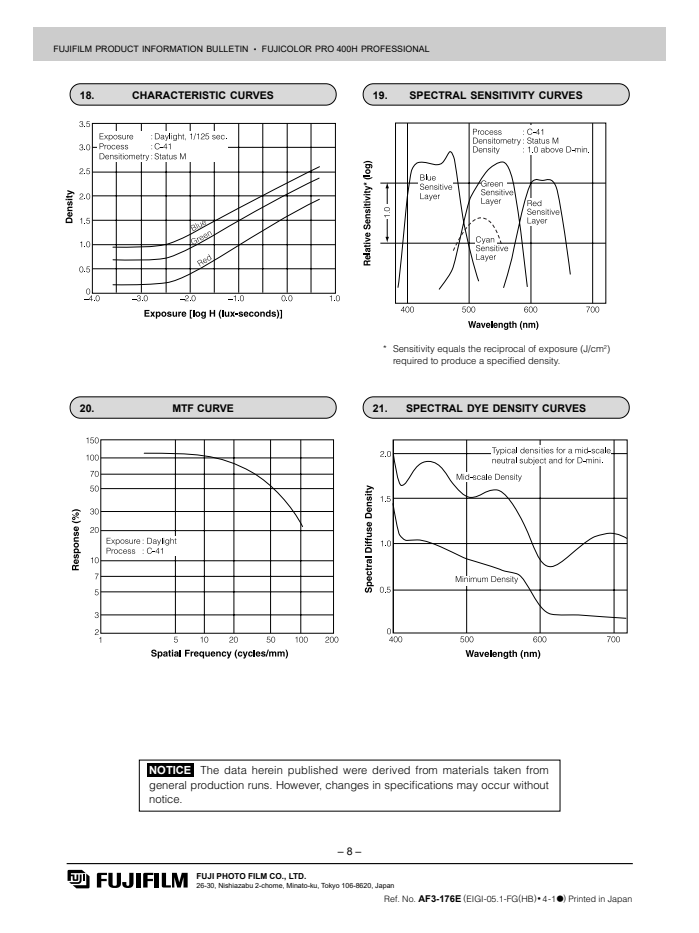
Fujicolor Pro 400H Professional is a daylight color negative film with an ISO speed of 400 intended for professional use. In addition to the conventional three RGB-sensitive layers, it features a fourth color-sensitive layer. The film is designed for ...
Subtractive 3 color: chromogenic monopack, still photography
Fujicolor Pro 160NS Professional is a daylight color negative film with an ISO speed of 160 intended for professional use. In addition to the conventional three RGB-sensitive layers, it features a fourth color-sensitive layer, combined with new ...
Subtractive 3 color: chromogenic monopack, still photography
Fujicolor Pro 160 S Professional is a daylight color negative film with an ISO speed of 160 intended for professional use. In addition to the conventional three RGB-sensitive layers, it features a fourth color-sensitive layer, combined with new ...
Subtractive 3 color: chromogenic monopack, still photography
Fujicolor Pro 160C Professional is a daylight color negative film with an ISO speed of 160 intended for professional use. In addition to the conventional three RGB-sensitive layers, it features a fourth color-sensitive layer, combined with new ...
Subtractive 3 color: chromogenic monopack, still photography
Fujicolor Portrait Film NPZ 800 Professional is an ISO 800 color negative film intended for portraits, weddings, and fashion photography. It uses 4th Color Layer and Fine Sigma technologies. It is designed for standard C-41 processing. In 2004, the ...
Subtractive 3 color: chromogenic monopack, still photography
Fujicolor Portrait Film NPH 400 Professional [NPH] is an ISO 400 daylight color negative film intended for portraits, weddings and commercial and fashion photography. In addition to the three conventional RGB-sensitive layers, it has a fourth ...
Subtractive 3 color: chromogenic monopack, still photography
Fujicolor Super HG 1600 is an ISO 1600 daylight-balanced color negative film. It uses Sigma Crystal Technology. It is intended for processing in Fuji Process CN-16, C-41 Process, or equivalent processes.
Subtractive 3 color: chromogenic monopack, still photography
Fujicolor True Definition 400 is an ISO 400 daylight-type color negative film. It features a new gradation design and 4th Color Layer and Super Fine-Σ Grain technologies. The film is intended for processing in Fujifilm Processes CN-16, CN-16Q, ...
Fujifilm Recording Film ETERNA-RDS (35 mm, Type 4791, PET base) is a black and white film used to create archival black-and-white separations from color digital masters using a film recorder. It is designed for processing in either the D96 or D97 ...
“The Fujicolor process is a three-color subtractive negative/positive process introduced in 1955 by the Fuji Photo Film Co., Ltd., Tokyo, Japan.
When the process was introduced it consisted of two elements that could be used singly or together. ...
Don't Look Now (GBR / ITA 1973, Nicolas Roeg). Credit: BFI National Film Archive. Photographs of the faded Fujicolor HP Positive Film Type 8813 by Joëlle Kost, ERC Advanced Grant FilmColors.
“Frederick Marshall Lee, of Walton, and Edward Raymond Turner, of Hounslow, to whom is usually accorded the credit of achieving the first practical results in additive projection. Their experimental work was financed by Charles Urban, a ...
„Their projector […] used three lenses and a special filter
wheel which enabled every frame of the film to be projected three times in succession through the appropriate filter as it passed through the triple frame projector aperture. Although it eventually led to the Kinemacolor two colour process, the Lee and Turner patent was not successful“. Source: Coote, Jack H. (1993): The Illustrated History of Colour Photography. Surbiton, Surrey: Fountain Press.
"The First Color Moving Pictures", from the YouTube channel of the National Media Museum. [quote id="1"]
Lee Turner projector in the Media History Museum in Bradford.
„In 1899 Lee and Turner obtained a patent for a three colour
process of cinematography requiring a single lens camera
[…] making a recurring sequence of red green and
blue exposures through a rotating filter cum shutter“. Source: Coote, Jack H. (1993): The Illustrated History of Colour Photography. Surbiton, Surrey: Fountain Press.
„Their projector […] used three lenses and a special filter
wheel which enabled every frame of the film to be projected
three times in succession through the appropriate filter as it
passed through the triple frame projector aperture. Although
it eventually led to the Kinemacolor two colour process, the
Lee and Turner patent was not successful“. Source: Coote, Jack H. (1993): The Illustrated History of Colour Photography. Surbiton, Surrey: Fountain Press.
National Media Museum, UK. Lee and Turner Colour Projector, 1902.
Source: Klein, Adrian Bernhard (Cornwell-Clyne) (1940): Colour Cinematography. Boston: American Photographic Pub. Co.
Illustration of the process from National Media Museum's short documentary.
38 mm positive of the Lee Turner film showing the three b/w images for the three color records. Credit: Brian Pritchard.
“Gilmore’s two-color additive process was based on a patent granted to F. E. Ives in 1918. A unique optical system exposed two images in pairs, and quarter-turned them lengthwise side by side on standard 35 mm film stock. One of the images was ...
Subtractive 3 color: dye imbibition process, still photography
“In 1915 the company launched a hybrid dye imbibition color printing system called Hicrography. From the separation negatives, positive impressions were made through the base on the presensitized dichromated film (Hicro Film), which also ...
Pénichon, Sylvie (2013): Twentieth Century Colour Photographs. The Complete Guide to Processes, Identification & Preservation. London, Los Angeles: Thames & Hudson, p. 134.
Subtractive 3 color: dye mordanting and silver toning process, still photography
“In 1932 Frederic Eugene Ives published details of his Polychrome printing system for making three-color paper prints or transparencies from two separation negatives made through a red and a green-blue filter. The process, described by its ...
Pénichon, Sylvie (2013): Twentieth Century Colour Photographs. The Complete Guide to Processes, Identification & Preservation. London, Los Angeles: Thames & Hudson, p. 281.
Similar to Technicolor, the Iriscolor process needed a special beam-splitter camera for exposing three black-and-white negatives on Kodak film stock. These negatives were used for imbibition printing.
Between 1940 and 1942, Tobis Tonbild-Syndikat AG ...
Additive two color process: rotating filters and toning
The film is recorded through alternating red and green filters, creating two color separations. After development, the print is placed in two alternating dye-baths, toning the blacks green and the whites red. Additionally, a black-and-white copy is ...
Francis H. Snyder, Henry W. Rimbach, Defender Photo Supply Company
Subtractive 3 color: silver toning, still photography
“Chromatone was the first commercially viable process of color print making entirely based on silver toning. It was developed in the early 1930s by the New Yorkers Francis H. Snyder and Henry W. Rimbach, who patented the toning methods and ...
Pénichon, Sylvie (2013): Twentieth Century Colour Photographs. The Complete Guide to Processes, Identification & Preservation. London, Los Angeles: Thames & Hudson, p. 282.
Pénichon, Sylvie (2013): Twentieth Century Colour Photographs. The Complete Guide to Processes, Identification & Preservation. London, Los Angeles: Thames & Hudson, p. 283.
“M. F. de Colombier appears to have been the first to suggest the application of this system to cinematography, and like so many French patents it is a little indefinite in phraseology. Three films were employed representing the same view and ...
Subtractive 2, 3 or 4 color: Beam-splitter and bi-pack, later dye-transfer
The Roncarolo system required a camera capable of recording two panchromatic negatives (which became three or four in subsequent patents) through the use of a beam splitter and red and green filters.
The chromatic information registered on the two or ...
additive three-color: Integrated filters and rotary filter
Much like many other additive processes, the Wolff-Heide system was based on three black and white color separations printed consecutively on one film strip and projected through a rotary filter attached to the projector. However, the biggest ...