
-
![]() Skleněné varhany (Stěklanna je garmonika, Andrej Chržanovskij, USSR 1968). Credit: Národní filmový archiv / National Film Archive, Prague. Photograph by Barbara Flueckiger
Select Category▼×
- All Categories
- Bibliography
- Chromogenic monopack
- Chromolytic multilayer
- Chromolytic single layer
- Color separation
- Data sheets
- Direct positive
- Double-coated / bi-pack
- Edge Codes and Identification
- Hand coloring
- Instant dye diffusion
- Other
- Printing / Dye-transfer / Pigment
- Screen processes
- Spatial synthesis (multiple lenses, beam splitter)
- Stencil coloring (pochoir, Pathécolor)
- Temporal synthesis (rotary filters)
- Theory
- Tinting
- Toning

“Brand name for various reversal films from Eastman Kodak (full name: Eastman Ektachrome) based on the Eastman Colour process.
a) Ektachrome Commercial is a 16 mm film with flat gradation manufactured since 1958 for recordings from which ...
-
![]() Source: Cornwell-Clyne, Adrian (1951): Colour Cinematography. London: Chapman & Hall.
- Credit: Illustration by Sarah Steinbacher, Multimedia & E-Learning-Services, University of Zurich. Source: Cornwell-Clyne, Adrian (1951): Colour Cinematography. London: Chapman & Hall.
- Credit: Illustration by Sarah Steinbacher, Multimedia & E-Learning-Services, University of Zurich. Source: Cornwell-Clyne, Adrian (1951): Colour Cinematography. London: Chapman & Hall.
- Credit: Illustration by Sarah Steinbacher, Multimedia & E-Learning-Services, University of Zurich. Source: Cornwell-Clyne, Adrian (1951): Colour Cinematography. London: Chapman & Hall.
- Credit: Illustration by Sarah Steinbacher, Multimedia & E-Learning-Services, University of Zurich. Source: Cornwell-Clyne, Adrian (1951): Colour Cinematography. London: Chapman & Hall.
- Coote, Jack (1948): New Three-Color Camera, In: Journal of the Society of Motion Picture Engineers, vol. 50, June 1948, pp. 543-553.
- Coote, Jack (1948): New Three-Color Camera, In: Journal of the Society of Motion Picture Engineers, vol. 50, June 1948, pp. 543-553.
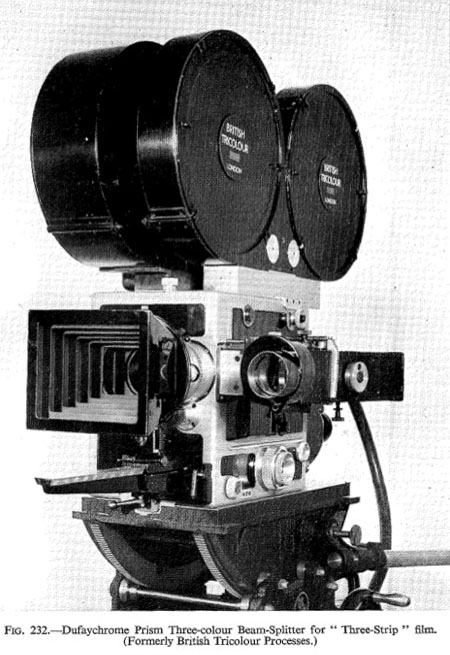
19 Images in 3 Galleries
In 1946 Kodachrome Commercial camera film Type 5268 was introduced. This stock had a lower-contrast emulsion and became leading in the professional field until it was replaced by Ektachrome Commercial type 7255 in 1958. Both Commercial Kodachrome and ...
“The Konicolor system, introduced by Konishiroku Shashin Kogyo (Now Konica Minolta Holdings, Inc.), split the image into three colors and shot them separately onto three b&w films. In that sense it had something in common with the US ‘Technicolor system’, but this was not a contact print with color dye to create positive film, but used coated emulsion to develop each color in a triple process, which is peculiar. […].”
“Kodak Dye Transfer materials were introduced by Eastman Kodak Company in February 1946 and replaced Eastman Wash-Off Relief. Principal improvements over the previous material included a simplified registration procedure, more rapidly ...
-
![]() Pénichon, Sylvie (2013): Twentieth Century Colour Photographs. The Complete Guide to Processes, Identification & Preservation. London, Los Angeles: Thames & Hudson, p. 148.

1 Image
-
![]() Credit: Cinémathèque française, conservatoire des techniques, Paris. Film: Test for Jour de Fête.
- Principle of capturing and projecting lenticular film. Credit: Joakim Reuteler and Rudolf Gschwind, Digital Humanities Lab, University of Basel, Switzerland. Illustration by Sarah Steinbacher, Multimedia & E-Learning-Services, University of Zurich.
- Principle of capturing and projecting lenticular film. Credit: Joakim Reuteler and Rudolf Gschwind, Digital Humanities Lab, University of Basel, Switzerland. Illustration by Sarah Steinbacher, Multimedia & E-Learning-Services, University of Zurich.

3 Images
“By the 1940s, most of the two-colour subtractive processes, apart from Cinecolor, were obsolete. The widespread use of the high-quality Technicolor process showed up the serious deficiencies in the simpler methods. The only significant new ...
-
![]() Technichrome, three-color print of bi-pack negatives, 1948. Credit: Gert Koshofer Collection. Sample No. 89. Photograph by Barbara Flueckiger

4 Images in 1 Gallery
-
![]() Credit: Illustration by Sarah Steinbacher, Multimedia & E-Learning-Services, University of Zurich. Source: Cornwell-Clyne, Adrian (1951): Colour Cinematography. London: Chapman & Hall.
- Source: Cornwell-Clyne, Adrian (1951): Colour Cinematography. London: Chapman & Hall.
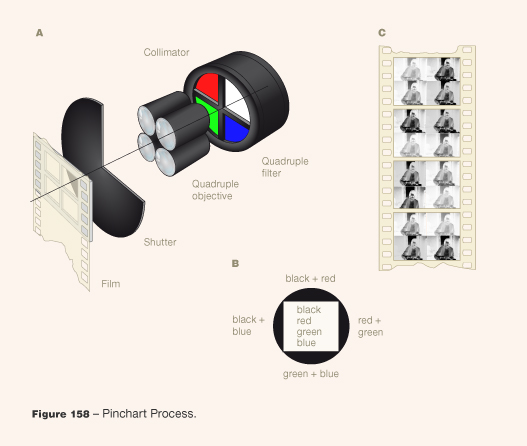
2 Images
-
![]() Rouxcolor, four-color, black and white negative and positive, ca. 1948. Credit: Gert Koshofer Collection. Sample No. 83. Photograph by Barbara Flueckiger
- Credit: Cinémathèque française, conservatoire des techniques, Paris.

7 Images in 1 Gallery
-
![]() No masking in the negative. Credit: Collection Gert Koshofer, Bergisch Gladbach (Germany).
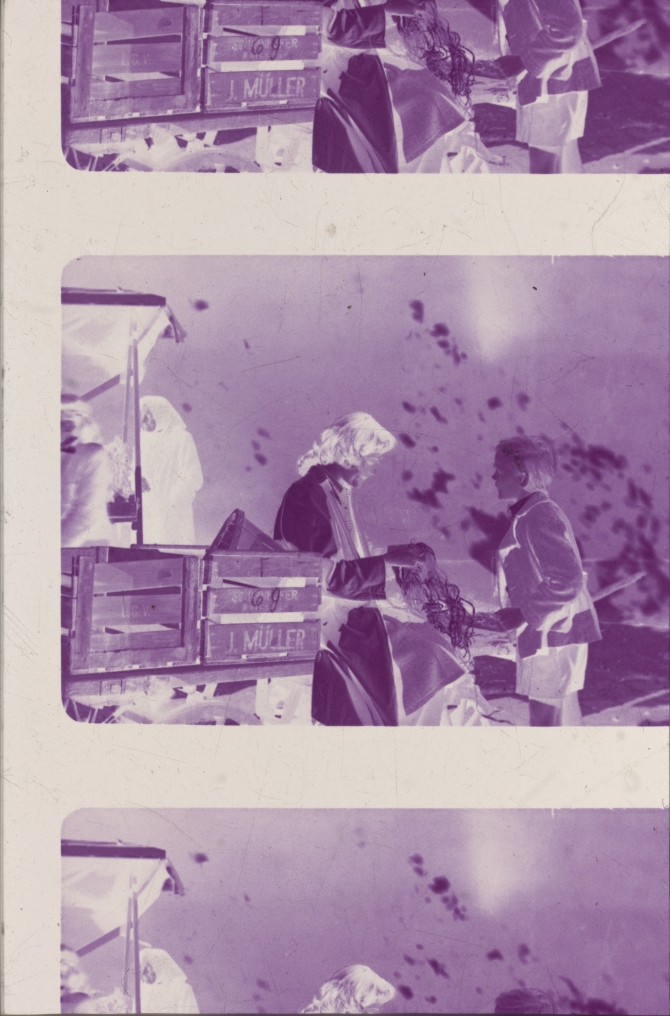
4 Images in 1 Gallery
See Ansco Colorpak / Ansco Color, type 735, Ansco Color Release Film, type 732 and Ansco Color Duplicating Film, type 132.
“The Fujicolor process is a three-color subtractive negative/positive process introduced in 1955 by the Fuji Photo Film Co., Ltd., Tokyo, Japan.
When the process was introduced it consisted of two elements that could be used singly or together. ...
-
![]() Don't Look Now (GBR / ITA 1973, Nicolas Roeg). Credit: BFI National Film Archive. Photographs of the faded Fujicolor HP Positive Film Type 8813 by Joëlle Kost, ERC Advanced Grant FilmColors.

141 Images in 7 Galleries
-
![]() Credit: Illustration by Sarah Steinbacher, Multimedia & E-Learning-Services, University of Zurich. Source: Ryan, Roderick T. (1977): A History of Motion Picture Color Technology. London: Focal Press.
- Source: Ryan, Roderick T. (1977): A History of Motion Picture Color Technology. London: Focal Press.
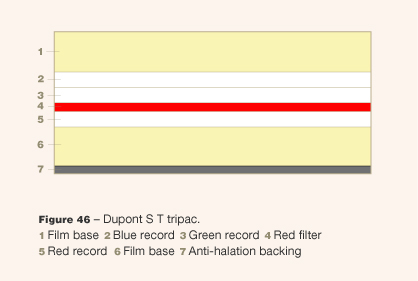
2 Images
-
![]() Magic Fire (USA 1955, William Dieterle), item no. DIF 2.04.35.14. Credit: Deutsches Filminstitut DIF. Photograph of the safety print by Barbara Flueckiger.

30 Images in 1 Gallery
-
![]() Credit: Illustration by Sarah Steinbacher, Multimedia & E-Learning-Services, University of Zurich. Source: Ryan, Roderick T. (1977): A History of Motion Picture Color Technology. London: Focal Press.
- Source: Ryan, Roderick T. (1977): A History of Motion Picture Color Technology. London: Focal Press.
- Source: Sease, V. B. (1949): DuPont's New Color Film. In:American Cinematographer, 30: 240, 257-258.
- Credit: Illustration by Sarah Steinbacher, Multimedia & E-Learning-Services, University of Zurich. Source: Sease, V. B. (1949): DuPont's New Color Film. In:American Cinematographer, 30: 240, 257-258.
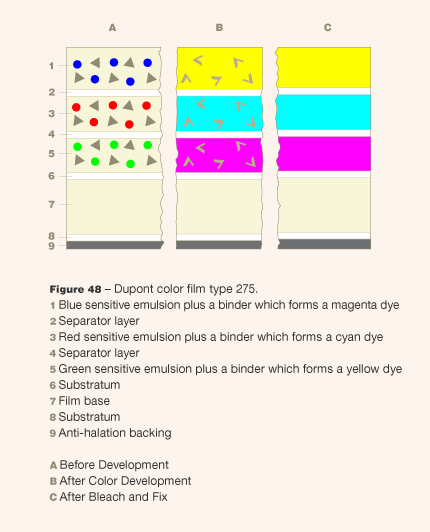
8 Images in 1 Gallery
-
![]() Faded Ferraniacolor positive from Eastmancolor negative, anamorphic (1:2,35). Credit: Národní filmový archiv / National Film Archive, Prague. Film: Smrt v sedle (Jindřich Polák, Czechoslovakia 1958).
- Faded Ferraniacolor positive from Eastmancolor negative, anamorphic (1:2,35). Credit: Národní filmový archiv / National Film Archive, Prague. Film: Smrt v sedle (Jindřich Polák, Czechoslovakia 1958).
- Faded Ferraniacolor positive from Eastmancolor negative, anamorphic (1:2,35). Credit: Národní filmový archiv / National Film Archive, Prague. Film: Smrt v sedle (Jindřich Polák, Czechoslovakia 1958).
- Faded Ferraniacolor positive from Eastmancolor negative, anamorphic (1:2,35). Credit: Národní filmový archiv / National Film Archive, Prague. Film: Smrt v sedle (Jindřich Polák, Czechoslovakia 1958).
- Faded Ferraniacolor positive from Eastmancolor negative, anamorphic (1:2,35). Credit: Národní filmový archiv / National Film Archive, Prague. Film: Smrt v sedle (Jindřich Polák, Czechoslovakia 1958).
- Faded Ferraniacolor positive from Eastmancolor negative, anamorphic (1:2,35). Credit: Národní filmový archiv / National Film Archive, Prague. Film: Smrt v sedle (Jindřich Polák, Czechoslovakia 1958).
- Faded Ferraniacolor positive from Eastmancolor negative, anamorphic (1:2,35). Credit: Národní filmový archiv / National Film Archive, Prague. Film: Smrt v sedle (Jindřich Polák, Czechoslovakia 1958).

217 Images in 8 Galleries
 Timeline of Historical Film Colors by Barbara Flueckiger is licensed under a Creative Commons Attribution-NonCommercial-NoDerivatives 4.0 International License.
Quote as Flueckiger, Barbara (2012 ff.): Timeline of Historical Film Colors. (= https://filmcolors.org/).
Download BibTex