
- All Categories
- Bibliography
- Chromogenic monopack
- Chromolytic multilayer
- Color separation
- Double-coated / bi-pack
- Edge Codes and Identification
- Hand coloring
- Other
- Printing / dye-transfer
- Printing / pigment process
- Screen processes
- Spatial synthesis (multiple lenses, beam splitter)
- Stencil coloring (pochoir, Pathécolor)
- Temporal synthesis (rotary filters)
- Theory
- Tinting
- Toning
-
![]() Credit: Cinémathèque française, conservatoire des techniques, Paris. Film: Test for Jour de Fête.
Credit: Cinémathèque française, conservatoire des techniques, Paris. Film: Test for Jour de Fête.
- Principle of capturing and projecting lenticular film. Credit: Joakim Reuteler and Rudolf Gschwind, Digital Humanities Lab, University of Basel, Switzerland. Illustration by Sarah Steinbacher, Multimedia & E-Learning-Services, University of Zurich.
- Principle of capturing and projecting lenticular film. Credit: Joakim Reuteler and Rudolf Gschwind, Digital Humanities Lab, University of Basel, Switzerland. Illustration by Sarah Steinbacher, Multimedia & E-Learning-Services, University of Zurich.

3 Images
-
![]() Source: Klein, Adrian Bernhard (Cornwell-Clyne) (1940): Colour Cinematography. Boston: American Photographic Pub. Co.
Source: Klein, Adrian Bernhard (Cornwell-Clyne) (1940): Colour Cinematography. Boston: American Photographic Pub. Co.
- Source: Klein, Adrian Bernhard (Cornwell-Clyne) (1940): Colour Cinematography. Boston: American Photographic Pub. Co.
- Source: Coe, Brian (1981): The History of Movie Photography. Westfield, N.J.: Eastview Editions.
- Schmidt, Richard / Kochs, Adolf (1943): Farbfilmtechnik. Eine Einführung für Filmschaffende. Berlin: Hesse, pp. 54-72. (Schriftenreihe der Reichsfilmkammer, 10.) (in German) [quote id='5']
- Schmidt, Richard / Kochs, Adolf (1943): Farbfilmtechnik. Eine Einführung für Filmschaffende. Berlin: Hesse, pp. 54-72. (Schriftenreihe der Reichsfilmkammer, 10.) (in German) [quote id='5']

9 Images in 1 Gallery
-
![]() Source: Klein, Adrian Bernhard (Cornwell-Clyne) (1940): Colour Cinematography. Boston: American Photographic Pub. Co.
Source: Klein, Adrian Bernhard (Cornwell-Clyne) (1940): Colour Cinematography. Boston: American Photographic Pub. Co.
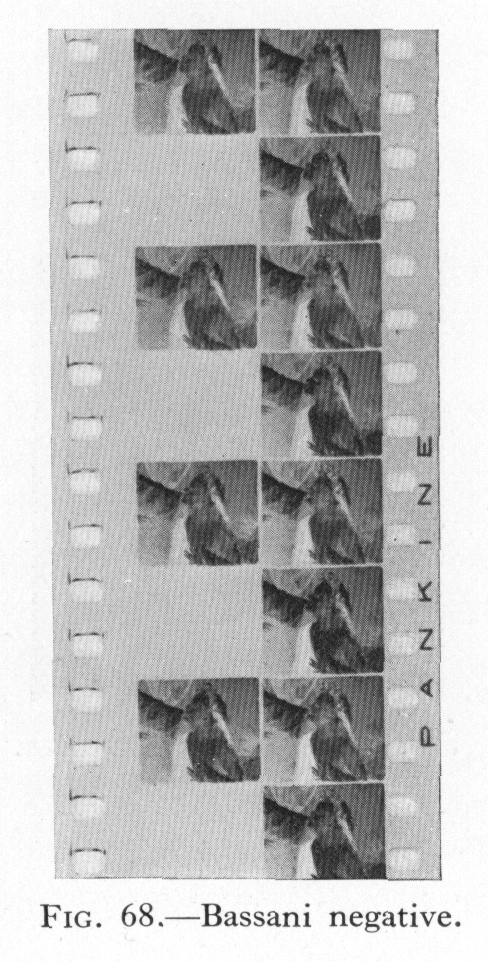
3 Images in 1 Gallery
-
![]() Strange Birds (US 1930, Mack Sennett). Credit: Library of Congress. Photograph of the nitrate print: Barbara Flueckiger
Strange Birds (US 1930, Mack Sennett). Credit: Library of Congress. Photograph of the nitrate print: Barbara Flueckiger
- Magnification. Credit: Geo. Willeman, Nitrate Film Vault Manager, Library of Congress. Film: Strange Birds (1930)

18 Images in 1 Gallery
-
![]() Linear filter structure in Polavision instant Super8 film. The filter lines are running along the film strip. According to the image placement of the Super-8 motion picture standard the image is divided vertically into triplets of R, G and B filter lines. The emulsion layer has been removed before this image was taken.
Credit: David Pfluger, ERC Advanced Grant FilmColors. Imaging was performed with support of the Center for Microscopy and Image Analysis, University of Zurich.
Linear filter structure in Polavision instant Super8 film. The filter lines are running along the film strip. According to the image placement of the Super-8 motion picture standard the image is divided vertically into triplets of R, G and B filter lines. The emulsion layer has been removed before this image was taken.
Credit: David Pfluger, ERC Advanced Grant FilmColors. Imaging was performed with support of the Center for Microscopy and Image Analysis, University of Zurich.
- Linear filter structure in Polavision instant Super8 film with an emulsion layer of a high photographic density. With the focus set on the emulsion the linear structure of the coloured filters is not visible in this image. Credit: David Pfluger, ERC Advanced Grant FilmColors. Imaging was performed with support of the Center for Microscopy and Image Analysis, University of Zurich.
- Comparision of the linear filter structure of Polachrome 35mm instant slide film and Polavision Super-8 motion picture film. While the technical concept behind the two film stocks is the same, the Super-8 film was produced with linear filters of a smaller width. Based on the given width of an RGB filter triplet and the 135 still image size there are about 920 horizontal RGB-triplets per image for a Polachrome slide. The Super-8 film image is rotated by 90° compared to the 135 film still image and has about 340 vertical RGB-triplets per frame. The positioning of the image content compared to the filter lines is indicated in the picture. Credit: David Pfluger, ERC Advanced Grant FilmColors. Imaging was performed with support of the Center for Microscopy and Image Analysis, University of Zurich.
- Excerpt of a Polavision Super-8 home movie scanned on a Kinetta scanner in 4.8K resolution edge to edge. In post production a zoom in and out was applied to show the linear filter structure of Polavision film in motion. The zoom was based on image detail from the scan. No upres procedure was applied. Credit: Scanning and editing by Martin Weiss.
- A comparison of the colour filter structures of Dufaycolor, Autochrome and Polavision from Anonymous (1978): Ma il Polavision e' un'altra cosa!. Phototest Italiana, 41, Oct., pp 72–77.
- A comparison of the colour filter structures of Dufaycolor, Autochrome and Polavision from Anonymous (1978): Ma il Polavision e' un'altra cosa!. Phototest Italiana, 41, Oct., pp 72–77. Translation: David Pfluger and Giorgio Trumpy.
- The process of exposure and development of Polavision instant Super-8 film. From Anonymous (1978): Ma il Polavision e' un'altra cosa!. Phototest Italiana, 41, Oct., p. 74.
- The process of exposure and development of Polavision instant Super-8 film. From Anonymous (1978): Ma il Polavision e' un'altra cosa!. Phototest Italiana, 41, Oct., p. 74. Translation: David Pfluger and Giorgio Trumpy.
- "Polavision (top) vs. Kodachrome 40: These are blowups from closely matching frames of Debra Goldie, filmed simultaneously with a Polavision and a conventional super 8 camera, side by side, with the Twi Light quartz lamp mounted on top of the former. Subject distance was 6 ft., but the super 8 camera was focused for 10 ft. – same as the Polavision camera at its close-up setting. Both Polavision and Kodachrome 40 are closely equal in speed, but differ distinctly in structure, faithfulness of color rendition, and latitude, as is obvious from these frame reproductions. What can't be seen is the relative opacity of Polavision: according to our measurement, it transmits less than 9 percent as Kodachrome 40. However, the lab that made the duplicate transparency blow-ups of the frames found that it had to give a full six stops extra exposure." (Leavitt, Don; Drukker Leendert (1978): First Look: Polavision instant movies. In: Popular Photography, Feb., p. 68.)
- "C'est devant un immense agrandissement de l'intérieur d'une cassette Polavision sur la-quelle se découpe la silhouette de l'orateur (ci-contre à gauche) que le Dr Land présenta son invention. Ce document permet de distinguer les poulies de guidage du film (1 et 2), la réserve de produit de traitement et son bec ré-partiteur (3), la bobine débitrice (4), l'ensemble formé par le presseur de film et le prisme (5), la poulie d'entraînement du film (6)." "It was in front of a huge enlargement of the interior of a Polavision cassette on which the silhouette of the speaker was cut out (opposite left) that Dr Land presented his invention. This document makes it possible to distinguish the guide pulleys of the film (1 and 2), the supply of treatment product and its distribution nozzle (3), the supply reel (4), the assembly formed by the presser of film and the prism (5), the film drive pulley (6)." (Anonymous (1977): Naissance du cinéma instantané. In: L'auto-journal, Rubrique realisée sous la direction de Pierre Marais, 12, Jul., pp. 94–95.)
- The production of the Filter structure on Polavision film includes the use of a lenticular surface, which is removed after the process. The lenticules are not involved in recording the color information during the taking of images in the camera. Figure 10 and Figure 11 from: Land, Edwin H. (1997): An Introduction to Polavision. In: Photographic Science and Engineering, 21,5, Sept., Oct., pp. 228–236, on p. 228.
- Comparison of thickness of the image carrying layer in a Kodak fine grain positive and Polavision film. Figure 24 from: Land, Edwin H. (1997): An Introduction to Polavision. In: Photographic Science and Engineering, 21,5, Sept., Oct., pp. 228–236, on p. 235.
- In the Polavision instant color film process the negative image recorded during the exposure of the film is neither developed from a latent image to a visible negative nor is it removed from the film. The latent negative stays as a layer in the film and is responsible for a slight attenuation of the image’s highlights. Figure 25 from: Land, Edwin H. (1997): An Introduction to Polavision. In: Photographic Science and Engineering, 21,5, Sept., Oct., pp. 228–236, on p. 236.
- Single frame of a Polavision home movie scanned in 3.5K resolution.

14 Images
-
![]() Linear filter structure in Polachrome 35mm instant slide film. The blue filter strips are slightly larger compared to the red and green filters. The filter lines are running along the film strip. According to the image placement of the 135 film format for still photography the image is divided horizontally into triplets of R, G and B filter lines.
The emulsion layer has been removed before the image was taken.
Credit: David Pfluger, ERC Advanced Grant FilmColors. Imaging was performed with support of the Center for Microscopy and Image Analysis, University of Zurich.
Linear filter structure in Polachrome 35mm instant slide film. The blue filter strips are slightly larger compared to the red and green filters. The filter lines are running along the film strip. According to the image placement of the 135 film format for still photography the image is divided horizontally into triplets of R, G and B filter lines.
The emulsion layer has been removed before the image was taken.
Credit: David Pfluger, ERC Advanced Grant FilmColors. Imaging was performed with support of the Center for Microscopy and Image Analysis, University of Zurich.
- Linear filter structure in Polachrome 35mm instant slide film with a emulsion layer of low photographic density. Credit: David Pfluger, ERC Advanced Grant FilmColors. Imaging was performed with support of the Center for Microscopy and Image Analysis, University of Zurich.
- Comparision of the linear filter structure of Polachrome 35mm instant slide film and Polavision Super-8 motion picture film. While the technical concept behind the two film stocks is the same, the Super-8 film was produced with linear filters of a smaller width. Based on the given width of an RGB filter triplet and the 135 still image size there are about 920 horizontal RGB-triplets per image for a Polachrome slide. The Super-8 film image is rotated by 90° compared to the 135 film still image and has about 340 vertical RGB-triplets per frame. The positioning of the image content compared to the filter lines is indicated in the picture. Credit: David Pfluger, ERC Advanced Grant FilmColors. Imaging was performed with support of the Center for Microscopy and Image Analysis, University of Zurich.

4 Images in 1 Gallery
-
![]() Credit: Geo. Willeman, Nitrate Film Vault Manager, Library of Congress. Film: The Sweetest Story.
Credit: Geo. Willeman, Nitrate Film Vault Manager, Library of Congress. Film: The Sweetest Story.
- Credit: Geo. Willeman, Nitrate Film Vault Manager, Library of Congress. Film: The Gift of Montezuma.
- Credit: Geo. Willeman, Nitrate Film Vault Manager, Library of Congress. Film: The Gift of Montezuma.
- Credit: Geo. Willeman, Nitrate Film Vault Manager, Library of Congress. Film: The Gift of Montezuma.
- Credit: Geo. Willeman, Nitrate Film Vault Manager, Library of Congress. Film: The Gift of Montezuma.
- Credit: Geo. Willeman, Nitrate Film Vault Manager, Library of Congress. Film: The Gift of Montezuma.
- Credit: Geo. Willeman, Nitrate Film Vault Manager, Library of Congress. Film: The Gift of Montezuma.
- Credit: Geo. Willeman, Nitrate Film Vault Manager, Library of Congress. Film: The Gift of Montezuma.
- Credit: Geo. Willeman, Nitrate Film Vault Manager, Library of Congress. Film: The Gift of Montezuma.
- Credit: Geo. Willeman, Nitrate Film Vault Manager, Library of Congress. Film: The Gift of Montezuma.
- Credit: Geo. Willeman, Nitrate Film Vault Manager, Library of Congress. Film: The Gift of Montezuma.
- Credit: Geo. Willeman, Nitrate Film Vault Manager, Library of Congress. Film: The Gift of Montezuma.
- Credit: Geo. Willeman, Nitrate Film Vault Manager, Library of Congress. Film: The Gift of Montezuma.
- Credit: Geo. Willeman, Nitrate Film Vault Manager, Library of Congress. Film: The Gift of Montezuma.
- Credit: Geo. Willeman, Nitrate Film Vault Manager, Library of Congress. Film: The Gift of Montezuma.
- Credit: Geo. Willeman, Nitrate Film Vault Manager, Library of Congress. Film: The Gift of Montezuma.
- Credit: Geo. Willeman, Nitrate Film Vault Manager, Library of Congress. Film: The Gift of Montezuma.
- Credit: Geo. Willeman, Nitrate Film Vault Manager, Library of Congress. Film: The Gift of Montezuma.
- Credit: Geo. Willeman, Nitrate Film Vault Manager, Library of Congress. Film: The Gift of Montezuma.
- Credit: Geo. Willeman, Nitrate Film Vault Manager, Library of Congress. Film: The Gift of Montezuma.
- Credit: Geo. Willeman, Nitrate Film Vault Manager, Library of Congress. Film: The Gift of Montezuma.
- Credit: Geo. Willeman, Nitrate Film Vault Manager, Library of Congress. Film: The Gift of Montezuma.
- Credit: Geo. Willeman, Nitrate Film Vault Manager, Library of Congress. Film: The Gift of Montezuma.
- Credit: Geo. Willeman, Nitrate Film Vault Manager, Library of Congress. Film: The Gift of Montezuma.
- Credit: Geo. Willeman, Nitrate Film Vault Manager, Library of Congress. Film: The Gift of Montezuma.
- Credit: Geo. Willeman, Nitrate Film Vault Manager, Library of Congress. Film: The Gift of Montezuma.
- Credit: Geo. Willeman, Nitrate Film Vault Manager, Library of Congress. Film: The Sweetest Story.
- Credit: Geo. Willeman, Nitrate Film Vault Manager, Library of Congress. Film: The Sweetest Story.
- Credit: Geo. Willeman, Nitrate Film Vault Manager, Library of Congress. Film: The Sweetest Story.
- Credit: Geo. Willeman, Nitrate Film Vault Manager, Library of Congress. Film: The Sweetest Story.
- Credit: Geo. Willeman, Nitrate Film Vault Manager, Library of Congress. Film: The Sweetest Story.
- Credit: Geo. Willeman, Nitrate Film Vault Manager, Library of Congress. Film: The Sweetest Story.
- Credit: Geo. Willeman, Nitrate Film Vault Manager, Library of Congress. Film: The Sweetest Story.
- Credit: Geo. Willeman, Nitrate Film Vault Manager, Library of Congress. Film: The Sweetest Story.
- Credit: Geo. Willeman, Nitrate Film Vault Manager, Library of Congress. Film: The Sweetest Story.
- Credit: Geo. Willeman, Nitrate Film Vault Manager, Library of Congress. Film: The Sweetest Story.
- Credit: Geo. Willeman, Nitrate Film Vault Manager, Library of Congress. Film: The Sweetest Story.
- Credit: Geo. Willeman, Nitrate Film Vault Manager, Library of Congress. Film: The Sweetest Story.
- Credit: Geo. Willeman, Nitrate Film Vault Manager, Library of Congress. Film: The Sweetest Story.
- Credit: Geo. Willeman, Nitrate Film Vault Manager, Library of Congress. Film: The Sweetest Story.
- Credit: Geo. Willeman, Nitrate Film Vault Manager, Library of Congress. Film: The Sweetest Story.
- Credit: Geo. Willeman, Nitrate Film Vault Manager, Library of Congress. Film: The Sweetest Story.

42 Images
-
![]() Casanova (FRA 1927, Alexandre Volkoff). Credit: Cinémathèque française. Photographs of the stencil colored safety print by Barbara Flueckiger.
Casanova (FRA 1927, Alexandre Volkoff). Credit: Cinémathèque française. Photographs of the stencil colored safety print by Barbara Flueckiger.
-
Print no. 1 of Amour d'esclave (FRA 1907, Albert Capellani). Credit: Library of Congress. Photograph of the nitrate film print by Barbara Flueckiger.
Edge mark: Pathé (April 1907-1909), on one edge, PATHÉ FRÈRES and on the other, 14 RUE FAVART PARIS (partially visible). Cf. Ill.PM.4: Brown, Harold (1990): Physical Characteristics of Early Films as Aids to Identification. Brussels: FIAF, on p. 9.
- Credit: Cinémathèque française, conservatoire des techniques, Paris.
- Source: Coe, Brian (1981): The History of Movie Photography. Westfield, N.J.: Eastview Editions.
-
Credit: Geo. Willeman, Nitrate Film Vault Manager, Library of Congress. Film: Amour d'esclave (France 1907).
Edge mark: PATHÉ FRÈRES PARIS (without gap, 1906-1907, partially visible). Cf.: Ill.PM.33: Brown, Harold (1990): Physical Characteristics of Early Films as Aids to Identification. Brussels: FIAF, on p. 9.
View Quote on Page: Edge Codes and Identification
Trade mark in scene: Pathé cockerel (until 1909). Cf.: Ill.TM.5: Brown 1990: on p. 30.
- Tinting in combination with stencil coloring. Credit: Turconi Collection by courtesy of George Eastman House Motion Picture Department Collection. Film: L'Exode (FRA 1910, Louis Feuillade)
- Credit: Turconi Collection by courtesy of George Eastman House Motion Picture Department Collection. Film: L'Exode (FRA 1910, Louis Feuillade)
-
Credit: Geo. Willeman, Nitrate Film Vault Manager, Library of Congress. Film: Le Pied de Mouton (ca. 1910).
Edge mark: Pathé (1909 onward), on one edge, PATHÉ FRÈRES 14 RUE FAVART PARIS and on the other, EXHIBITION INTERDITE EN FRANCE EN SUISSE ET EN BELGIQUE (partially visible). Cf.: Ill.PM.5: Brown, Harold (1990): Physical Characteristics of Early Films as Aids to Identification. Brussels: FIAF, on p. 9.
- Credit: Geo. Willeman, Nitrate Film Vault Manager, Library of Congress. Film: The Golden Beetle (1907).
- Credit: Geo. Willeman, Nitrate Film Vault Manager, Library of Congress. Film: Unknown film (ca. 1919).
- Credit: Cinémathèque française, conservatoire des techniques, Paris.
- Credit: Cineteca di Bologna.
- Source: Eggert, John (1932): Kurzer Überblick über den Stand der Farbenkinematographie. In: Bericht über den VIII. Internationalen Kongress für wissenschaftliche und angewandte Photographie, Dresden 1931, pp. 214-222. Leipzig: J. A. Barth.
- Credit: Turconi Collection by courtesy of George Eastman Museum, Motion Picture Department Collection. Film: Kinder-Karno in Nizza.
- Toplight and backlight, Swiss collector's copy. Source: Didiée, L. (1926): Le Film vierge Pathé. Manuel de développement et de tirage. Paris: Pathé.
- Backlight, Swiss collector's copy. Source: Didiée, L. (1926): Le Film vierge Pathé. Manuel de développement et de tirage. Paris: Pathé.
- Toplight and backlight, Swiss collector's copy. Source: Didiée, L. (1926): Le Film vierge Pathé. Manuel de développement et de tirage. Paris: Pathé.
- Toplight and backlight, Swiss collector's copy. Source: Didiée, L. (1926): Le Film vierge Pathé. Manuel de développement et de tirage. Paris: Pathé.
- Pathéorama. Toplight and backlight, Swiss collector's copy. Source: Didiée, L. (1926): Le Film vierge Pathé. Manuel de développement et de tirage. Paris: Pathé.
- Pathéorama. Backlight, Swiss collector's copy. Source: Didiée, L. (1926): Le Film vierge Pathé. Manuel de développement et de tirage. Paris: Pathé.
- Pathéorama. Credit: Clayton Scoble and Stephen Jennings, Harvard University, Fine Arts Library. Backlight. Source: Didiée, L. (1926): Le Film vierge Pathé. Manuel de développement et de tirage. Paris: Pathé.
- Credit: Clayton Scoble and Stephen Jennings, Harvard University, Fine Arts Library. Backlight. Source: Didiée, L. (1926): Le Film vierge Pathé. Manuel de développement et de tirage. Paris: Pathé.

2193 Images in 73 Galleries
-
![]() Iridescence on Multicolor print, reflection properties. Credit: Library of Congress. Photograph by Barbara Flueckiger
Iridescence on Multicolor print, reflection properties. Credit: Library of Congress. Photograph by Barbara Flueckiger
- Magnification 20x. Credit: photomicrograph by Silvana Konermann.
- Magnification 10x. Credit: photomicrograph by Silvana Konermann.
- Magnification 5x. Credit: photomicrograph by Silvana Konermann.
- Source: Eggert, John (1932): Kurzer Überblick über den Stand der Farbenkinematographie. Bericht über den VIII. Internationalen Kongress für wissenschaftliche und angewandte Photographie, Dresden 1931, pp. 214-222. Leipzig: J. A. Barth.
- Credit: Geo. Willeman, Nitrate Film Vault Manager, Library of Congress. Film: Fox Movietone Follies of 1929.
- Source: Coe, Brian (1981): The History of Movie Photography. Westfield, N.J.: Eastview Editions.
- Source: Cornwell-Clyne, Adrian (1951): Colour Cinematography. London: Chapman & Hall.
- Source: Cornwell-Clyne, Adrian (1951): Colour Cinematography. London: Chapman & Hall.
- Credit: Illustration by Sarah Steinbacher, Multimedia & E-Learning-Services, University of Zurich. Source: Cornwell-Clyne, Adrian (1951): Colour Cinematography. London: Chapman & Hall.
- Source: Eggert, John (1932): Kurzer Überblick über den Stand der Farbenkinematographie. Bericht über den VIII. Internationalen Kongress für wissenschaftliche und angewandte Photographie, Dresden 1931, pp. 214-222. Leipzig: J. A. Barth.
- Magnification of an area. Source: Eggert, John (1932): Kurzer Überblick über den Stand der Farbenkinematographie. Bericht über den VIII. Internationalen Kongress für wissenschaftliche und angewandte Photographie, Dresden 1931, pp. 214-222. Leipzig: J. A. Barth.
- Reflection properties. Source: Eggert, John (1932): Kurzer Überblick über den Stand der Farbenkinematographie. Bericht über den VIII. Internationalen Kongress für wissenschaftliche und angewandte Photographie, Dresden 1931, pp. 214-222. Leipzig: J. A. Barth.

72 Images in 6 Galleries
-
![]() Photograph by Martin Weiss, ERC Adanced Grant FilmColors.
Photograph by Martin Weiss, ERC Adanced Grant FilmColors.

1 Image
-
![]() Source: Pénichon, Sylvie (2013): Twentieth Century Colour Photographs. The Complete Guide to Processes, Identification & Preservation. London, Los Angeles: Thames & Hudson, p. 74.
Source: Pénichon, Sylvie (2013): Twentieth Century Colour Photographs. The Complete Guide to Processes, Identification & Preservation. London, Los Angeles: Thames & Hudson, p. 74.
- Source: Pénichon, Sylvie (2013): Twentieth Century Colour Photographs. The Complete Guide to Processes, Identification & Preservation. London, Los Angeles: Thames & Hudson, p. 44.

2 Images
-
![]() Principle of capturing and projecting lenticular film. Credit: Joakim Reuteler and Rudolf Gschwind, Digital Humanities Lab, University of Basel, Switzerland. Illustration by Sarah Steinbacher, Multimedia & E-Learning-Services, University of Zurich.
Principle of capturing and projecting lenticular film. Credit: Joakim Reuteler and Rudolf Gschwind, Digital Humanities Lab, University of Basel, Switzerland. Illustration by Sarah Steinbacher, Multimedia & E-Learning-Services, University of Zurich.

1 Image
-
![]() Agfacolor B original negative. Credit: Národní filmový archiv / National Film Archive, Prague. Film: Jan Roháč z Dubé (Czechoslovakia 1947, Vladimír Borsky).
Agfacolor B original negative. Credit: Národní filmový archiv / National Film Archive, Prague. Film: Jan Roháč z Dubé (Czechoslovakia 1947, Vladimír Borsky).
- Faded Agfacolor period nitrate print. Credit: Národní filmový archiv / National Film Archive, Prague. Film: Jan Roháč z Dubé (Czechoslovakia 1947, Vladimír Borský).
- Agfacolor B original negative. Credit: Národní filmový archiv / National Film Archive, Prague. Film: Jan Roháč z Dubé (Czechoslovakia 1947, Vladimír Borsky).
- Faded Agfacolor period nitrate print. Credit: Národní filmový archiv / National Film Archive, Prague. Film: Jan Roháč z Dubé (Czechoslovakia 1947, Vladimír Borský).
- Agfacolor B original negative. Credit: Národní filmový archiv / National Film Archive, Prague. Film: Jan Roháč z Dubé (Czechoslovakia 1947, Vladimír Borsky).
- Agfacolor B original negative. Credit: Národní filmový archiv / National Film Archive, Prague. Film: Kvítí z Čech (Czechoslovakia 1947, dir. Václav Jan Staněk).
- Agfacolor positive nitrate print. Credit: Národní filmový archiv / National Film Archive, Prague. Film: Kvítí z Čech (Czechoslovakia 1947, dir. Václav Jan Staněk).
- Agfacolor positive nitrate print. Credit: Národní filmový archiv / National Film Archive, Prague. Film: Kvítí z Čech (Czechoslovakia 1947, dir. Václav Jan Staněk).
- Agfacolor B original negative. Credit: Národní filmový archiv / National Film Archive, Prague. Film: Mistr třeboňský (Czechoslovakia 1950, dir. František Kudláč).
- Agfacolor B original negative. Credit: Národní filmový archiv / National Film Archive, Prague. Film: Mistr třeboňský (Czechoslovakia 1950, dir. František Kudláč).
- Agfacolor positive nitrate print. Credit: Národní filmový archiv / National Film Archive, Prague. Film: Mistr třeboňský (Czechoslovakia 1950, dir. František Kudláč).
- Agfacolor B original negative. Credit: Národní filmový archiv / National Film Archive, Prague. Film: Praha v říjnu (Czechoslovakia 1945, dir. František Sádek).
- Faded Agfacolor period nitrate print. Credit: Národní filmový archiv / National Film Archive, Prague. Film: Praha v říjnu (Czechoslovakia 1945, dir. František Sádek).
- Agfacolor B original negative. Credit: Národní filmový archiv / National Film Archive, Prague. Film: Praha v říjnu (Czechoslovakia 1945, dir. František Sádek).
- Agfacolor B original negative. Credit: Národní filmový archiv / National Film Archive, Prague. Film: Zasadil dědek řepu (Czechoslovakia 1945, dir. Jiří Trnka).
- Agfacolor positive nitrate print. Credit: Národní filmový archiv / National Film Archive, Prague. Film: Zasadil dědek řepu (Czechoslovakia 1945, Jiří Trnka).
- Agfacolor positive nitrate print. Credit: Národní filmový archiv / National Film Archive, Prague. Film: Zasadil dědek řepu (Czechoslovakia 1945, Jiří Trnka).
- Credit: By courtesy of Deutsche Kinemathek, Berlin. Photograph by Barbara Flueckiger. Film: 1/50 Sekunde, commercial for Niggemeyer Foto/Kino (1952).
- Schmidt, Richard / Kochs, Adolf (1943): Farbfilmtechnik. Eine Einführung für Filmschaffende. Berlin: Hesse, pp. 77-98. (Schriftenreihe der Reichsfilmkammer, 10.) (in German) [quote cite='35875']
- Schmidt, Richard / Kochs, Adolf (1943): Farbfilmtechnik. Eine Einführung für Filmschaffende. Berlin: Hesse, pp. 77-98. (Schriftenreihe der Reichsfilmkammer, 10.) (in German) [quote cite='35875']
- Schmidt, Richard / Kochs, Adolf (1943): Farbfilmtechnik. Eine Einführung für Filmschaffende. Berlin: Hesse, pp. 77-98. (Schriftenreihe der Reichsfilmkammer, 10.) (in German) [quote cite='35875']

21 Images
 Timeline of Historical Film Colors by Barbara Flueckiger is licensed under a Creative Commons Attribution-NonCommercial-NoDerivatives 4.0 International License.
Quote as Flueckiger, Barbara (2012 ff.): Timeline of Historical Film Colors. (= https://filmcolors.org/).
Download BibTex