
-
![]() Rouxcolor, four-color, black and white negative and positive, ca. 1948. Credit: Gert Koshofer Collection. Sample No. 83. Photograph by Barbara Flueckiger
Rouxcolor, four-color, black and white negative and positive, ca. 1948. Credit: Gert Koshofer Collection. Sample No. 83. Photograph by Barbara Flueckiger
- Credit: Cinémathèque française, conservatoire des techniques, Paris.
Category: Spatial synthesis (multiple lenses, beam splitter)▼×
- All Categories
- Bibliography
- Chromogenic monopack
- Chromolytic multilayer
- Color separation
- Double-coated / bi-pack
- Edge Codes and Identification
- Hand coloring
- Other
- Printing / dye-transfer
- Printing / pigment process
- Screen processes
- Stencil coloring (pochoir, Pathécolor)
- Temporal synthesis (rotary filters)
- Theory
- Tinting
- Toning

-
![]() Credit: Illustration by Sarah Steinbacher, Multimedia & E-Learning-Services, University of Zurich. Source: Cornwell-Clyne, Adrian (1951): Colour Cinematography. London: Chapman & Hall.
Credit: Illustration by Sarah Steinbacher, Multimedia & E-Learning-Services, University of Zurich. Source: Cornwell-Clyne, Adrian (1951): Colour Cinematography. London: Chapman & Hall.
- Source: Cornwell-Clyne, Adrian (1951): Colour Cinematography. London: Chapman & Hall.
2 Images
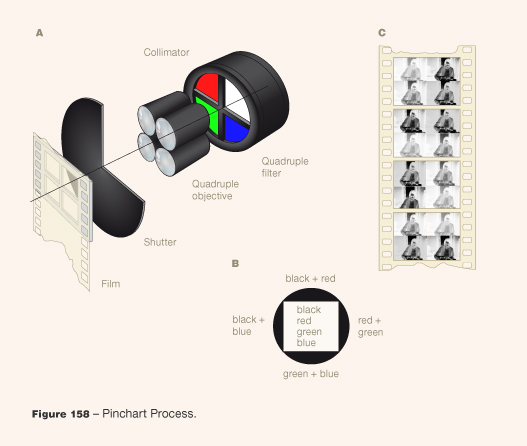
For this four-color process, the light beam was decomposed into four parts, each of which simultaneously exposed an area equal to one quarter of the 35mm frame of a black and white negative. This was obtained optically by placing a diaphragm and a ...
-
![]() Cross-section of the optical system displaying the different lenses, the prism and the four filters. Source: Pierotti, Federico (2016): Un'archeologia del colore nel cinema italiano. Dal Technicolor ad Antonioni. Pisa: Edizioni ETS, p. 71.
Cross-section of the optical system displaying the different lenses, the prism and the four filters. Source: Pierotti, Federico (2016): Un'archeologia del colore nel cinema italiano. Dal Technicolor ad Antonioni. Pisa: Edizioni ETS, p. 71.
- 35mm black and white film strip with four equal-sized images (left) and 16mm projector with Cristiani-Mascarini optical system. Source: Pierotti, Federico (2016): Un'archeologia del colore nel cinema italiano. Dal Technicolor ad Antonioni. Pisa: Edizioni ETS, p. 71.

2 Images
-
![]() Credit: Illustration by Sarah Steinbacher, Multimedia & E-Learning-Services, University of Zurich. Source: Ryan, Roderick T. (1977): A History of Motion Picture Color Technology. London: Focal Press.
Credit: Illustration by Sarah Steinbacher, Multimedia & E-Learning-Services, University of Zurich. Source: Ryan, Roderick T. (1977): A History of Motion Picture Color Technology. London: Focal Press.
- Source: Ryan, Roderick T. (1977): A History of Motion Picture Color Technology. London: Focal Press.
- Source: Kistler, L. R. (1945): The Projection of Thomascolor Motion Pictures. In: International Projectionist, 20,7, Jul., pp. 12–14.
- Source: Kistler, L. R. (1945): The Projection of Thomascolor Motion Pictures. In: International Projectionist, 20,7, Jul., pp. 12–14.
- Left: Thomascolor camera lens mount for converting standard motion picture camera into Thomascolor. Right: A closeup of the Thomascolor projector lens mount for standard film projectors. The inventor points out that this is all that is needed to convert a standard projector to Thomascolor. Source: Anonymous (1944): Thomascolor. Four-Color Process For Motion Pictures. In: International Projectionist, 19,10, Oct., pp. 7–9.

5 Images
The Roncarolo system required a camera capable of recording two panchromatic negatives (which became three or four in subsequent patents) through the use of a beam splitter and red and green filters.
The chromatic information registered on the two or ...
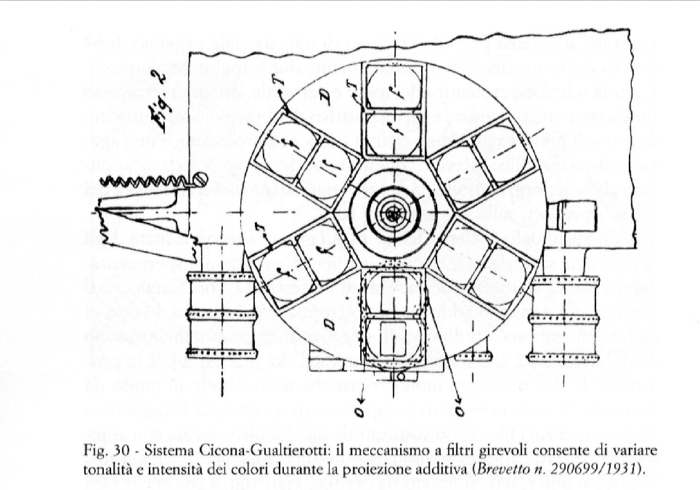
Unlike other additive systems invented in previous years, Gualtierotti tried to avoid the phenomenon of chromatic aberration inherent in the use of multiple lenses or the creation of successive separation records. The proposed solution was based on ...
-
![]() Rotating filters permitting to adjust tonality and intensity of the colors. Source: Pierotti, Federico (2016): Un'archeologia del colore nel cinema italiano. Dal Technicolor ad Antonioni. Pisa: Edizioni ETS, p. 62
Rotating filters permitting to adjust tonality and intensity of the colors. Source: Pierotti, Federico (2016): Un'archeologia del colore nel cinema italiano. Dal Technicolor ad Antonioni. Pisa: Edizioni ETS, p. 62
1 Image
“The process of J. Szczepanik in 1925 was impracticable. He used a non-intermittent camera having a chain of eighteen lenses moving together with the film behind a collimating lens, three pictures being simultaneously exposed.”
(Klein, ...
In this process, two positives, one orange-red one blue-green, were cemented together. Several specifications and modifications exist, for instance the strengthening of the perforated film margins via a second exposure, in an attempt to overcome wear ...
During the capturing of the film a beam-splitter in combination with filters in the camera divided the incoming light into a red and a green separation negative on black-and-white stock. When projected in the cinema the two images were combined simultaneously by additive mixture through corresponding red and green filters into one picture consisting of red and green colored light. The reduction of the whole color range to two colors (and their additive combinations) was necessary because of the complex optical arrangement.
-
![]() The beam-splitter prism. Source: Coote, Jack H. (1993): The Illustrated History of Colour Photography. Surbiton, Surrey: Fountain Press.
The beam-splitter prism. Source: Coote, Jack H. (1993): The Illustrated History of Colour Photography. Surbiton, Surrey: Fountain Press.

6 Images in 1 Gallery
“The first two-colour additive method in which the two components were taken and projected simultaneously was the Colcin process, in 1913. The result of a Franco-Japanese collaboration, it was demonstrated at the International Kinematographic ...
-
![]() Source: Coe, Brian (1981): The History of Movie Photography. Westfield, N.J.: Eastview Editions.
Source: Coe, Brian (1981): The History of Movie Photography. Westfield, N.J.: Eastview Editions.

1 Image
“The competition between Kinemacolor and other rival systems was partially stimulated by a Utopian faith in the potential of film technology to achieve ‘natural colour’, reality ‘as it is’ being the goal of the cinematic ...
-
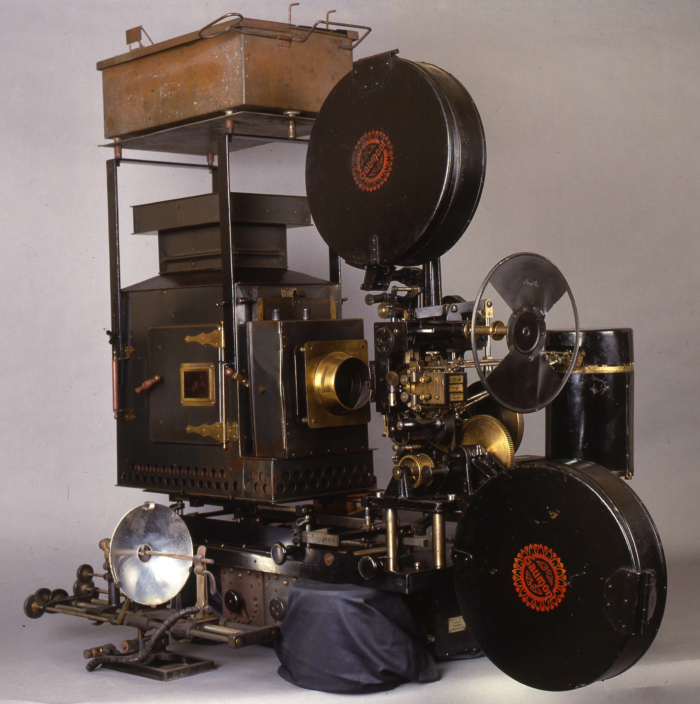
![]() Credit: Cinémathèque française, conservatoire des techniques, Paris.
Credit: Cinémathèque française, conservatoire des techniques, Paris.
- Source: Ede, François (1994): Jour de fête ou la couleur retrouvée. Cahiers du Cinéma: Paris.
- Credit: Paolo Cherchi Usai. Source: Cherchi Usai, Paolo (2000): Silent Cinema. London: BFI.
- Credit: Illustration by Sarah Steinbacher, Multimedia & E-Learning-Services, University of Zurich. Source: Ede, François (1994): Jour de fête ou la couleur retrouvée. Cahiers du Cinéma: Paris.
- Credit: Cinémathèque française, conservatoire des techniques, Paris.
- Source: Gaumont, Léon (1959): Gaumont Chronochrome Process Described by the Inventor. In: Raymond Fielding (ed.): A Technological History of Motion Pictures and Television. An Anthology from the Pages of The Journal of the Society of Motion Picture and Television Engineers. Berkeley; Los Angeles: University of California Press, 1967, pp. 65-67.
- Source: Gaumont, Léon (1959): Gaumont Chronochrome Process Described by the Inventor. In: Raymond Fielding (ed.): A Technological History of Motion Pictures and Television. An Anthology from the Pages of The Journal of the Society of Motion Picture and Television Engineers. Berkeley; Los Angeles: University of California Press, 1967, pp. 65-67.
12 Images in 2 Galleries
The process relied on two-, three- or even four-color selections being superimposed on the screen. On the positive, two, three or four images of reduced dimensions were printed on a single frame with a longitudinal and lateral distance corresponding ...
 Timeline of Historical Film Colors by Barbara Flueckiger is licensed under a Creative Commons Attribution-NonCommercial-NoDerivatives 4.0 International License.
Quote as Flueckiger, Barbara (2012 ff.): Timeline of Historical Film Colors. (= https://filmcolors.org/).
Download BibTex