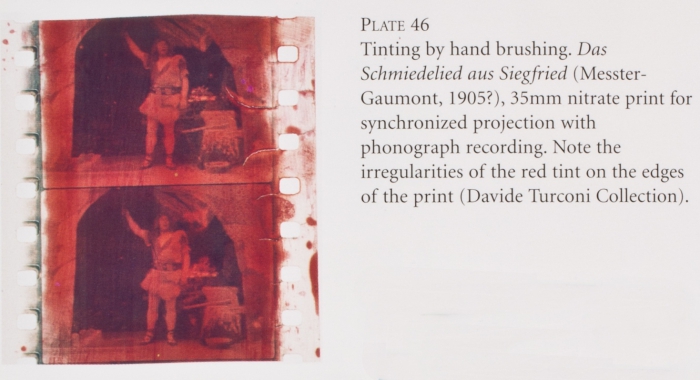
Very little information is available on this very rare process. Instead of immersion into a dye-bath the positive print was coated uniformly with a varnish. This technique can be identified by the lack on dyes in the perforation area and by the ...
-
![]() Credit: Paolo Cherchi Usai. Source: Cherchi Usai, Paolo (2000): Silent Cinema. London: BFI.
Credit: Paolo Cherchi Usai. Source: Cherchi Usai, Paolo (2000): Silent Cinema. London: BFI.