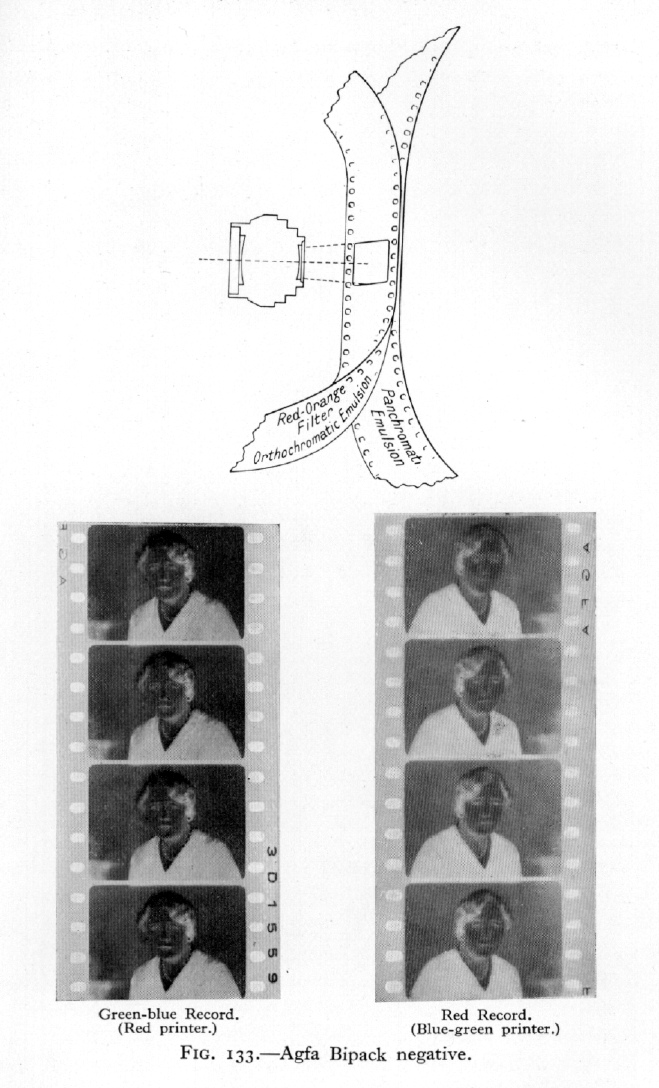
Subtractive 2 color: bi-pack, still photography and film
“A. Gurtner (Eng. P. 7924/03; U.S.P. 730454), used a front element that was sensitive only to the blue, and a rear element that was sensitive up to but not including the red. He was the first person to suggest that the two films or plates be ...
Principle of capturing and projecting lenticular film. Credit: Joakim Reuteler and Rudolf Gschwind, Digital Humanities Lab, University of Basel, Switzerland. Illustration by Sarah Steinbacher, Multimedia & E-Learning-Services, University of Zurich.
Credit: Illustration by Sarah Steinbacher, Multimedia & E-Learning-Services, University of Zurich. Source: Ede, François (1994): Jour de fête ou la couleur retrouvée. Cahiers du Cinéma: Paris.
Schmidt, Richard / Kochs, Adolf (1943): Farbfilmtechnik. Eine Einführung für Filmschaffende. Berlin: Hesse, pp. 54-72. (Schriftenreihe der Reichsfilmkammer, 10.) (in German) [quote id='6']
“R. Berthon patented the use of a lens diaphragm with three apertures, covered respectively with red, green and blue-violet filters, and a sensitive surface on a support, the other side of which was impressed with hemi-spherical, transparent, ...
Principle of capturing and projecting lenticular film. Credit: Joakim Reuteler and Rudolf Gschwind, Digital Humanities Lab, University of Basel, Switzerland. Illustration by Sarah Steinbacher, Multimedia & E-Learning-Services, University of Zurich.
Credit: Illustration by Sarah Steinbacher, Multimedia & E-Learning-Services, University of Zurich. Source: Ede, François (1994): Jour de fête ou la couleur retrouvée. Cahiers du Cinéma: Paris.
Principle of capturing and projecting lenticular film. Credit: Joakim Reuteler and Rudolf Gschwind, Digital Humanities Lab, University of Basel, Switzerland. Illustration by Sarah Steinbacher, Multimedia & E-Learning-Services, University of Zurich.
Source: Heymer, Gerd (1933): Auflösungsvermögen und Farbwiedergabe in der Farbrasterphotographie. In: Veröffentlichungen des wissenschaftlichen Zentral-Laboratoriums der photographischen Abteilung Agfa, 3, 1933, pp. 188-207.
Subtractive 3 color: pigment process, still photography
“Introduced in the mid-1930s by George Murphy, Inc., of New York City, Belcolor was considered one of the simplest ways to obtain color transparencies, as it required no special equipment or expert technique and could be used successfully ...
“Camera.—An interesting camera has been made by the Société Chromofilm, Paris. An astonishing mechanism moves the entire gate, and film within it, at each exposure, with reference to the normal fixed objective. Three miniature negatives are ...
Subtractive 3 color: dye destruction process, silver dye-bleach, still photography
“Between 1934 and 1941 Eastman Kodak developed a silver dye-bleach printing material called Azochrome. In 1941 it announced the launching of Azochrome but held back the product at the onset of World War II. After the war, the company decided to ...
Subtractive 3 color: pigment process, still photography
“Introduced by the Autotype Company in 1944, the Autotype Wet Carbon Process was a variant of the traditional carbon process with novelty wet-printing pigment papers. Considerable time was saved when printing with this material as the pigment ...
Subtractive 3 color: pigment process, still photography
“As in previous versions of the process, pigment papers were soaked in a sensitizing bath and then squeegeed firmly onto the surface of wet bromide prints to harden the pigmented gelatin in proportion to the amount of silver contained in the ...
Source: Pénichon, Sylvie (2013): Twentieth Century Colour Photographs. The Complete Guide to Processes, Identification & Preservation. London, Los Angeles: Thames & Hudson, p. 103.
Subtractive 3 color: dye imbibition process, still photography
“Introduced around the same time as Colorsnap and Uvatype, Autotype Dyebro combined the three-color carbro and dye imbibition processes. The method was invented by Owen Wheeler (1859–1932) and commercialized by the Autotype Company in about ...
Several attempts were made to apply the Autochrome process invented by the Lumière brothers to motion pictures.
Transparent potato starch grains with a diameter of 15–20 micrometer were colored in the additive primaries red, green and blue. The ...
Source: Eggert, John (1932): Kurzer Überblick über den Stand der Farbenkinematographie. Bericht über den VIII. Internationalen Kongress für wissenschaftliche und angewandte Photographie, Dresden 1931, pp. 214-222. Leipzig: J. A. Barth.
Cinécolor, mosaic screen, ca. 1929. Credit: Gert Koshofer Collection. Sample No. 68. Photograph by Barbara Flueckiger.
Credit: Cinémathèque française, conservatoire des techniques, Paris.
Magnification of an image area. Source: Eggert, John (1932): Kurzer Überblick über den Stand der Farbenkinematographie. Bericht über den VIII. Internationalen Kongress für wissenschaftliche und angewandte Photographie, Dresden 1931, pp. 214-222. Leipzig: J. A. Barth.
Source: Eggert, John (1932): Kurzer Überblick über den Stand der Farbenkinematographie. Bericht über den VIII. Internationalen Kongress für wissenschaftliche und angewandte Photographie, Dresden 1931, pp. 214-222. Leipzig: J. A. Barth.
Additive 3 color: mosaic screen, still photography and film
“The Autochrome process was the first fully practical single-plate colour process to reach the photographic public. It was easy to use. The plate was loaded into a conventional holder, glass to the front. The exposure was made through a yellow ...
Photomicrograph (50x) of an Autochrome mosaic screen. Credit: Courtesy of George Eastman House, International Museum of Photography and Film.
Source: Lavédrine, Bertrand (2009): Photographs of the Past. Process and Preservation. Los Angeles: Getty Publications.
Source: Coote, Jack H. (1993): The Illustrated History of Colour Photography. Surbiton, Surrey: Fountain Press.
Source: Holme, Charles (1908): Colour Photography, and Other Recent Developments of the Art of the Camera. London, Paris, New York.: Offices of The Studio.
Pénichon, Sylvie (2013): Twentieth Century Colour Photographs. The Complete Guide to Processes, Identification & Preservation. London, Los Angeles: Thames & Hudson, p. 70.
Pénichon, Sylvie (2013): Twentieth Century Colour Photographs. The Complete Guide to Processes, Identification & Preservation. London, Los Angeles: Thames & Hudson, p. 26.
Pénichon, Sylvie (2013): Twentieth Century Colour Photographs. The Complete Guide to Processes, Identification & Preservation. London, Los Angeles: Thames & Hudson, p. 65.
Pénichon, Sylvie (2013): Twentieth Century Colour Photographs. The Complete Guide to Processes, Identification & Preservation. London, Los Angeles: Thames & Hudson, p. 27.
Source: Pénichon, Sylvie (2013): Twentieth Century Colour Photographs. The Complete Guide to Processes, Identification & Preservation. London, Los Angeles: Thames & Hudson, p. 235.
Source: Pénichon, Sylvie (2013): Twentieth Century Colour Photographs. The Complete Guide to Processes, Identification & Preservation. London, Los Angeles: Thames & Hudson, p. 64.
“R. Berthon and M. Audibert patented a method of obtaining a virtual image by means of an anterior lens and prisms or mirrors. This idea was further improved upon in E.P. 17,023, 1913. In F.P. 458,040 Audibert proposed to use a negative front lens ...
Subtractive 4 color: pigment process, still photography
“In 1998 Racey Gilbert purchased Polaroid’s stock of pigment films and opened Ataraxia Studio in Bensalem, Pennsylvania, to make high-quality collectors’ carbon prints. Under the direction of Gérard Niemetzky, the studio produced ...
Source: Pénichon, Sylvie (2013): Twentieth Century Colour Photographs. The Complete Guide to Processes, Identification & Preservation. London, Los Angeles: Thames & Hudson, p. 98.
Subtractive 4 color: pigment process, still photography
“In the early 1980s photographers frustrated by the poor stability of dye coupling materials started to experiment with pigment processes. Among them was Charles Berger, a California-based fine art photographer who, in 1982, developed a modern ...
Pénichon, Sylvie (2013): Twentieth Century Colour Photographs. The Complete Guide to Processes, Identification & Preservation. London, Los Angeles: Thames & Hudson, p. 93.
Pénichon, Sylvie (2013): Twentieth Century Colour Photographs. The Complete Guide to Processes, Identification & Preservation. London, Los Angeles: Thames & Hudson, p. 94.
Cross section scheme of Anscochrome. Scource: Forrest; John L. (1955): Processing Anscochrome Motion-Picture Films for Industrial and Scientific Applications. In: Journal SMPTE, Vol. 64, Dec. 1955, p. 679.
Subtractive 3 color: dye coupling or chromogenic process, still photography and film
“Ansco Color Printon
In 1943 Ansco followed suit and launched a printing material on white-pigmented acetate base called Ansco Color Printon (Fig. 5.7). Initially, Printon was made accessible only to the military. After 1945 it became available to ...
Pénichon, Sylvie (2013): Twentieth Century Colour Photographs. The Complete Guide to Processes, Identification & Preservation. London, Los Angeles: Thames & Hudson, p. 167.
Pénichon, Sylvie (2013): Twentieth Century Colour Photographs. The Complete Guide to Processes, Identification & Preservation. London, Los Angeles: Thames & Hudson, p. 166.