Dufaycolor reversal

Additive 3 color: Line screen (réseau), 16 mm, reversal
(see detail page on Dufaycolor)

Spicer-Dufay

Additive 3 color: Line screen (réseau), 35 mm reversal
For a description of Spicer-Dufay see detail page on Dufaycolor)

78 Images in 2 Galleries

Dufaycolor

Additive 3 color: Line screen (réseau), 35 mm and 16 mm, reversal and negative-positive stock, still photography and film

Dufaycolor was a regular line screen process whereby the incident light was filtered through a pattern of tiny color patches created by lines in red, green and blue, the so called réseau.

231 Images in 9 Galleries

Condax-Dytrol

Subtractive 3 color: dye imbibition process, still photography
“Around 1940, Condax-Speck, Inc., of New York started to market dyes and mordant for the Condax-Dytrol system of dye imbibition printing (Fig. 4.19). The system, developed by company owners Louis M. Condax (1897–1971) and Robert P. Speck, ...

Kodak Dye Transfer

Subtractive 3 color: dye imbibition process, still photography
“Kodak Dye Transfer materials were introduced by Eastman Kodak Company in February 1946 and replaced Eastman Wash-Off Relief. Principal improvements over the previous material included a simplified registration procedure, more rapidly ...

1 Image

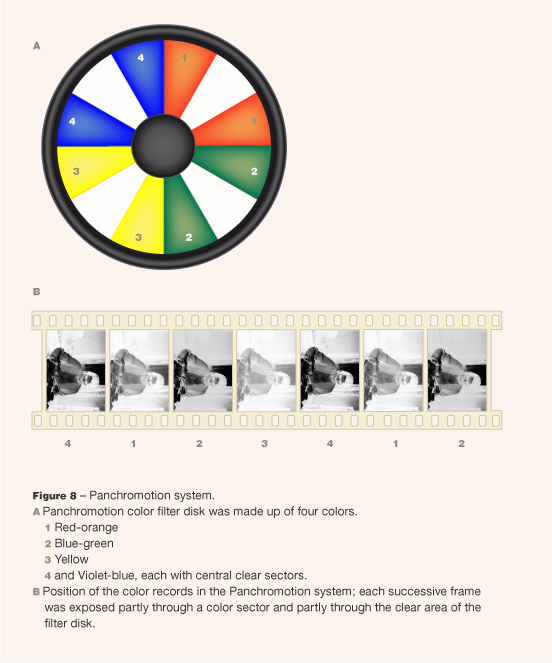
Procédé Tetrachrome

Additive four-color process: rotating filters
Based on four primary colors, the process successively recorded two simultaneous images for two primary colors each. In projection, the four images were combined on screen, supposedly via a regular projector.

Rouxcolor 2 color / Cineoptichrome

Additive 2 color: Beam-splitter

2 Images

Sirius

Subtractive 2 color: Beam-splitter, double-coated
“The Dutch Sirius Color process (1929) used a camera with a beamsplitting system behind the lens to expose a single film, the film passing through two gates at right angles to each other. The double-coated print film was dye-toned. The process ...

142 Images in 4 Galleries

Horst

Additive 3 color: Beam-splitter, 65 mm negative

4 Images in 1 Gallery

Sistema Cristiani-Mascarini

Additive four-color: beam splitter and filters, four images on 35mm black and white film.
For this four-color process, the light beam was decomposed into four parts, each of which simultaneously exposed an area equal to one quarter of the 35mm frame of a black and white negative. This was obtained optically by placing a diaphragm and a ...

2 Images

Lumière Alticolor

Additive 3 color: mosaic screen, combined system, still photography
“Lumière Alticolor (1952–1955): rolls and pack films on celluloid base. Alticolor starch grains are smaller but of less regular shape than those used in Filmcolor (Fig. 2.74). There are no black pigment particles; therefore, Alticolor ...

1 Image

Lumière Filmcolor

Additive 3 color: mosaic screen, combined system, still photography
“Lumière Filmcolor (1931–1953): sheet films (only) on celluloid base (Fig. 2.69). Individual colored grains cannot be seen with the naked eye, but clumps of grains of the same color give the image a pointillist effect. Filmcolor starch ...

1 Image

Lumière Lumicolor

Additive 3 color: mosaic screen, combined system, still photography
“Lumière Lumicolor (1933–1953): rolls and pack films on celluloid base. Individual colored grains cannot be seen with the naked eye, but clumps of grains of the same color give the image a pointillist effect (Fig. 2.71). Starch grains ...

1 Image

Audibert

Addtive 3 color: Beam-splitter, mosaic screen, 65 mm

3 Images

Harmonicolor

Subtractive 2 color: Bi-pack, double-coated
“Harmonicoior was developed by French chemist Maurice Combes. It was first formally demonstrated in London by Harmonicoior Films Ltd, of 4 Great Winchester Street, on the 23 March 1936 at the Curzon Soho with the film Talking Hands, produced at ...

Handschiegl / DeMille-Wyckoff / Wyckoff Process

Applied color: Imbibition
Similar to stenciling, the Handschiegl process was applied mechanically to manually defined image parts. Therefore it is an applied color process. After the film was shot and edited, for each color applied a separate print was made. In contrast to ...

142 Images in 8 Galleries

Panacolor

Subtractive 3 color: Color separation, multilayer print

11 Images in 1 Gallery

Russian two-color system

Subtractive two color

1 Image

Tinting by application of varnish

Applied colors: Tinting
Very little information is available on this very rare process. Instead of immersion into a dye-bath the positive print was coated uniformly with a varnish. This technique can be identified by the lack on dyes in the perforation area and by the ...

1 Image

Cosmocolor

Additive 2 color: Beam-splitter, double-coated

2 Images

Cinemacolor

Additive 2 color: Beam-splitter, sub-standard vertical

2 Images

Prism

Additive 3 color: Prism

1 Image

Autotype Dyebro

Subtractive 3 color: dye imbibition process, still photography
“Introduced around the same time as Colorsnap and Uvatype, Autotype Dyebro combined the three-color carbro and dye imbibition processes. The method was invented by Owen Wheeler (1859–1932) and commercialized by the Autotype Company in about ...

Russian three-color process

Subtractive three color

6 Images

Brewster

Subtractive 2 color: Perforated mirror as beam-splitter, duplitized film
“Following the premises of one of William Friese-Greene’s systems, this two-colour subtractive process required that two reels of film be printed in parallel through a lens fitted with a prism that split light in two directions, through red ...

Brewster

Subtractive 2 or 3 color: Perforated mirror as beam-splitter, duplitized film
“The Brewster Process. (U.S.P. 1,752,477. 1930-) Camera. – P. D. Brewster, an American inventor, who was one of the first to apply the bipack system to colour cinematography, has a number of patents to his credit covering various cameras and ...

52 Images in 1 Gallery

Talkicolor

Additive 2 color: Alternately stained
“Two-colour additive process Talkicolor was developed by Percy James Pearce along with Dr Anthony Bernardi who was also involved in the development of Raycol. The process was funded mainly by the author Elinor Glyn through her company Elinor ...

3 Images in 1 Gallery

Fresson Quadrichromy

Subtractive 4 color: pigment process, still photography
“In 1951, when pigment processes were falling into disfavor, Pierre Fresson (1904–1983) of Atelier Fresson developed Fresson Quadrichromy, a four-color printing method based on the monochrome direct carbon process (charbon-satin) that had ...

1 Image

Ulysse

Two, three or four color color additive process: multiple lenses
The process relied on two-, three- or even four-color selections being superimposed on the screen. On the positive, two, three or four images of reduced dimensions were printed on a single frame with a longitudinal and lateral distance corresponding ...

Polaroid integral films

Subtractive 3 color: dye diffusion process, still photography
“In 1972 Polaroid introduced an entirely new concept of instant photography with the film SX-70. With the new integral system, negative and receiving sheets were sealed into a single unit and all the reactive materials were present in the unit ...

1 Image