
Select Category▼×
- All Categories
- Bibliography
- Chromogenic monopack
- Chromolytic multilayer
- Color separation
- Double-coated / bi-pack
- Edge Codes and Identification
- Hand coloring
- Other
- Printing / dye-transfer
- Printing / pigment process
- Screen processes
- Spatial synthesis (multiple lenses, beam splitter)
- Stencil coloring (pochoir, Pathécolor)
- Temporal synthesis (rotary filters)
- Theory
- Tinting
- Toning
-
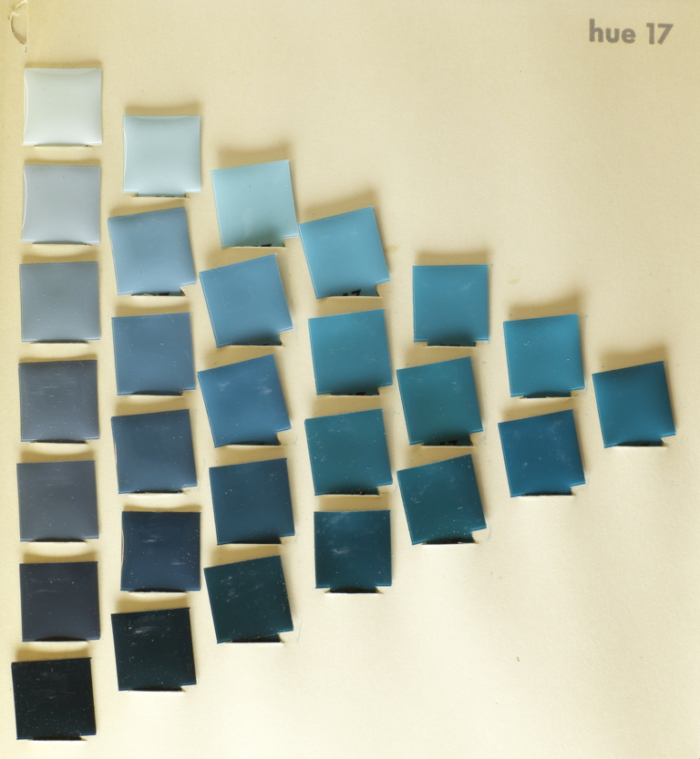
![]() Source: Jacobson, Egbert (1942): The Color Harmony Manual and How to Use It. Chicago: Color Laboratories Division, Container Corp. of America. Credit: Faber Birren Collection, Yale University. Photograph by Barbara Flueckiger.
Source: Jacobson, Egbert (1942): The Color Harmony Manual and How to Use It. Chicago: Color Laboratories Division, Container Corp. of America. Credit: Faber Birren Collection, Yale University. Photograph by Barbara Flueckiger.
1 Image

-
![]() Didone abbandonata (ITA 1910, Luigi Maggi).
Credit: Cineteca di Bologna.
Photographs of the tinted nitrate print by Barbara Flueckiger.
Didone abbandonata (ITA 1910, Luigi Maggi).
Credit: Cineteca di Bologna.
Photographs of the tinted nitrate print by Barbara Flueckiger.
Frame characteristics / features of margins: Ambrosio. Cf.: Brown, Harold (1990): Physical Characteristics of Early Films as Aids to Identification. Brussels: FIAF, on p. 24.

91 Images in 6 Galleries
 Timeline of Historical Film Colors by Barbara Flueckiger is licensed under a Creative Commons Attribution-NonCommercial-NoDerivatives 4.0 International License.
Quote as Flueckiger, Barbara (2012 ff.): Timeline of Historical Film Colors. (= https://filmcolors.org/).
Download BibTex