
Select Category▼×
- All Categories
- Bibliography
- Chromogenic monopack
- Chromolytic multilayer
- Color separation
- Double-coated / bi-pack
- Edge Codes and Identification
- Hand coloring
- Other
- Printing / dye-transfer
- Printing / pigment process
- Screen processes
- Spatial synthesis (multiple lenses, beam splitter)
- Stencil coloring (pochoir, Pathécolor)
- Temporal synthesis (rotary filters)
- Theory
- Tinting
- Toning
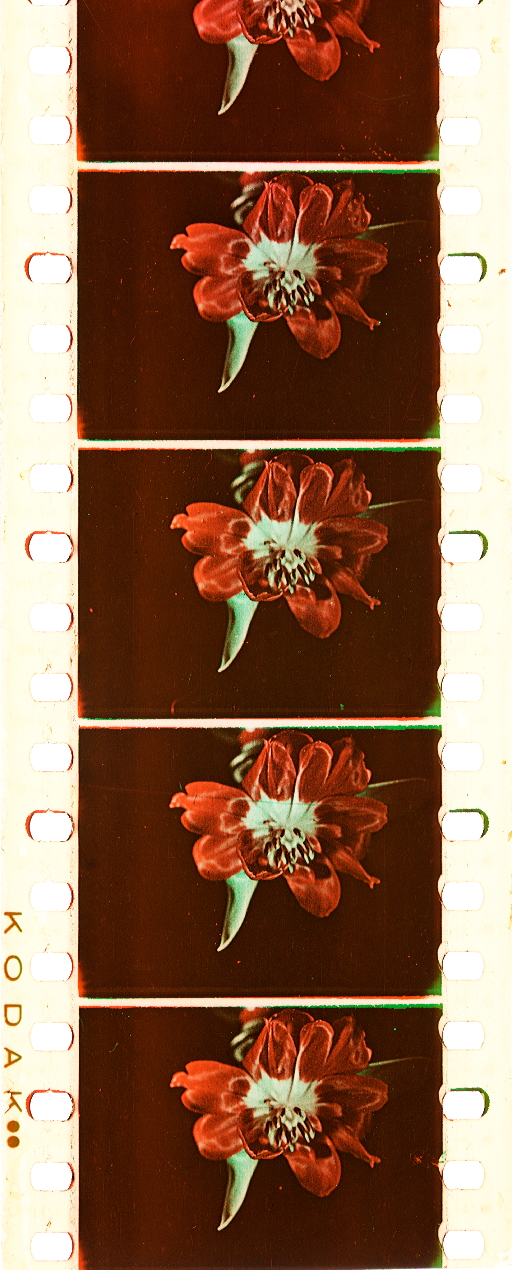
Photographs of unidentified color film technologies. Several different principles and times. Feel free to contact us if you can help identifying them!
-
![]() Unidentified Processes from the Kodak Film Samples Collection and the Cinematography Collection.
Credit: National Science and Media Museum Bradford.
Photographs by Barbara Flueckiger in collaboration with Noemi Daugaard, SNSF Film Colors.
Unidentified Processes from the Kodak Film Samples Collection and the Cinematography Collection.
Credit: National Science and Media Museum Bradford.
Photographs by Barbara Flueckiger in collaboration with Noemi Daugaard, SNSF Film Colors.
- Unidentified Processes from the Kodak Film Samples Collection and the Cinematography Collection. Credit: National Science and Media Museum Bradford. Photographs by Barbara Flueckiger in collaboration with Noemi Daugaard, SNSF Film Colors.
- Unidentified Processes from the Kodak Film Samples Collection and the Cinematography Collection. Credit: National Science and Media Museum Bradford. Photographs by Barbara Flueckiger in collaboration with Noemi Daugaard, SNSF Film Colors.
298 Images in 5 Galleries
 Timeline of Historical Film Colors by Barbara Flueckiger is licensed under a Creative Commons Attribution-NonCommercial-NoDerivatives 4.0 International License.
Quote as Flueckiger, Barbara (2012 ff.): Timeline of Historical Film Colors. (= https://filmcolors.org/).
Download BibTex