
Select Category▼×
- All Categories
- Bibliography
- Chromogenic monopack
- Chromolytic multilayer
- Color separation
- Double-coated / bi-pack
- Edge Codes and Identification
- Hand coloring
- Other
- Printing / dye-transfer
- Printing / pigment process
- Screen processes
- Spatial synthesis (multiple lenses, beam splitter)
- Stencil coloring (pochoir, Pathécolor)
- Temporal synthesis (rotary filters)
- Theory
- Tinting
- Toning
“The Konicolor system, introduced by Konishiroku Shashin Kogyo (Now Konica Minolta Holdings, Inc.), split the image into three colors and shot them separately onto three b&w films. In that sense it had something in common with the US ‘Technicolor system’, but this was not a contact print with color dye to create positive film, but used coated emulsion to develop each color in a triple process, which is peculiar. […].”
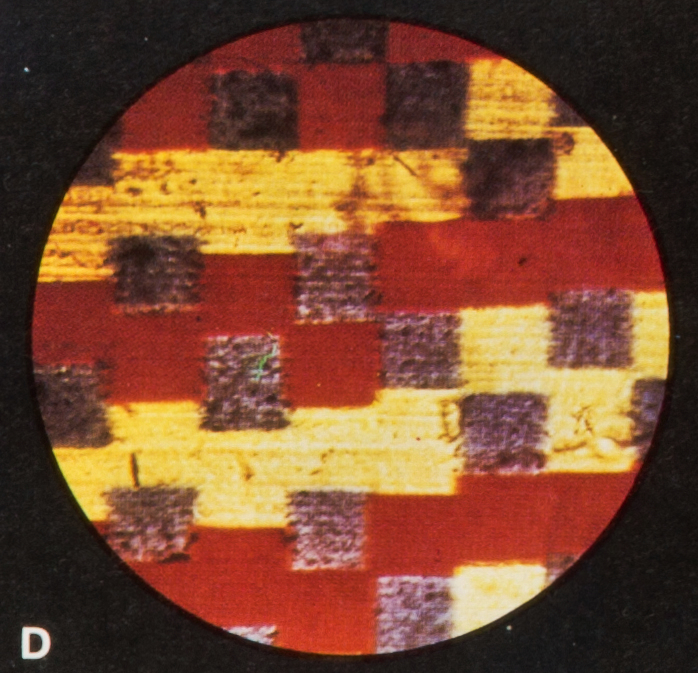
“Another method of producing a line screen was patented in 1904 by the German Robert Krayn, and was demonstrated by him in November 1907. Krayn stained very thin celluloid sheets red, green and blue, and cemented them interleaved to form a thick ...
-
![]() Source: Coe, Brian (1978): Colour Photography. The First Hundred Years 1840-1940. London: Ash & Grant, p. 54.
Source: Coe, Brian (1978): Colour Photography. The First Hundred Years 1840-1940. London: Ash & Grant, p. 54.
- Source: Pénichon, Sylvie (2013): Twentieth Century Colour Photographs. The Complete Guide to Processes, Identification & Preservation. London, Los Angeles: Thames & Hudson, p. 34.
- Source: Pénichon, Sylvie (2013): Twentieth Century Colour Photographs. The Complete Guide to Processes, Identification & Preservation. London, Los Angeles: Thames & Hudson, p. 35.
- Source: Pénichon, Sylvie (2013): Twentieth Century Colour Photographs. The Complete Guide to Processes, Identification & Preservation. London, Los Angeles: Thames & Hudson, p. 35.
- Source: Pénichon, Sylvie (2013): Twentieth Century Colour Photographs. The Complete Guide to Processes, Identification & Preservation. London, Los Angeles: Thames & Hudson, p. 36.
- Source: Pénichon, Sylvie (2013): Twentieth Century Colour Photographs. The Complete Guide to Processes, Identification & Preservation. London, Los Angeles: Thames & Hudson, p. 74.
- Source: Pénichon, Sylvie (2013): Twentieth Century Colour Photographs. The Complete Guide to Processes, Identification & Preservation. London, Los Angeles: Thames & Hudson, p. 74.
7 Images
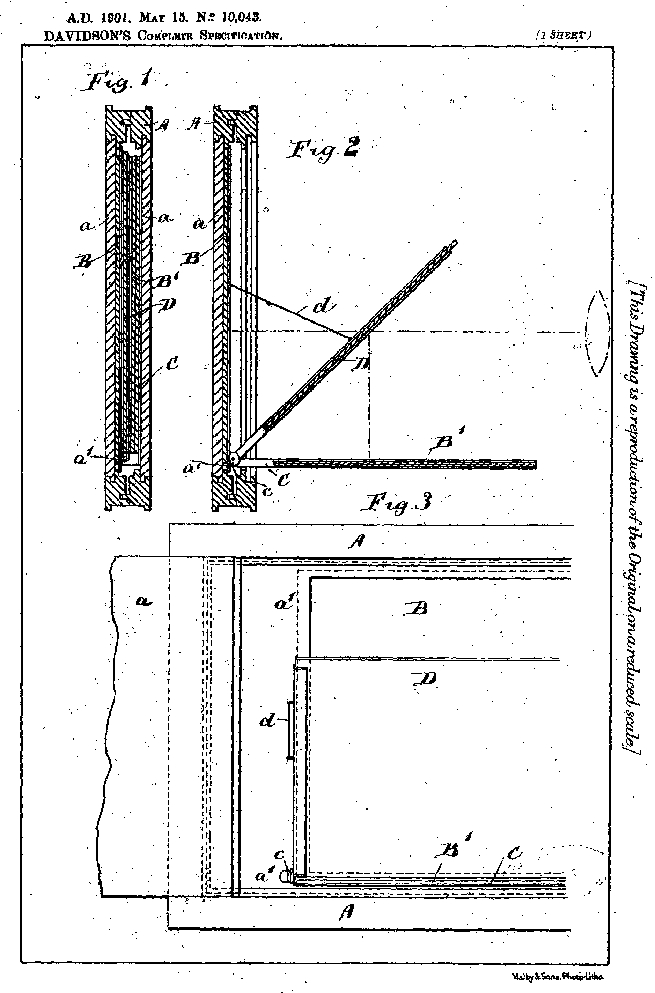
“Apparently, associated with W. Friese-Greene, in the same year, Captain William Norman Lascelles-Davidson, also of Brighton, patented a triple lens motion picture camera (E.P. 23,863, 1898). The colour filters revolved either behind the lenses, ...
-
![]() Drawing from E.P. 13,468, 1901.
Drawing from E.P. 13,468, 1901.
1 Image
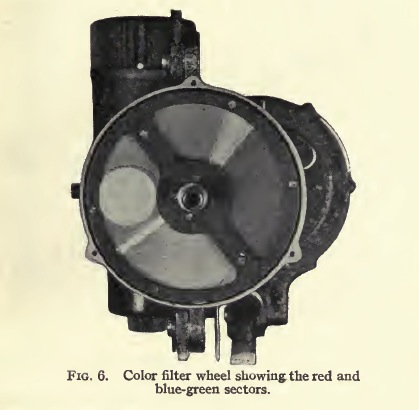
“Frederick Marshall Lee, of Walton, and Edward Raymond Turner, of Hounslow, to whom is usually accorded the credit of achieving the first practical results in additive projection. Their experimental work was financed by Charles Urban, a ...
-
![]() „Their projector […] used three lenses and a special filter
wheel which enabled every frame of the film to be projected three times in succession through the appropriate filter as it passed through the triple frame projector aperture. Although it eventually led to the Kinemacolor two colour process, the Lee and Turner patent was not successful“. Source: Coote, Jack H. (1993): The Illustrated History of Colour Photography. Surbiton, Surrey: Fountain Press.
„Their projector […] used three lenses and a special filter
wheel which enabled every frame of the film to be projected three times in succession through the appropriate filter as it passed through the triple frame projector aperture. Although it eventually led to the Kinemacolor two colour process, the Lee and Turner patent was not successful“. Source: Coote, Jack H. (1993): The Illustrated History of Colour Photography. Surbiton, Surrey: Fountain Press.
- "The First Color Moving Pictures", from the YouTube channel of the National Media Museum. [quote id="1"]
- Lee Turner projector in the Media History Museum in Bradford.
- „In 1899 Lee and Turner obtained a patent for a three colour process of cinematography requiring a single lens camera […] making a recurring sequence of red green and blue exposures through a rotating filter cum shutter“. Source: Coote, Jack H. (1993): The Illustrated History of Colour Photography. Surbiton, Surrey: Fountain Press.
- „In 1899 Lee and Turner obtained a patent for a three colour process of cinematography requiring a single lens camera […] making a recurring sequence of red green and blue exposures through a rotating filter cum shutter“. Source: Coote, Jack H. (1993): The Illustrated History of Colour Photography. Surbiton, Surrey: Fountain Press.
- „Their projector […] used three lenses and a special filter wheel which enabled every frame of the film to be projected three times in succession through the appropriate filter as it passed through the triple frame projector aperture. Although it eventually led to the Kinemacolor two colour process, the Lee and Turner patent was not successful“. Source: Coote, Jack H. (1993): The Illustrated History of Colour Photography. Surbiton, Surrey: Fountain Press.
- National Media Museum, UK. Lee and Turner Colour Projector, 1902.
- Source: Klein, Adrian Bernhard (Cornwell-Clyne) (1940): Colour Cinematography. Boston: American Photographic Pub. Co.
- Illustration of the process from National Media Museum's short documentary.
- 38 mm positive of the Lee Turner film showing the three b/w images for the three color records. Credit: Brian Pritchard.

16 Images in 1 Gallery
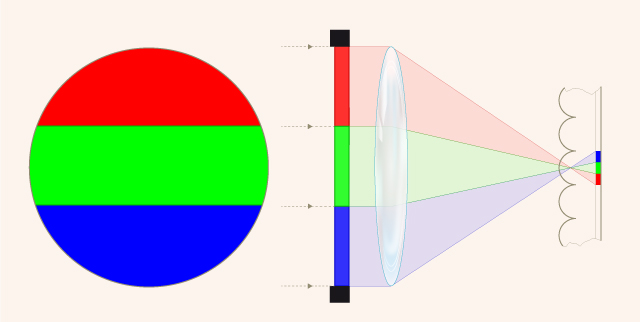
“Every element of a cross-lined screen acts as a pinhole camera, and reproduces an image of the aperture of the objective in whose rear focal plane it is placed. Thus, when using a square stop, the dots in the halftone produced will be square ...
-
![]() Credit: Illustration by Sarah Steinbacher, Multimedia & E-Learning-Services, University of Zurich. Source: Ede, François (1994): Jour de fête ou la couleur retrouvée. Cahiers du Cinéma: Paris.
Credit: Illustration by Sarah Steinbacher, Multimedia & E-Learning-Services, University of Zurich. Source: Ede, François (1994): Jour de fête ou la couleur retrouvée. Cahiers du Cinéma: Paris.
- Principle of capturing and projecting lenticular film. Credit: Joakim Reuteler and Rudolf Gschwind, Digital Humanities Lab, University of Basel, Switzerland. Illustration by Sarah Steinbacher, Multimedia & E-Learning-Services, University of Zurich.
- Principle of capturing and projecting lenticular film. Credit: Joakim Reuteler and Rudolf Gschwind, Digital Humanities Lab, University of Basel, Switzerland. Illustration by Sarah Steinbacher, Multimedia & E-Learning-Services, University of Zurich.
- Principle of capturing and projecting lenticular film. Credit: Joakim Reuteler and Rudolf Gschwind, Digital Humanities Lab, University of Basel, Switzerland. Illustration by Sarah Steinbacher, Multimedia & E-Learning-Services, University of Zurich.
4 Images
-
![]() Source: Pénichon, Sylvie (2013): Twentieth Century Colour Photographs. The Complete Guide to Processes, Identification & Preservation. London, Los Angeles: Thames & Hudson, p. 74.
Source: Pénichon, Sylvie (2013): Twentieth Century Colour Photographs. The Complete Guide to Processes, Identification & Preservation. London, Los Angeles: Thames & Hudson, p. 74.
- Source: Pénichon, Sylvie (2013): Twentieth Century Colour Photographs. The Complete Guide to Processes, Identification & Preservation. London, Los Angeles: Thames & Hudson, p. 44.

2 Images
“In 1891, Professor Gabriel Lippmann demonstrated to the French Académie des Sciences interference colour photographs of the spectrum and of stained glass windows, taken by a modification of Wiener’s method. An exceedingly fine grained, ...
-
![]() Source: Coe, Brian (1978): Colour Photography. The First Hundred Years 1840-1940. London: Ash & Grant.
Source: Coe, Brian (1978): Colour Photography. The First Hundred Years 1840-1940. London: Ash & Grant.
- Source: Lavédrine, Bertrand (2009): Photographs of the Past. Process and Preservation. Los Angeles: Getty Publications.
- Source: Coote, Jack H. (1993): The Illustrated History of Colour Photography. Surbiton, Surrey: Fountain Press.
- Source: Pénichon, Sylvie (2013): Twentieth Century Colour Photographs. The Complete Guide to Processes, Identification & Preservation. London, Los Angeles: Thames & Hudson, p. 19.
- Source: Pénichon, Sylvie (2013): Twentieth Century Colour Photographs. The Complete Guide to Processes, Identification & Preservation. London, Los Angeles: Thames & Hudson, p. 235.

5 Images
“An American two-colour subtractive process still worked by the Consolidated Film Industries division of Republic Pictures Corporation. This concern was licensed by the owners of the “Prizma” patents, which it will be remembered was ...
-
![]() Mysore Yesterday and Tomorrow Credit: Image courtesy of the 20th Century Fox Collection at the Academy Film Archive. Photograph: Barbara Flueckiger.
Mysore Yesterday and Tomorrow Credit: Image courtesy of the 20th Century Fox Collection at the Academy Film Archive. Photograph: Barbara Flueckiger.

23 Images in 2 Galleries
“To offset the possible effects of poor contact between the various members of the tripack, J. H. Smith coated the emulsions directly one on top of the other, but with an insulating layer of collodion between them. In this manner there was ...
-
![]() Source: U.S.P. 781469, Sept. 13,1904
Source: U.S.P. 781469, Sept. 13,1904

1 Image
Mordant toning or dye toning is a special case of toning whereby the silver image is replaced by colored compounds. Soluble dyes attach to a colorless (silver ferrocyanide) or nearly colorless (silver iodide) silver salt obtained by bleaching. Dye ...
-
![]() Virages sur mordançage, Bleu (blue mordant toning), backlight, Swiss collectors'copy. Source: Didiée, L. (1926): Le Film vierge Pathé. Manuel de développement et de tirage. Paris: Pathé. [quote id='7']
Virages sur mordançage, Bleu (blue mordant toning), backlight, Swiss collectors'copy. Source: Didiée, L. (1926): Le Film vierge Pathé. Manuel de développement et de tirage. Paris: Pathé. [quote id='7']
- Photomicrograph, 25x. Credit: Norbert Wey, Institute of Pathology, University of Zurich.
- Photomicrograph, 50x. Credit: Norbert Wey, Institute of Pathology, University of Zurich.
- Photomicrograph, 100x. Credit: Norbert Wey, Institute of Pathology, University of Zurich.
- Photomicrograph, 100x. Credit: Norbert Wey, Institute of Pathology, University of Zurich.

171 Images in 7 Galleries
-
![]() Source: Dubray, J.A. (1933): The Morgana Process In: Journal of the Society of Motion Picture Engineers 21,5, 1933, pp. 403-412.
Source: Dubray, J.A. (1933): The Morgana Process In: Journal of the Society of Motion Picture Engineers 21,5, 1933, pp. 403-412.
1 Image
-
![]() Photograph by Martin Weiss, ERC Adanced Grant FilmColors.
Photograph by Martin Weiss, ERC Adanced Grant FilmColors.

1 Image
“In the Multicolor (two-color) subtractive process, two negative films are run simultaneously through any standard camera with their emulsion surfaces in contact. The front negative is orthochromatic, with the surface layer dyed orange-red to ...
-
![]() Iridescence on Multicolor print, reflection properties. Credit: Library of Congress. Photograph by Barbara Flueckiger
Iridescence on Multicolor print, reflection properties. Credit: Library of Congress. Photograph by Barbara Flueckiger
- Magnification 20x. Credit: photomicrograph by Silvana Konermann.
- Magnification 10x. Credit: photomicrograph by Silvana Konermann.
- Magnification 5x. Credit: photomicrograph by Silvana Konermann.
- Source: Eggert, John (1932): Kurzer Überblick über den Stand der Farbenkinematographie. Bericht über den VIII. Internationalen Kongress für wissenschaftliche und angewandte Photographie, Dresden 1931, pp. 214-222. Leipzig: J. A. Barth.
- Credit: Geo. Willeman, Nitrate Film Vault Manager, Library of Congress. Film: Fox Movietone Follies of 1929.
- Source: Coe, Brian (1981): The History of Movie Photography. Westfield, N.J.: Eastview Editions.
- Source: Cornwell-Clyne, Adrian (1951): Colour Cinematography. London: Chapman & Hall.
- Source: Cornwell-Clyne, Adrian (1951): Colour Cinematography. London: Chapman & Hall.
- Credit: Illustration by Sarah Steinbacher, Multimedia & E-Learning-Services, University of Zurich. Source: Cornwell-Clyne, Adrian (1951): Colour Cinematography. London: Chapman & Hall.
- Source: Eggert, John (1932): Kurzer Überblick über den Stand der Farbenkinematographie. Bericht über den VIII. Internationalen Kongress für wissenschaftliche und angewandte Photographie, Dresden 1931, pp. 214-222. Leipzig: J. A. Barth.
- Magnification of an area. Source: Eggert, John (1932): Kurzer Überblick über den Stand der Farbenkinematographie. Bericht über den VIII. Internationalen Kongress für wissenschaftliche und angewandte Photographie, Dresden 1931, pp. 214-222. Leipzig: J. A. Barth.
- Reflection properties. Source: Eggert, John (1932): Kurzer Überblick über den Stand der Farbenkinematographie. Bericht über den VIII. Internationalen Kongress für wissenschaftliche und angewandte Photographie, Dresden 1931, pp. 214-222. Leipzig: J. A. Barth.

72 Images in 6 Galleries
“New Agfa Color Plate (1923–1932): colored particles very small and not visible to the naked eye, but clumps of particles of the same color give the image a pointillist effect (Fig. 2.62). Unlike with the autochromes, in which the grains ...
-
![]() Source: Pénichon, Sylvie (2013): Twentieth Century Colour Photographs. The Complete Guide to Processes, Identification & Preservation. London, Los Angeles: Thames & Hudson, p. 73.
Source: Pénichon, Sylvie (2013): Twentieth Century Colour Photographs. The Complete Guide to Processes, Identification & Preservation. London, Los Angeles: Thames & Hudson, p. 73.

1 Image
“In 1873 Dr Vogel discovered that by adding dyes to the sensitive material, its sensitivity could be extended, so that it would record green as well as blue. The new ‘orthochromatic’ plates were available commercially from 1882. The ...
-
![]() „Film orthochromatique (film négatif Pathé Standard)“ (orthochromatic stock). Source: Didiée, L. (1926): Le Film vierge Pathé. Manuel de développement et de tirage. Paris: Pathé.
„Film orthochromatique (film négatif Pathé Standard)“ (orthochromatic stock). Source: Didiée, L. (1926): Le Film vierge Pathé. Manuel de développement et de tirage. Paris: Pathé.
- „Film ordinaire (non orthochromatique)“ (Normal, non-orthochromatic stock). Source: Didiée, L. (1926): Le Film vierge Pathé. Manuel de développement et de tirage. Paris: Pathé.

2 Images
-
![]() Cross section scheme of different Orwo materials. Source: Kaufmann, Siegfried (1976): Vom ersten Umkehrfilm zum Orwochrom-System. In: Bild und Ton 3/1976, pp. 88-93.
Cross section scheme of different Orwo materials. Source: Kaufmann, Siegfried (1976): Vom ersten Umkehrfilm zum Orwochrom-System. In: Bild und Ton 3/1976, pp. 88-93.

84 Images in 3 Galleries
-
![]() Frauenschicksale (GDR 1952, Slatan Dudow). Credit: Bundesarchiv Filmarchiv. Photographs of the Orwocolor safety print by Michelle Beutler, ERC Advanced Grant FilmColors.
Frauenschicksale (GDR 1952, Slatan Dudow). Credit: Bundesarchiv Filmarchiv. Photographs of the Orwocolor safety print by Michelle Beutler, ERC Advanced Grant FilmColors.
- Cross section of Orwo positive print. Credit: Carsta Knaack, HTW Berlin. Film: L'Ours (J.-J. Annaud, 1988).
- Cross section schemes of different materials by Orwo. Source: Kaufmann, Siegfried (1976): Vom ersten Farbumkehrfilm zum Orwochrom-System. In: Bild und Ton, 3/1976, p. 88-93.

1026 Images in 27 Galleries
-
![]() Credit: Gert Koshofer Collection. Photograph by Barbara Flueckiger
Credit: Gert Koshofer Collection. Photograph by Barbara Flueckiger

11 Images in 1 Gallery
”Kelley’s first color process was a four-color additive system introduced in 1913. Called Panchromotion, Kelley formed a company which would exploit the process commercially and, he hoped, provide strong competition for Kinemacolor. He apparently ...
-
![]() Credit: Illustration by Sarah Steinbacher, Multimedia & E-Learning-Services, University of Zurich. Source: Ryan, Roderick T. (1977): A History of Motion Picture Color Technology. London: Focal Press.
Credit: Illustration by Sarah Steinbacher, Multimedia & E-Learning-Services, University of Zurich. Source: Ryan, Roderick T. (1977): A History of Motion Picture Color Technology. London: Focal Press.
- Source: Ryan, Roderick T. (1977): A History of Motion Picture Color Technology. London: Focal Press.
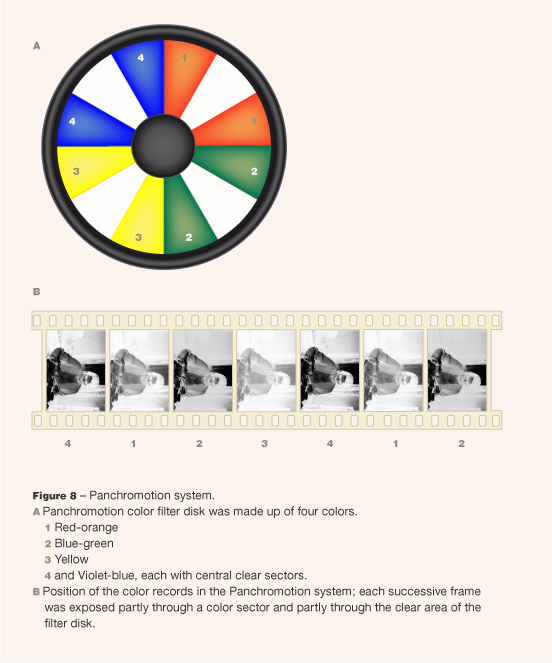
2 Images
“In October, Eggert of the Agfa Research Department, read a paper at the Berlin meeting of the Deutsche Gesellschaft für photographische Forschung, on the Pantochrom subtractive lenticular bipack tricolor process. (Fig. 1) The green and blue ...
-
![]() Agfa Pantachrom. Source: Arens, Hans; Heymer, Gerd (1939): Die „Agfa-Farbentafel für Farbenphotographie“. In: Veröffentlichungen des wissenschaftlichen Zentral-Laboratoriums der photographischen Abteilung Agfa, Vol. 6, 1939, pp. 225-229. Leipzig: Hirzel. Photograph by Martin Weiss, ERC Advanced Grant FilmColors.
Agfa Pantachrom. Source: Arens, Hans; Heymer, Gerd (1939): Die „Agfa-Farbentafel für Farbenphotographie“. In: Veröffentlichungen des wissenschaftlichen Zentral-Laboratoriums der photographischen Abteilung Agfa, Vol. 6, 1939, pp. 225-229. Leipzig: Hirzel. Photograph by Martin Weiss, ERC Advanced Grant FilmColors.

19 Images in 3 Galleries
 Timeline of Historical Film Colors by Barbara Flueckiger is licensed under a Creative Commons Attribution-NonCommercial-NoDerivatives 4.0 International License.
Quote as Flueckiger, Barbara (2012 ff.): Timeline of Historical Film Colors. (= https://filmcolors.org/).
Download BibTex