
Based on four primary colors, the process successively recorded two simultaneous images for two primary colors each. In projection, the four images were combined on screen, supposedly via a regular projector.
Select Category▼×
- All Categories
- Bibliography
- Chromogenic monopack
- Chromolytic multilayer
- Color separation
- Double-coated / bi-pack
- Edge Codes and Identification
- Hand coloring
- Other
- Printing / dye-transfer
- Printing / pigment process
- Screen processes
- Spatial synthesis (multiple lenses, beam splitter)
- Stencil coloring (pochoir, Pathécolor)
- Temporal synthesis (rotary filters)
- Theory
- Tinting
- Toning
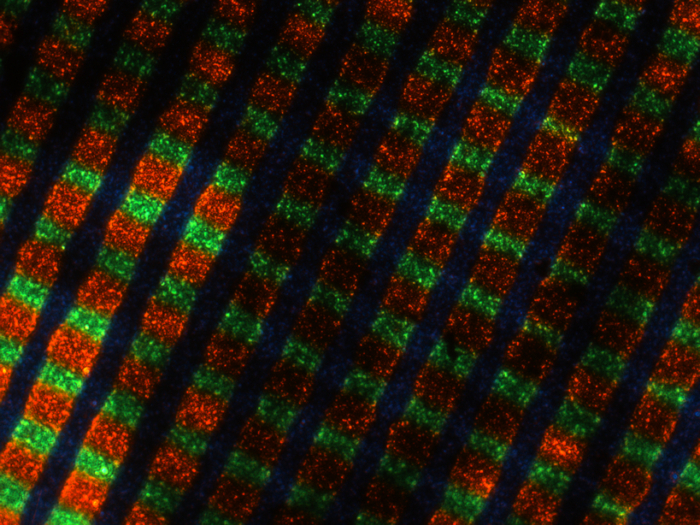
Dufaycolor was a regular line screen process whereby the incident light was filtered through a pattern of tiny color patches created by lines in red, green and blue, the so called réseau.
-
![]() Reversal Colour Positive. Credit: Courtesy of BFI National Archive. Photograph by Barbara Flueckiger. Film: A Colour Box (GB 1935, Len Lye).
Reversal Colour Positive. Credit: Courtesy of BFI National Archive. Photograph by Barbara Flueckiger. Film: A Colour Box (GB 1935, Len Lye).
- Microscopic image of the filter structure of a Dufaycolor film. The Emulsion has been removed. The visible structures are not silver grain but the structure of the filter layers. Credit: David Pfluger, ERC Advanced Grant FilmColors. Imaging was performed with support of the Center for Microscopy and Image Analysis, University of Zurich.
- Microscopic images of Dufaycolor film with the focus set at different points within the emulsion and filter layers. The images have been chained to show a travelling through the 3-dimensional structure of the layers. Credit: David Pfluger, conversion to video by Martin Weiss, ERC Advanced Grant FilmColors. Imaging was performed with support of the Center for Microscopy and Image Analysis, University of Zurich.

231 Images in 9 Galleries
For a description of Spicer-Dufay see detail page on Dufaycolor)
-
![]() Magnification 20x. Credit: photomicrograph by Silvana Konermann. Source: Eggert, John (1932): Kurzer Überblick über den Stand der Farbenkinematographie. Bericht über den VIII. Internationalen Kongress für wissenschaftliche und angewandte Photographie, Dresden 1931, pp. 214-222. Leipzig: J. A. Barth.
Magnification 20x. Credit: photomicrograph by Silvana Konermann. Source: Eggert, John (1932): Kurzer Überblick über den Stand der Farbenkinematographie. Bericht über den VIII. Internationalen Kongress für wissenschaftliche und angewandte Photographie, Dresden 1931, pp. 214-222. Leipzig: J. A. Barth.
- Magnification 10x. Credit: photomicrograph by Silvana Konermann. Source: Eggert, John (1932): Kurzer Überblick über den Stand der Farbenkinematographie. Bericht über den VIII. Internationalen Kongress für wissenschaftliche und angewandte Photographie, Dresden 1931, pp. 214-222. Leipzig: J. A. Barth.
- Magnification 5x. Credit: photomicrograph by Silvana Konermann. Source: Eggert, John (1932): Kurzer Überblick über den Stand der Farbenkinematographie. Bericht über den VIII. Internationalen Kongress für wissenschaftliche und angewandte Photographie, Dresden 1931, pp. 214-222. Leipzig: J. A. Barth.
- Source: Eggert, John (1932): Kurzer Überblick über den Stand der Farbenkinematographie. In: Bericht über den VIII. Internationalen Kongress für wissenschaftliche und angewandte Photographie, Dresden 1931, pp. 214-222. Leipzig: J. A. Barth.
- Source: Coe, Brian (1981): The History of Movie Photography. Westfield, N.J.: Eastview Editions.
- Magnification of an image area. Source: Eggert, John (1932): Kurzer Überblick über den Stand der Farbenkinematographie. Bericht über den VIII. Internationalen Kongress für wissenschaftliche und angewandte Photographie, Dresden 1931, pp. 214-222. Leipzig: J. A. Barth.
- Source: Eggert, John (1932): Kurzer Überblick über den Stand der Farbenkinematographie. Bericht über den VIII. Internationalen Kongress für wissenschaftliche und angewandte Photographie, Dresden 1931, pp. 214-222. Leipzig: J. A. Barth.
78 Images in 2 Galleries
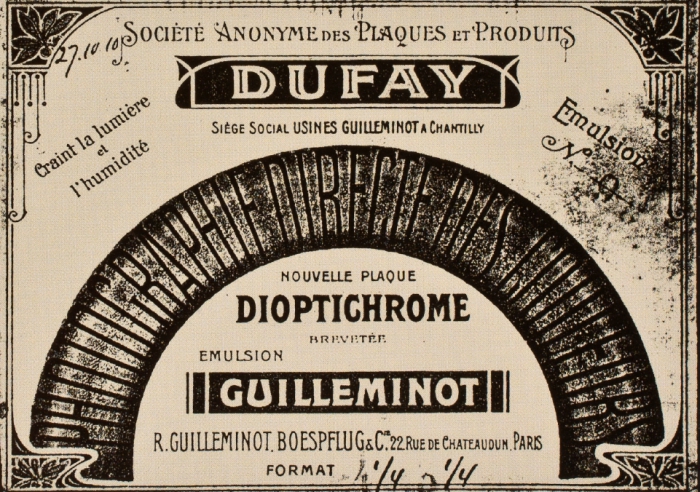
“The most successful of all the screen processes was the one initiated by Louis Dufay. Today the product is known as Dufaycolor, but it was first introduced about 1910 as the Dioptichrome plate. The first Dufay patents were assigned to an ...
(see detail page on Dufaycolor)
-
![]() Coote, Jack H. (1993): The Illustrated History of Colour Photography. Surbiton, Surrey: Fountain Press,
Coote, Jack H. (1993): The Illustrated History of Colour Photography. Surbiton, Surrey: Fountain Press,
- Credit: Cinémathèque française, conservatoire des techniques, Paris.
- Source: Ede, François (1994): Jour de fête ou la couleur retrouvée. Cahiers du Cinéma: Paris.
- Pénichon, Sylvie (2013): Twentieth Century Colour Photographs. The Complete Guide to Processes, Identification & Preservation. London, Los Angeles: Thames & Hudson, p. 71.
- Source: Pénichon, Sylvie (2013): Twentieth Century Colour Photographs. The Complete Guide to Processes, Identification & Preservation. London, Los Angeles: Thames & Hudson, p. 73.
- Source: Pénichon, Sylvie (2013): Twentieth Century Colour Photographs. The Complete Guide to Processes, Identification & Preservation. London, Los Angeles: Thames & Hudson, p. 31.
- Source: Pénichon, Sylvie (2013): Twentieth Century Colour Photographs. The Complete Guide to Processes, Identification & Preservation. London, Los Angeles: Thames & Hudson, p. 32.
- Source: Pénichon, Sylvie (2013): Twentieth Century Colour Photographs. The Complete Guide to Processes, Identification & Preservation. London, Los Angeles: Thames & Hudson, p. 33.
- Source: Pénichon, Sylvie (2013): Twentieth Century Colour Photographs. The Complete Guide to Processes, Identification & Preservation. London, Los Angeles: Thames & Hudson, p. 48.
- Source: Pénichon, Sylvie (2013): Twentieth Century Colour Photographs. The Complete Guide to Processes, Identification & Preservation. London, Los Angeles: Thames & Hudson, p. 69.
10 Images
“Louis Ducos du Hauron is reported to have become interested in the reproduction of colors by photography in 1859, when he was twentyone years old (Potonniée, 1939). In 1862 he submitted to a friend of his family, M. Lelut, a paper embodying ...
-
![]() "Du Hauron invented his Chromographoscope in 1874. It could be used either as a camera or an additive viewer." Source: Coote, Jack H. (1993): The Illustrated History of Colour Photography. Surbiton, Surrey: Fountain Press.
"Du Hauron invented his Chromographoscope in 1874. It could be used either as a camera or an additive viewer." Source: Coote, Jack H. (1993): The Illustrated History of Colour Photography. Surbiton, Surrey: Fountain Press.
- An early three-color print by Louis Ducros Du Hauron, 1877.

2 Images
“In 1930 Mannes and Godowsky were invited to join the staff of the Kodak Research Laboratory, where they concentrated on methods of processing multilayer films, while their colleagues worked out ways of manufacturing them. The result was the new Kodachrome film, launched in 1935. Three very thin emulsion layers were coated on film base, the emulsions being sensitised with non-wandering dyes to red, green and blue light, the red-sensitive layer being at the bottom.” (Coe, Brian (1978): Colour Photography. The First Hundred Years 1840-1940. London: Ash & Grant, pp. 121 ff.)
-
![]() Credit: Lichtspiel / Kinemathek Bern. Film: New York, Taufe und Ausflug (CH 1954, Donald Brun).
Credit: Lichtspiel / Kinemathek Bern. Film: New York, Taufe und Ausflug (CH 1954, Donald Brun).
- Surface emulsion side, raking light. Credit: Carsta Knaack, HTW Berlin. Film: Regular 8mm home movie, anonymous 1975.

92 Images in 6 Galleries
-
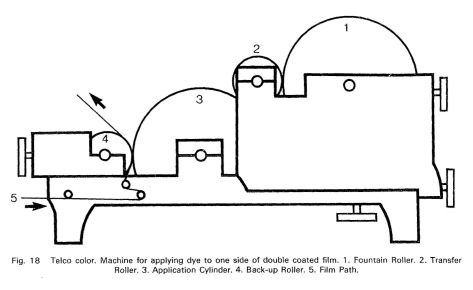
![]() Source: Ryan, Roderick T. (1977): A History of Motion Picture Color Technology. London: Focal Press.
Source: Ryan, Roderick T. (1977): A History of Motion Picture Color Technology. London: Focal Press.
1 Image
“The competition between Kinemacolor and other rival systems was partially stimulated by a Utopian faith in the potential of film technology to achieve ‘natural colour’, reality ‘as it is’ being the goal of the cinematic ...
-
![]() Credit: Cinémathèque française, conservatoire des techniques, Paris.
Credit: Cinémathèque française, conservatoire des techniques, Paris.
- Source: Ede, François (1994): Jour de fête ou la couleur retrouvée. Cahiers du Cinéma: Paris.
- Credit: Paolo Cherchi Usai. Source: Cherchi Usai, Paolo (2000): Silent Cinema. London: BFI.
- Credit: Illustration by Sarah Steinbacher, Multimedia & E-Learning-Services, University of Zurich. Source: Ede, François (1994): Jour de fête ou la couleur retrouvée. Cahiers du Cinéma: Paris.
- Credit: Cinémathèque française, conservatoire des techniques, Paris.
- Source: Gaumont, Léon (1959): Gaumont Chronochrome Process Described by the Inventor. In: Raymond Fielding (ed.): A Technological History of Motion Pictures and Television. An Anthology from the Pages of The Journal of the Society of Motion Picture and Television Engineers. Berkeley; Los Angeles: University of California Press, 1967, pp. 65-67.
- Source: Gaumont, Léon (1959): Gaumont Chronochrome Process Described by the Inventor. In: Raymond Fielding (ed.): A Technological History of Motion Pictures and Television. An Anthology from the Pages of The Journal of the Society of Motion Picture and Television Engineers. Berkeley; Los Angeles: University of California Press, 1967, pp. 65-67.
12 Images in 2 Galleries
“This two-color additive system for color cinematography was invented in 1916 by Leon Forrest Douglass of San Rafael, California. A special beam splitter camera would advance each roll of film two frames per exposure with its double frame pull down ...
-
![]() Source: Ryan, Roderick T. (1977): A History of Motion Picture Color Technology. London: Focal Press. Credit: Illustration by Sarah Steinbacher, Multimedia & E-Learning-Services, University of Zurich.
Source: Ryan, Roderick T. (1977): A History of Motion Picture Color Technology. London: Focal Press. Credit: Illustration by Sarah Steinbacher, Multimedia & E-Learning-Services, University of Zurich.
- Source: Ryan, Roderick T. (1977): A History of Motion Picture Color Technology. London: Focal Press.
- Source: Ryan, Roderick T. (1977): A History of Motion Picture Color Technology. London: Focal Press. Credit: Illustration by Sarah Steinbacher, Multimedia & E-Learning-Services, University of Zurich.
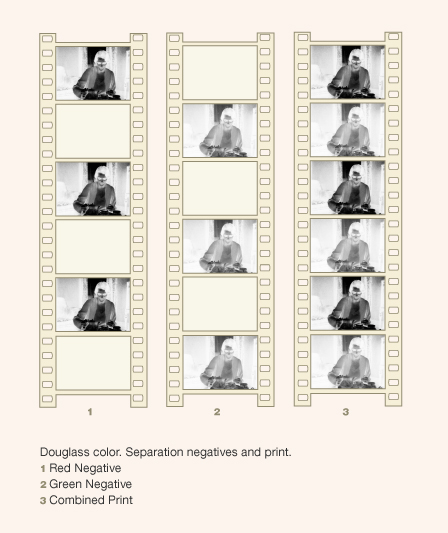
3 Images
“Douglass Color No. 2 (1919). The two negatives of the Douglass Color system No. 1 were printed on a positive. In this updated version of the process, rather than projecting the frames through red and green filters, both latent images were ...
“In the imbibition process, a dye image is transferred from a gelatin relief image to a receiving layer made either of paper or film. Charles Cros described this method of “hydrotypie” transfer printing in 1880 and suggested it ...
-
![]() Cyan and magenta combined, third layer, yellow missing. Source: Meister Lucius & Brüning (1905): Pinatypie. Positiv-Verfahren für die Dreifarbenphotographie. Höchst am Main.
Cyan and magenta combined, third layer, yellow missing. Source: Meister Lucius & Brüning (1905): Pinatypie. Positiv-Verfahren für die Dreifarbenphotographie. Höchst am Main.
- Source: Pénichon, Sylvie (2013): Twentieth Century Colour Photographs. The Complete Guide to Processes, Identification & Preservation. London, Los Angeles: Thames & Hudson, p. 235.
- Source: Pénichon, Sylvie (2013): Twentieth Century Colour Photographs. The Complete Guide to Processes, Identification & Preservation. London, Los Angeles: Thames & Hudson, p. 235.
- Source: Pénichon, Sylvie (2013): Twentieth Century Colour Photographs. The Complete Guide to Processes, Identification & Preservation. London, Los Angeles: Thames & Hudson, p. 132.

4 Images
-
![]() Credit: Brian Pritchard.
Credit: Brian Pritchard.

1 Image
-
![]() Magnification of an image area. Source: Eggert, John (1932): Kurzer Überblick über den Stand der Farbenkinematographie. Bericht über den VIII. Internationalen Kongress für wissenschaftliche und angewandte Photographie, Dresden 1931, pp. 214-222. Leipzig: J. A. Barth.
Magnification of an image area. Source: Eggert, John (1932): Kurzer Überblick über den Stand der Farbenkinematographie. Bericht über den VIII. Internationalen Kongress für wissenschaftliche und angewandte Photographie, Dresden 1931, pp. 214-222. Leipzig: J. A. Barth.
- Color chart. Credit: Guido Seeber Nachlass, Deutsche Kinemathek, Berlin. Source: Goergen, Jeanpaul (2010): Rotorange und blaugrün. Das Zweifarbenverfahren Ufacolor 1931-1940. In: Filmblatt, no. 43, pp. 77-92.
- Credit: Guido Seeber Nachlass, Deutsche Kinemathek, Berlin. Source: Goergen, Jeanpaul (2010): Rotorange und blaugrün. Das Zweifarbenverfahren Ufacolor 1931-1940. In: Filmblatt, no. 43, pp. 77-92.
- Source: Eggert, John (1932): Kurzer Überblick über den Stand der Farbenkinematographie. Bericht über den VIII. Internationalen Kongress für wissenschaftliche und angewandte Photographie, Dresden 1931, pp. 214-222. Leipzig: J. A. Barth.
- Credit: Bundesarchiv-Filmarchiv, photo: Marian Stefanowski. Source: Goergen, Jeanpaul (2010): Rotorange und blaugrün. Das Zweifarbenverfahren Ufacolor 1931-1940. In: Filmblatt, no. 43, pp. 77-92. Film: Bunte Tierwelt. Studien in Hagebecks Tierpark in Stellingen (1931).
- Credit: Bundesarchiv-Filmarchiv, photo: Marian Stefanowski. Source: Goergen, Jeanpaul (2010): Rotorange und blaugrün. Das Zweifarbenverfahren Ufacolor 1931-1940. In: Filmblatt, no. 43, pp. 77-92. Film: Karneval (1936).
- Credit: Bundesarchiv-Filmarchiv, photo: Jeanpaul Goergen. Source: Goergen, Jeanpaul (2010): Rotorange und blaugrün. Das Zweifarbenverfahren Ufacolor 1931-1940. In: Filmblatt, no. 43, pp. 77-92. Film: Bunte Fischwelt (1936).
- Credit: Bundesarchiv-Filmarchiv, photo: Marian Stefanowski. Source: Goergen, Jeanpaul (2010): Rotorange und blaugrün. Das Zweifarbenverfahren Ufacolor 1931-1940. In: Filmblatt, no. 43, pp. 77-92. Film: Karneval (1936).
- Credit: Deutsches Filminstitut DIF (Vicas Nachlass), photo: Jeanpaul Goergen. Source: Goergen, Jeanpaul (2010): Rotorange und blaugrün. Das Zweifarbenverfahren Ufacolor 1931-1940. In: Filmblatt, no. 43, pp. 77-92. Film: Potsdam (1934).
- Credit: Bundesarchiv-Filmarchiv, photo: Marian Stefanowski. Source: Goergen, Jeanpaul (2010): Rotorange und blaugrün. Das Zweifarbenverfahren Ufacolor 1931-1940. In: Filmblatt, no. 43, pp. 77-92. Film: Farben machen froh (1938).
- Magnification 5x. Credit: photomicrograph by Silvana Konermann.
- Magnification 10x. Credit: photomicrograph by Silvana Konermann.
- Magnification 20x. Credit: photomicrograph by Silvana Konermann.
- Source: Eggert, John (1932): Kurzer Überblick über den Stand der Farbenkinematographie. In:Bericht über den VIII. Internationalen Kongress für wissenschaftliche und angewandte Photographie, Dresden 1931, pp. 214-222. Leipzig: J. A. Barth.
- Magnification of an image area. Source: Eggert, John (1932): Kurzer Überblick über den Stand der Farbenkinematographie. In:Bericht über den VIII. Internationalen Kongress für wissenschaftliche und angewandte Photographie, Dresden 1931, pp. 214-222. Leipzig: J. A. Barth.
- Reflection on Ufacolor film. Source: Eggert, John (1932): Kurzer Überblick über den Stand der Farbenkinematographie. In:Bericht über den VIII. Internationalen Kongress für wissenschaftliche und angewandte Photographie, Dresden 1931, pp. 214-222. Leipzig: J. A. Barth.
- An opened splice of an Ufacolor positive shows the two colors used in the process. Credit: David Pfluger. Source: David Pfluger’s collection.

136 Images in 7 Galleries
“The Konicolor system, introduced by Konishiroku Shashin Kogyo (Now Konica Minolta Holdings, Inc.), split the image into three colors and shot them separately onto three b&w films. In that sense it had something in common with the US ‘Technicolor system’, but this was not a contact print with color dye to create positive film, but used coated emulsion to develop each color in a triple process, which is peculiar. […].”
Karl Schinzel proposed a multi-layered monopack for still photography, based on the principle of the dye-bleach process which was later elaborated to a practical application with Gasparcolor.
“In 1894 Professor John Joly of Dublin patented a process for producing a screen of red, green and blue-violet lines by ruling them on a gelatin-coated glass plate. Joly used ruling machines of great accuracy, with drawing pens trailed across ...
-
![]() Photomicrograph (20x) of a Joly screen. Credit: Courtesy of George Eastman House, International Museum of Photography and Film.
Photomicrograph (20x) of a Joly screen. Credit: Courtesy of George Eastman House, International Museum of Photography and Film.
- Credit: Courtesy of George Eastman House, International Museum of Photography and Film.
- Source: Coe, Brian (1978): Colour Photography. The First Hundred Years 1840-1940. London: Ash & Grant.
- Credit: Gawain Weaver, Photograph Conservator, Gawain Weaver Art Conservation, San Anselmo, CA.
- Source: Pénichon, Sylvie (2013): Twentieth Century Colour Photographs. The Complete Guide to Processes, Identification & Preservation. London, Los Angeles: Thames & Hudson, p. 69.
- Source: Pénichon, Sylvie (2013): Twentieth Century Colour Photographs. The Complete Guide to Processes, Identification & Preservation. London, Los Angeles: Thames & Hudson, p. 22.
- Source: Pénichon, Sylvie (2013): Twentieth Century Colour Photographs. The Complete Guide to Processes, Identification & Preservation. London, Los Angeles: Thames & Hudson, p. 23.
7 Images
“To offset the possible effects of poor contact between the various members of the tripack, J. H. Smith coated the emulsions directly one on top of the other, but with an insulating layer of collodion between them. In this manner there was ...
-
![]() Source: U.S.P. 781469, Sept. 13,1904
Source: U.S.P. 781469, Sept. 13,1904

1 Image
“The Warner-Powrie process patented in 1905 was the earliest commercial process using a screen made with bichromated colloid. A glass plate was thinly coated with bichromated gelatin or fish glue and exposed to light through a screen having ...

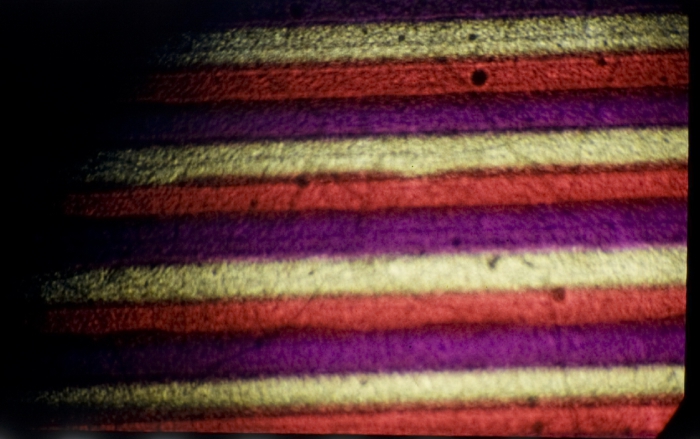
The Kodachrome process was invented in 1913 by John G. Capstaff for still photography and subsequently adapted to motion pictures. For the process two frames were advanced simultaneously, one located above the other. The light passed either through two lenses or through a beam-splitter, fitted with red and green filters. The release print was exposed through a beam-splitter whereby the alternate frames were projected onto either side of double-coated stock. After development by a usual b/w process, the film was tanned to harden the exposed areas. The soft areas were dyed red-orange and blue-green respectively.
-
![]() Two-Color Kodachrome Print (USA ca. 1925 to 1927, Anonymous). Credit: George Eastman Museum. Photographs of the Kodachrome two-color double coated stock from 1925 and 1927 by Olivia Kristina Stutz, ERC Advanced Grant FilmColors.
Two-Color Kodachrome Print (USA ca. 1925 to 1927, Anonymous). Credit: George Eastman Museum. Photographs of the Kodachrome two-color double coated stock from 1925 and 1927 by Olivia Kristina Stutz, ERC Advanced Grant FilmColors.
- Source: Eggert, John (1932): Kurzer Überblick über den Stand der Farbenkinematographie. In:Bericht über den VIII. Internationalen Kongress für wissenschaftliche und angewandte Photographie, Dresden 1931, pp. 214-222. Leipzig: J. A. Barth.
- Magnification 5x. Credit: photomicrograph by Silvana Konermann.
- Magnification 10x. Credit: photomicrograph by Silvana Konermann.
- Magnification 20x. Credit: photomicrograph by Silvana Konermann.
- Kodachrome Two-color test from 1922, YouTube channel of the George Eastman House.

350 Images in 12 Galleries
“In October, Eggert of the Agfa Research Department, read a paper at the Berlin meeting of the Deutsche Gesellschaft für photographische Forschung, on the Pantochrom subtractive lenticular bipack tricolor process. (Fig. 1) The green and blue ...
-
![]() Agfa Pantachrom. Source: Arens, Hans; Heymer, Gerd (1939): Die „Agfa-Farbentafel für Farbenphotographie“. In: Veröffentlichungen des wissenschaftlichen Zentral-Laboratoriums der photographischen Abteilung Agfa, Vol. 6, 1939, pp. 225-229. Leipzig: Hirzel. Photograph by Martin Weiss, ERC Advanced Grant FilmColors.
Agfa Pantachrom. Source: Arens, Hans; Heymer, Gerd (1939): Die „Agfa-Farbentafel für Farbenphotographie“. In: Veröffentlichungen des wissenschaftlichen Zentral-Laboratoriums der photographischen Abteilung Agfa, Vol. 6, 1939, pp. 225-229. Leipzig: Hirzel. Photograph by Martin Weiss, ERC Advanced Grant FilmColors.

19 Images in 3 Galleries
In this process, two positives, one orange-red one blue-green, were cemented together. Several specifications and modifications exist, for instance the strengthening of the perforated film margins via a second exposure, in an attempt to overcome wear ...
“The process of J. Szczepanik in 1925 was impracticable. He used a non-intermittent camera having a chain of eighteen lenses moving together with the film behind a collimating lens, three pictures being simultaneously exposed.”
(Klein, ...
“In a lecture on the theory of three primary colors, given at the Royal Institution of Great Britain on May 17, 1861, Maxwell presented the first demonstration of a photograph in color. According to the records of that meeting (Maxwell, 1890c, ...
-
![]() Source: Coe, Brian (1981): The History of Movie Photography. Westfield, N.J.: Eastview Editions.
Source: Coe, Brian (1981): The History of Movie Photography. Westfield, N.J.: Eastview Editions.

1 Image
-
![]() Source: Cornwell-Clyne, Adrian (1951): Colour Cinematography. London: Chapman & Hall.
Source: Cornwell-Clyne, Adrian (1951): Colour Cinematography. London: Chapman & Hall.
- Credit: Illustration by Sarah Steinbacher, Multimedia & E-Learning-Services, University of Zurich. Source: Cornwell-Clyne, Adrian (1951): Colour Cinematography. London: Chapman & Hall.
- Credit: Illustration by Sarah Steinbacher, Multimedia & E-Learning-Services, University of Zurich. Source: Cornwell-Clyne, Adrian (1951): Colour Cinematography. London: Chapman & Hall.
- Credit: Illustration by Sarah Steinbacher, Multimedia & E-Learning-Services, University of Zurich. Source: Cornwell-Clyne, Adrian (1951): Colour Cinematography. London: Chapman & Hall.
- Credit: Illustration by Sarah Steinbacher, Multimedia & E-Learning-Services, University of Zurich. Source: Cornwell-Clyne, Adrian (1951): Colour Cinematography. London: Chapman & Hall.
- Coote, Jack (1948): New Three-Color Camera, In: Journal of the Society of Motion Picture Engineers, vol. 50, June 1948, pp. 543-553.
- Coote, Jack (1948): New Three-Color Camera, In: Journal of the Society of Motion Picture Engineers, vol. 50, June 1948, pp. 543-553.
19 Images in 3 Galleries
“Harriscolor
In this method as in other methods of color photography, independent color value negatives are first obtained. The Harriscolor process can employ one of the following two methods: Either a camera wherein the dividing light prisms ...
-
![]() Credit: Technicolor Collection. George Eastman House Moving Image Department. Photograph by Barbara Flueckiger.
Credit: Technicolor Collection. George Eastman House Moving Image Department. Photograph by Barbara Flueckiger.
- Credit: Technicolor Collection. George Eastman House Moving Image Department. Photograph by Barbara Flueckiger.
- Credit: Technicolor Collection. George Eastman House Moving Image Department. Photograph by Barbara Flueckiger.

3 Images
“In 1873 Dr Vogel discovered that by adding dyes to the sensitive material, its sensitivity could be extended, so that it would record green as well as blue. The new ‘orthochromatic’ plates were available commercially from 1882. The ...
-
![]() „Film orthochromatique (film négatif Pathé Standard)“ (orthochromatic stock). Source: Didiée, L. (1926): Le Film vierge Pathé. Manuel de développement et de tirage. Paris: Pathé.
„Film orthochromatique (film négatif Pathé Standard)“ (orthochromatic stock). Source: Didiée, L. (1926): Le Film vierge Pathé. Manuel de développement et de tirage. Paris: Pathé.
- „Film ordinaire (non orthochromatique)“ (Normal, non-orthochromatic stock). Source: Didiée, L. (1926): Le Film vierge Pathé. Manuel de développement et de tirage. Paris: Pathé.

2 Images
“Dr. H. W. Vogel, the discoverer of colour sensitizers, made three-colour photography possible, and has been the first to recognise the relation between colour sensitiveness of plate and printing colour in the following principle made known in ...
“The first patent that has been found was granted to H. Isensee and he placed in front of the lens, both in taking and projection, a rotary shutter with three 120 degrees sectors in the usual colors.”
(Wall, E.J. (1925): The History of ...
-
![]() Source: D.R.P. 98,799, Dec. 17, 1897
Source: D.R.P. 98,799, Dec. 17, 1897
- Credit: Illustration by Sarah Steinbacher, Multimedia & E-Learning-Services, University of Zurich. Source: D.R.P. 98,799, Dec. 17, 1897

2 Images
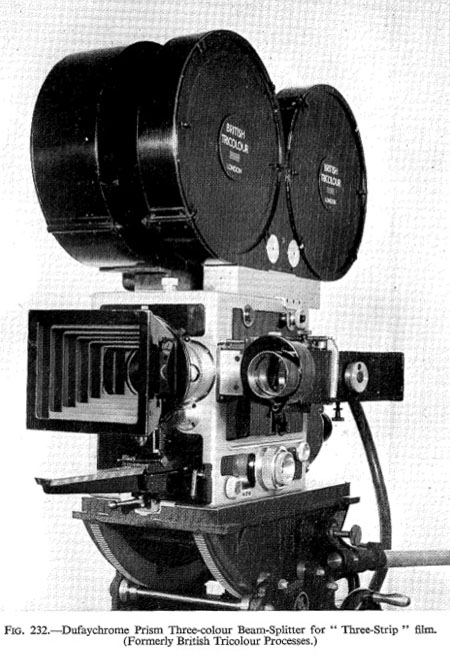
During the capturing of the film a beam-splitter in combination with filters in the camera divided the incoming light into a red and a green separation negative on black-and-white stock. When projected in the cinema the two images were combined simultaneously by additive mixture through corresponding red and green filters into one picture consisting of red and green colored light. The reduction of the whole color range to two colors (and their additive combinations) was necessary because of the complex optical arrangement.
-
![]() The beam-splitter prism. Source: Coote, Jack H. (1993): The Illustrated History of Colour Photography. Surbiton, Surrey: Fountain Press.
The beam-splitter prism. Source: Coote, Jack H. (1993): The Illustrated History of Colour Photography. Surbiton, Surrey: Fountain Press.

6 Images in 1 Gallery
“In the design of apparatus Urban was assisted after 1905 by Henry W. Joy. The Urban-Joy perforator appeared in 1906. The Urban-Joy anti-firing device, a shutter to prevent the firing of inflammable film when projectors broke down, was another ...
“The Rotocolor process was an additive system for color cinematography. The process was announced in 1931 by H. Muller. According to an article in Film Daily, April 12, 1931, and The Motion Picture Herald, April 11, 1931, the process consisted of ...
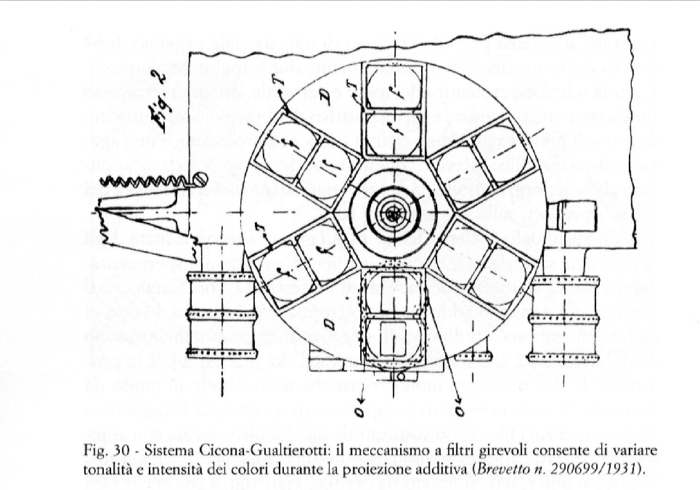
Unlike other additive systems invented in previous years, Gualtierotti tried to avoid the phenomenon of chromatic aberration inherent in the use of multiple lenses or the creation of successive separation records. The proposed solution was based on ...
-
![]() Rotating filters permitting to adjust tonality and intensity of the colors. Source: Pierotti, Federico (2016): Un'archeologia del colore nel cinema italiano. Dal Technicolor ad Antonioni. Pisa: Edizioni ETS, p. 62
Rotating filters permitting to adjust tonality and intensity of the colors. Source: Pierotti, Federico (2016): Un'archeologia del colore nel cinema italiano. Dal Technicolor ad Antonioni. Pisa: Edizioni ETS, p. 62
1 Image
The basic idea of the lenticular film was developed by the German Raphaël Liesegang in 1896 and applied to still photography by the French Rodolphe Berthon in 1908.
The lenticular process applies tiny cylindrical lenses embossed on the film support ...
-
![]() Color reconstruction. Credit: Gisela Harich-Hamburger, Diplomrestauratorin (FH).
Color reconstruction. Credit: Gisela Harich-Hamburger, Diplomrestauratorin (FH).
- Source: Heymer, Gerd (1933): Auflösungsvermögen und Farbwiedergabe in der Farbrasterphotographie. In: Veröffentlichungen des wissenschaftlichen Zentral-Laboratoriums der photographischen Abteilung Agfa, 3, 1933, pp. 188-207.
- Source: Weil, F. (1933): The Optical-Photographic Principles of the Agfacolor Process. In: Journal of the Society of Motion Picture Engineers, 20, (April, 1933), No. 4, p. 301-308.
- Both the Kodak and Agfa lenticular processes required the correct banded filter to be used with each different batch of panchromatic film. These two filters were for different batches of Agfacolor used in a Leica camera.. Source: Coote, Jack H. (1993): The Illustrated History of Colour Photography. Surbiton, Surrey: Fountain Press.
- Credit: Illustration by Sarah Steinbacher, Multimedia & E-Learning-Services, University of Zurich. Source: Ede, François (1994): Jour de fête ou la couleur retrouvée. Cahiers du Cinéma: Paris.
- Principle of capturing and projecting lenticular film. Credit: Joakim Reuteler and Rudolf Gschwind, Digital Humanities Lab, University of Basel, Switzerland. Illustration by Sarah Steinbacher, Multimedia & E-Learning-Services, University of Zurich.
- Principle of capturing and projecting lenticular film. Credit: Joakim Reuteler and Rudolf Gschwind, Digital Humanities Lab, University of Basel, Switzerland. Illustration by Sarah Steinbacher, Multimedia & E-Learning-Services, University of Zurich.
- Principle of capturing and projecting lenticular film. Credit: Joakim Reuteler and Rudolf Gschwind, Digital Humanities Lab, University of Basel, Switzerland. Illustration by Sarah Steinbacher, Multimedia & E-Learning-Services, University of Zurich.
- Magnification 5x, front. Credit: photomicrograph by Silvana Konermann.
- Magnification 10x, back. Credit: photomicrograph by Silvana Konermann.
- Magnification 20x, front. Credit: photomicrograph by Silvana Konermann.
- Reflection on Agfacolor lenticular film. Source: Eggert, John (1932): Kurzer Überblick über den Stand der Farbenkinematographie. In: Bericht über den VIII. Internationalen Kongress für wissenschaftliche und angewandte Photographie, Dresden 1931, pp. 214-222. Leipzig: J. A. Barth.
- Reconstruction of lenticular film by Joakim Reuteler and Rudolf Gschwind, Digital Humanities Lab, University of Basel, Switzerland in the framework of their research project doLCE
- Agfacolor Lenticular sample from the Kodak Film Samples Collection at the National Science and Media Museum in Bradford. Credit: National Science and Media Museum Bradford. Photographs by Barbara Flueckiger in collaboration with Noemi Daugaard.
- Analog reconstruction by Giorgio Trumpy, ERC Advanced Grant FilmColors

15 Images
-
![]() Credit: Geo. Willeman, Nitrate Film Vault Manager, Library of Congress. Film: Captain Calamity (1936)
Credit: Geo. Willeman, Nitrate Film Vault Manager, Library of Congress. Film: Captain Calamity (1936)
- Credit: Geo. Willeman, Nitrate Film Vault Manager, Library of Congress. Film: Captain Calamity (1936)

2 Images
Kinemacolor was an additive process operated with alternating red and green filters that were applied to the shutter in front of the camera and in front of the projector. With at least 32 fps the frame rate was double the minimal frame rate of 16 fps. Time parallax with small differences between the red and green record resulted in color fringes that became visible when objects or scenes were moving.
-
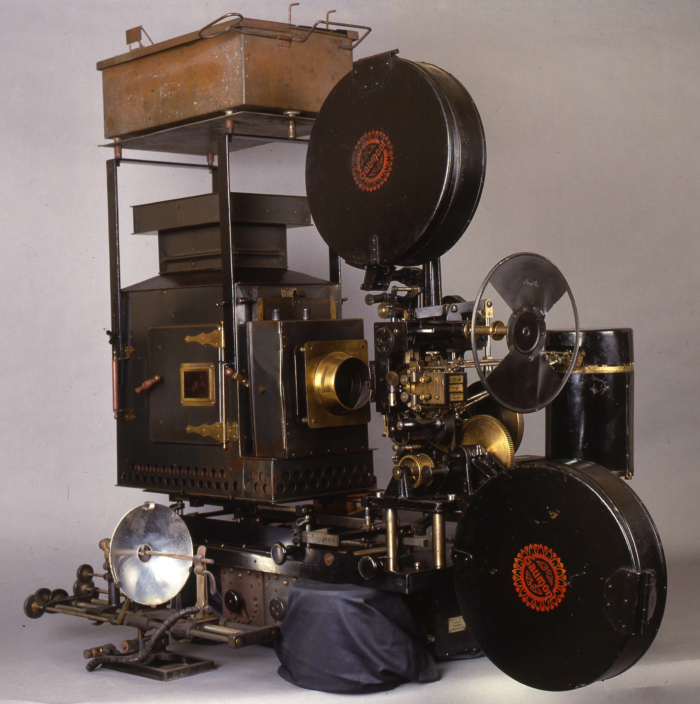
![]() Kinemacolor projector used for David Cleveland's and Brian Pritchard's reconstruction. Credit: Brian Pritchard.
Kinemacolor projector used for David Cleveland's and Brian Pritchard's reconstruction. Credit: Brian Pritchard.

13 Images in 3 Galleries
“Then we come upon the name of George Albert Smith, F.R.A.S., of Laboratory Lodge, Roman Crescent, Southwick, Brighton, who in E.P. 26,671, of 1906, patented the method which eventually was commercialized as Kinemacolor.
In this patent he ...
“In 1956, after the failure of the French venture, Gaspar resumed his own production of printing materials and chemicals (Koshofer 1981a). In the late 1950s he entered into an agreement with 3M Company of St. Paul, Minnesota, to explore the ...
“In 1891, Professor Gabriel Lippmann demonstrated to the French Académie des Sciences interference colour photographs of the spectrum and of stained glass windows, taken by a modification of Wiener’s method. An exceedingly fine grained, ...
-
![]() Source: Coe, Brian (1978): Colour Photography. The First Hundred Years 1840-1940. London: Ash & Grant.
Source: Coe, Brian (1978): Colour Photography. The First Hundred Years 1840-1940. London: Ash & Grant.
- Source: Lavédrine, Bertrand (2009): Photographs of the Past. Process and Preservation. Los Angeles: Getty Publications.
- Source: Coote, Jack H. (1993): The Illustrated History of Colour Photography. Surbiton, Surrey: Fountain Press.
- Source: Pénichon, Sylvie (2013): Twentieth Century Colour Photographs. The Complete Guide to Processes, Identification & Preservation. London, Los Angeles: Thames & Hudson, p. 19.
- Source: Pénichon, Sylvie (2013): Twentieth Century Colour Photographs. The Complete Guide to Processes, Identification & Preservation. London, Los Angeles: Thames & Hudson, p. 235.

5 Images
“Frederick Marshall Lee, of Walton, and Edward Raymond Turner, of Hounslow, to whom is usually accorded the credit of achieving the first practical results in additive projection. Their experimental work was financed by Charles Urban, a ...
-
![]() „Their projector […] used three lenses and a special filter
wheel which enabled every frame of the film to be projected three times in succession through the appropriate filter as it passed through the triple frame projector aperture. Although it eventually led to the Kinemacolor two colour process, the Lee and Turner patent was not successful“. Source: Coote, Jack H. (1993): The Illustrated History of Colour Photography. Surbiton, Surrey: Fountain Press.
„Their projector […] used three lenses and a special filter
wheel which enabled every frame of the film to be projected three times in succession through the appropriate filter as it passed through the triple frame projector aperture. Although it eventually led to the Kinemacolor two colour process, the Lee and Turner patent was not successful“. Source: Coote, Jack H. (1993): The Illustrated History of Colour Photography. Surbiton, Surrey: Fountain Press.
- "The First Color Moving Pictures", from the YouTube channel of the National Media Museum. [quote id="1"]
- Lee Turner projector in the Media History Museum in Bradford.
- „In 1899 Lee and Turner obtained a patent for a three colour process of cinematography requiring a single lens camera […] making a recurring sequence of red green and blue exposures through a rotating filter cum shutter“. Source: Coote, Jack H. (1993): The Illustrated History of Colour Photography. Surbiton, Surrey: Fountain Press.
- „In 1899 Lee and Turner obtained a patent for a three colour process of cinematography requiring a single lens camera […] making a recurring sequence of red green and blue exposures through a rotating filter cum shutter“. Source: Coote, Jack H. (1993): The Illustrated History of Colour Photography. Surbiton, Surrey: Fountain Press.
- „Their projector […] used three lenses and a special filter wheel which enabled every frame of the film to be projected three times in succession through the appropriate filter as it passed through the triple frame projector aperture. Although it eventually led to the Kinemacolor two colour process, the Lee and Turner patent was not successful“. Source: Coote, Jack H. (1993): The Illustrated History of Colour Photography. Surbiton, Surrey: Fountain Press.
- National Media Museum, UK. Lee and Turner Colour Projector, 1902.
- Source: Klein, Adrian Bernhard (Cornwell-Clyne) (1940): Colour Cinematography. Boston: American Photographic Pub. Co.
- Illustration of the process from National Media Museum's short documentary.
- 38 mm positive of the Lee Turner film showing the three b/w images for the three color records. Credit: Brian Pritchard.

16 Images in 1 Gallery
“Gilmore’s two-color additive process was based on a patent granted to F. E. Ives in 1918. A unique optical system exposed two images in pairs, and quarter-turned them lengthwise side by side on standard 35 mm film stock. One of the images was ...
-
![]() Source: U.S.P. 1,262,954 (Ives, Frederic Eugene; filed Feb. 18, 1914; granted Apr. 16, 1918)
Source: U.S.P. 1,262,954 (Ives, Frederic Eugene; filed Feb. 18, 1914; granted Apr. 16, 1918)

1 Image
Similar to Technicolor, the Iriscolor process needed a special beam-splitter camera for exposing three black-and-white negatives on Kodak film stock. These negatives were used for imbibition printing.
Between 1940 and 1942, Tobis Tonbild-Syndikat AG ...
The film is recorded through alternating red and green filters, creating two color separations. After development, the print is placed in two alternating dye-baths, toning the blacks green and the whites red. Additionally, a black-and-white copy is ...
“M. F. de Colombier appears to have been the first to suggest the application of this system to cinematography, and like so many French patents it is a little indefinite in phraseology. Three films were employed representing the same view and ...
 Timeline of Historical Film Colors by Barbara Flueckiger is licensed under a Creative Commons Attribution-NonCommercial-NoDerivatives 4.0 International License.
Quote as Flueckiger, Barbara (2012 ff.): Timeline of Historical Film Colors. (= https://filmcolors.org/).
Download BibTex