
During the 1940s Kodachrome was used as camera material for films that were blown up to 35mm Technicolor projection prints. Technicolor used this technology from 1942 until the mid-1950s when Eastman Kodak introduced the Eastmancolor ...
Category: Chromogenic monopack▼×
- All Categories
- Bibliography
- Chromolytic multilayer
- Chromolytic single layer
- Color separation
- Data sheets
- Direct positive
- Double-coated / bi-pack
- Edge Codes and Identification
- Hand coloring
- Instant dye diffusion
- Other
- Printing / Dye-transfer / Pigment
- Screen processes
- Spatial synthesis (multiple lenses, beam splitter)
- Stencil coloring (pochoir, Pathécolor)
- Temporal synthesis (rotary filters)
- Theory
- Tinting
- Toning
See Anscochrome and Super Anscochrome Daylight, type 225.
See Anscochrome and Super Anscochrome Tungsten, type 226.
-
![]() Skleněné varhany (Stěklanna je garmonika, Andrej Chržanovskij, USSR 1968). Credit: Národní filmový archiv / National Film Archive, Prague. Photograph by Barbara Flueckiger

15 Images in 3 Galleries
“Polacolor was commercialized in 1963 and became an immediate success. It was acclaimed as the ‘most outstanding single advance in photographic science made during this century’ (Crawley 1963). Indeed, Polacolor introduced important ...
-
![]() Source: Pénichon, Sylvie (2013): Twentieth Century Colour Photographs. The Complete Guide to Processes, Identification & Preservation. London, Los Angeles: Thames & Hudson, p. 235.
- Source: Pénichon, Sylvie (2013): Twentieth Century Colour Photographs. The Complete Guide to Processes, Identification & Preservation. London, Los Angeles: Thames & Hudson, p. 235.
- Source: Pénichon, Sylvie (2013): Twentieth Century Colour Photographs. The Complete Guide to Processes, Identification & Preservation. London, Los Angeles: Thames & Hudson, p. 235.
- Source: Pénichon, Sylvie (2013): Twentieth Century Colour Photographs. The Complete Guide to Processes, Identification & Preservation. London, Los Angeles: Thames & Hudson, p. 258.

4 Images
-
![]() Frauenschicksale (GDR 1952, Slatan Dudow). Credit: Bundesarchiv Filmarchiv. Photographs of the Orwocolor safety print by Michelle Beutler, ERC Advanced Grant FilmColors.
- Cross section of Orwo positive print. Credit: Carsta Knaack, HTW Berlin. Film: L'Ours (J.-J. Annaud, 1988).
- Cross section schemes of different materials by Orwo. Source: Kaufmann, Siegfried (1976): Vom ersten Farbumkehrfilm zum Orwochrom-System. In: Bild und Ton, 3/1976, p. 88-93.

1026 Images in 27 Galleries
-
![]() Cross section scheme of different Orwo materials. Source: Kaufmann, Siegfried (1976): Vom ersten Umkehrfilm zum Orwochrom-System. In: Bild und Ton 3/1976, pp. 88-93.

84 Images in 3 Galleries
“In 1941 Kodak introduced a printing service for wallet-size Minicolor prints on a white opaque support of pigmented acetate made from 35mm transparencies (Fig. 5.6). A similar product called Kotavachrome was designed for larger prints made ...
-
![]() Pénichon, Sylvie (2013): Twentieth Century Colour Photographs. The Complete Guide to Processes, Identification & Preservation. London, Los Angeles: Thames & Hudson, p. 165.

1 Image
“The Konicolor system, introduced by Konishiroku Shashin Kogyo (Now Konica Minolta Holdings, Inc.), split the image into three colors and shot them separately onto three b&w films. In that sense it had something in common with the US ‘Technicolor system’, but this was not a contact print with color dye to create positive film, but used coated emulsion to develop each color in a triple process, which is peculiar. […].”
Kodachrome Professional was introduced in 1942 to be used as camera material. It was the Kodachrome material that was blown up to 35mm Technicolor dye transfer prints, which was the Technicolor Monopack system.
According to Norris Pope this material ...
Kodachrome II was introduced in 1961. It was the first film stock since 1936 that was specifically meant for amateur use. Eastman Kodak presented the material as superior to the ‘regular Kodachrome’. It supposedly had a higher speed of 25 ...
-
![]() La perception et l'imaginaire (FRA 1964, Éric Duvivier). Credit: Image'Est. Photographs of the Kodachrome II camera material by Bregt Lameris, ERC Advanced Grant FilmColors.
- Les autopathes (FRA 1971, Éric Duvivier). Credit: Image'Est. Photographs of the kodachrome reversal by Bregt Lameris, ERC Advanced Grant FilmColors.
- Hallucinations: Images du monde visionnaire (FRA 1963, Éric Duvivier). Credit: Image'Est. Photographs of undated Kodachrome II projection print by Bregt Lameris, ERC Advanced Grant FilmColors.

84 Images in 5 Galleries
In 1946 Kodachrome Commercial camera film Type 5268 was introduced. This stock had a lower-contrast emulsion and became leading in the professional field until it was replaced by Ektachrome Commercial type 7255 in 1958. Both Commercial Kodachrome and ...
Although Kodachrome 16mm reversal film was introduced as an amateur film format, rapidly after its introduction it became a format frequently used by (semi-)professional film makers. The reason was that Kodachrome was a relatively easy to use film ...
Duplicating stock for reversal film. Replaced Kodachrome duplicating stock type 5262. Contrary to its predecessor the new stock was not suited as camera material. Type 5265 could only be used for duplication.
“In 1930 Mannes and Godowsky were invited to join the staff of the Kodak Research Laboratory, where they concentrated on methods of processing multilayer films, while their colleagues worked out ways of manufacturing them. The result was the new Kodachrome film, launched in 1935. Three very thin emulsion layers were coated on film base, the emulsions being sensitised with non-wandering dyes to red, green and blue light, the red-sensitive layer being at the bottom.” (Coe, Brian (1978): Colour Photography. The First Hundred Years 1840-1940. London: Ash & Grant, pp. 121 ff.)
-
![]() Credit: Lichtspiel / Kinemathek Bern. Film: New York, Taufe und Ausflug (CH 1954, Donald Brun).
- Surface emulsion side, raking light. Credit: Carsta Knaack, HTW Berlin. Film: Regular 8mm home movie, anonymous 1975.

92 Images in 6 Galleries
-
![]() Cross section of Inducolor-print, leader only, title unknown. Credit: Carsta Knaack, HTW Berlin.
- Leader of print, title and age unknown. Credit: Carsta Knaack, HTW Berlin.

2 Images
-
![]() No masking in the negative. Credit: Collection Gert Koshofer, Bergisch Gladbach (Germany).
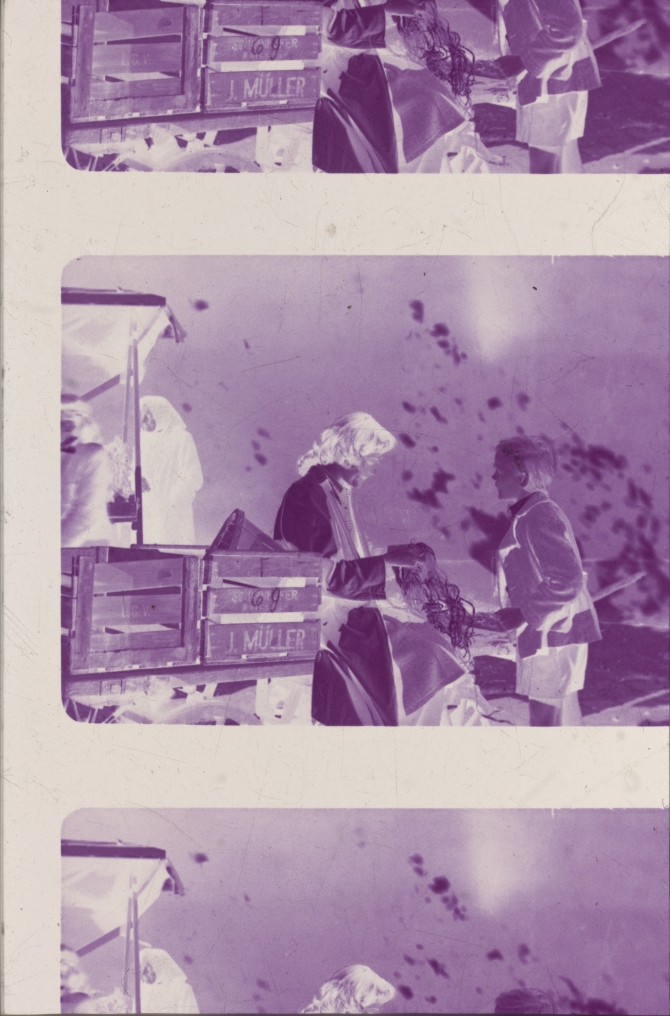
4 Images in 1 Gallery
-
![]() Comparing cross section schemes of different Gevachrome types. Scource: Verbrugghe, R. G. L. (1967): A Sharp Reversal Color Print Film. In: Journal SMPTE, Vol. 76, Dec. 1967, p. 1198.

10 Images in 1 Gallery
“The Fujicolor process is a three-color subtractive negative/positive process introduced in 1955 by the Fuji Photo Film Co., Ltd., Tokyo, Japan.
When the process was introduced it consisted of two elements that could be used singly or together. ...
-
![]() Don't Look Now (GBR / ITA 1973, Nicolas Roeg). Credit: BFI National Film Archive. Photographs of the faded Fujicolor HP Positive Film Type 8813 by Joëlle Kost, ERC Advanced Grant FilmColors.

141 Images in 7 Galleries
Fujichrome is the collective brand name for colour reversal films produced by the Fujifilm Corporation. The brand was also used for Single 8 film, the production of which ceased in 2019. The launch of “Fujicolor Reversal Film” (with an ...
 Timeline of Historical Film Colors by Barbara Flueckiger is licensed under a Creative Commons Attribution-NonCommercial-NoDerivatives 4.0 International License.
Quote as Flueckiger, Barbara (2012 ff.): Timeline of Historical Film Colors. (= https://filmcolors.org/).
Download BibTex