
-
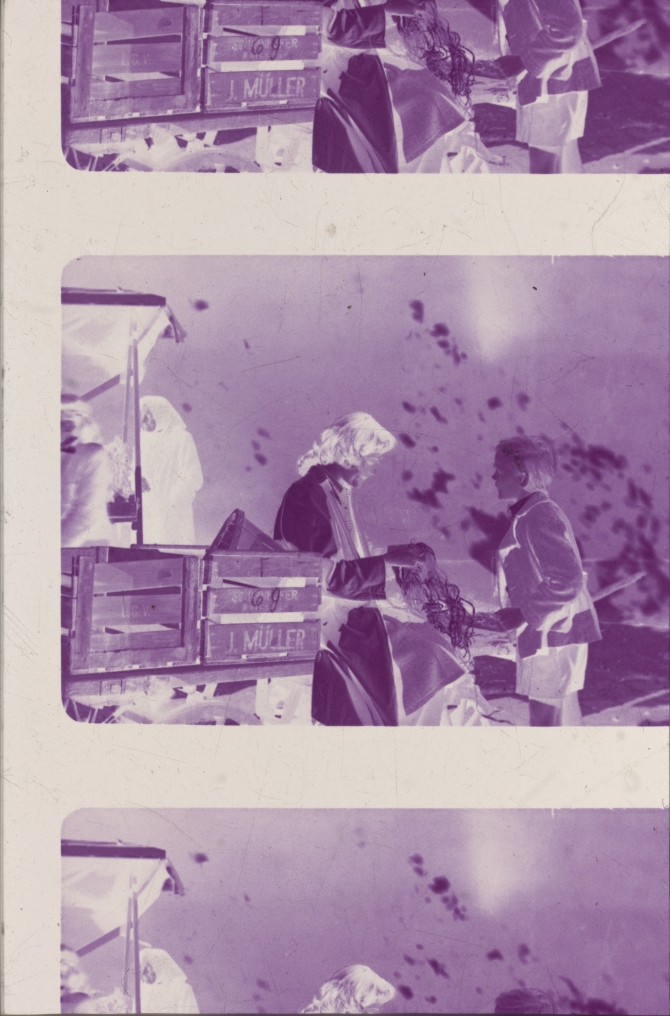
![]() No masking in the negative. Credit: Collection Gert Koshofer, Bergisch Gladbach (Germany).
Select Category▼×
- All Categories
- Bibliography
- Chromogenic monopack
- Chromolytic multilayer
- Chromolytic single layer
- Color separation
- Data sheets
- Direct positive
- Double-coated / bi-pack
- Edge Codes and Identification
- Hand coloring
- Instant dye diffusion
- Other
- Printing / Dye-transfer / Pigment
- Screen processes
- Spatial synthesis (multiple lenses, beam splitter)
- Stencil coloring (pochoir, Pathécolor)
- Temporal synthesis (rotary filters)
- Theory
- Tinting
- Toning
-
![]() Comparing cross section schemes of different Gevachrome types. Scource: Verbrugghe, R. G. L. (1967): A Sharp Reversal Color Print Film. In: Journal SMPTE, Vol. 76, Dec. 1967, p. 1198.

10 Images in 1 Gallery
“The competition between Kinemacolor and other rival systems was partially stimulated by a Utopian faith in the potential of film technology to achieve ‘natural colour’, reality ‘as it is’ being the goal of the cinematic ...
-
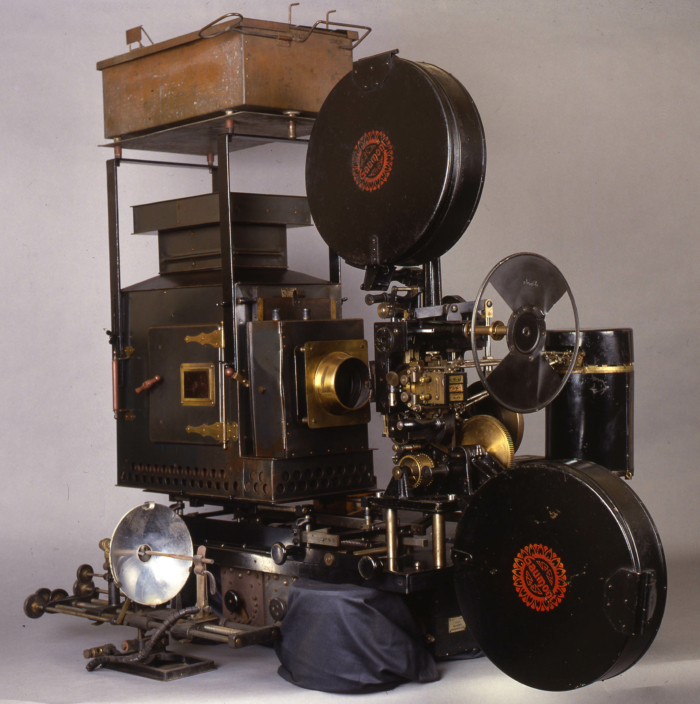
![]() Credit: Cinémathèque française, conservatoire des techniques, Paris.
- Source: Ede, François (1994): Jour de fête ou la couleur retrouvée. Cahiers du Cinéma: Paris.
- Credit: Paolo Cherchi Usai. Source: Cherchi Usai, Paolo (2000): Silent Cinema. London: BFI.
- Credit: Illustration by Sarah Steinbacher, Multimedia & E-Learning-Services, University of Zurich. Source: Ede, François (1994): Jour de fête ou la couleur retrouvée. Cahiers du Cinéma: Paris.
- Credit: Cinémathèque française, conservatoire des techniques, Paris.
- Source: Gaumont, Léon (1959): Gaumont Chronochrome Process Described by the Inventor. In: Raymond Fielding (ed.): A Technological History of Motion Pictures and Television. An Anthology from the Pages of The Journal of the Society of Motion Picture and Television Engineers. Berkeley; Los Angeles: University of California Press, 1967, pp. 65-67.
- Source: Gaumont, Léon (1959): Gaumont Chronochrome Process Described by the Inventor. In: Raymond Fielding (ed.): A Technological History of Motion Pictures and Television. An Anthology from the Pages of The Journal of the Society of Motion Picture and Television Engineers. Berkeley; Los Angeles: University of California Press, 1967, pp. 65-67.
12 Images in 2 Galleries
Gasparcolor was the first three-color multi-layer monopack film available for practical use. It was a double-coated print film with a cyan layer on one side and two layers dyed magenta and yellow on the other side (see illustrations).
-
![]() Uit het rijk der kristallen (NDL 1927?, J.C. Mol). Credit: EYE Film Museum. Photographs of the Dufaycolor and Gasparcolor nitrate print by Barbara Flueckiger.
- Kreise (English title Circles) (Oskar Fischinger, GER 1933-34) Oskar Fischinger's own nitrate print. Credit: Library of Congress, (c) Fischinger Trust, courtesy Center for Visual Music. Photograph Fischinger's own nitrate print by Barbara Flueckiger.
- Credit: (c) Fischinger Trust, courtesy Center for Visual Music. Film: Allegretto by Oskar Fischinger (1936-1943).
- Credit: (c) Fischinger Trust, courtesy Center for Visual Music. Film: Gasparcolor tests by Oskar Fischinger, c. 1933-34.
- Credit: Cinémathèque suisse. Film: Komposition in Blau (Composition in Blue) AKA Lichtkonzert Nr. 1 (Light-Concert No. 1) (GER 1935, Oskar Fischinger).
- Credit: Cinémathèque suisse. © Fischinger Trust, courtesy Center for Visual Music. Film: Komposition in Blau (Composition in Blue) AKA Lichtkonzert Nr. 1 (Light-Concert No. 1) (GER 1935, Oskar Fischinger).
- Credit: Cinémathèque suisse. © Fischinger Trust, courtesy Center for Visual Music. Film: Komposition in Blau (Composition in Blue) AKA Lichtkonzert Nr. 1 (Light-Concert No. 1) (GER 1935, Oskar Fischinger).
- Source: Coe, Brian (1981): The History of Movie Photography. Westfield, N.J.: Eastview Editions.
- Color chart on Agfa Tripofilm. This was the raw stock used for Gasparcolor in Germany until about 1939. Source: Arens, Hans; Heymer, Gerd (1939): Die „Agfa-Farbentafel für Farbenphotographie“. In: Veröffentlichungen des wissenschaftlichen Zentral-Laboratoriums der photographischen Abteilung Agfa, Vol. 6, 1939, pp. 225-229. Leipzig: Hirzel. Photograph by Barbara Flueckiger.
- Source: Pénichon, Sylvie (2013): Twentieth Century Colour Photographs. The Complete Guide to Processes, Identification & Preservation. London, Los Angeles: Thames & Hudson, p. 213.

398 Images in 24 Galleries
“In 1944 he launched a new reflection printing material on a white-pigmented acetate base called Gasparcolor Opaque, which was, initially and for the duration of the war, available only to the U.S. military. The processing of Gasparcolor Opaque ...
-
![]() Source: Pénichon, Sylvie (2013): Twentieth Century Colour Photographs. The Complete Guide to Processes, Identification & Preservation. London, Los Angeles: Thames & Hudson, p. 235.
- Pénichon, Sylvie (2013): Twentieth Century Colour Photographs. The Complete Guide to Processes, Identification & Preservation. London, Los Angeles: Thames & Hudson, p. 228.

2 Images
Fujifilm Recording Film ETERNA-RDS (35 mm, Type 4791, PET base) is a black and white film used to create archival black-and-white separations from color digital masters using a film recorder. It is designed for processing in either the D96 or D97 ...
-
![]() Fujifilm (2010): Data Sheet. Fujifilm Recording Film for Digital Separation ETERNA-RDS, 35mm Type 4791 (PET) (FXX-KB-1006E), p. 1.

1 Image
Fujicolor Pro 160NS Professional is a daylight color negative film with an ISO speed of 160 intended for professional use. In addition to the conventional three RGB-sensitive layers, it features a fourth color-sensitive layer, combined with new ...
-
![]() Fujifilm (n.d.): Product Information Bulletin, Color Negative Films. Fujicolor Pro 160 NS Professional (AF3-0232E), p. 7.

1 Image
“The company also launched its first peel-apart color print films, Fuji FP-100 and Fuji FP-800, which were compatible with Polaroid cameras and camera backs. The image formation of the new peel-apart films was similar to that of Fuji integral ...
“The chemistry and structure layer of Fuji FI-10 integral film were very similar to those of Kodak PR-10, with the film being exposed on one side and viewed on the opposite side. However, its layers were much thinner than those of Kodak and ...
-
![]() Pénichon, Sylvie (2013): Twentieth Century Colour Photographs. The Complete Guide to Processes, Identification & Preservation. London, Los Angeles: Thames & Hudson, p. 245.

1 Image
Fujicolor True Definition 400 is an ISO 400 daylight-type color negative film. It features a new gradation design and 4th Color Layer and Super Fine-Σ Grain technologies. The film is intended for processing in Fujifilm Processes CN-16, CN-16Q, ...
-
![]() Fujifilm (n.d.): Product Information Bulletin, Color Negative Films. Fujicolor True Definition 400 (AF3-196E), p. 6.

1 Image
Fujicolor Superia X-TRA 800 [CZ] is a daylight color negative film with an ISO speed of 800. It is designed for processing using Fujifilm Processes CN-16, CN-16Q, CN-16FA, or CN-16L, as well as Kodak Process C-41.
-
![]() Fujifilm (n.d.): Data Sheet, Color Negative Films. Fujicolor Superia X-TRA 800 (AF3-068E), p. 4.

1 Image
Fujicolor Superia X-TRA 400 [CH] is a daylight color negative film with an ISO speed of 400. It features 4th Color Layer and Super Fine-∑(Sigma) Grain Technology to achieve high image quality. The film is designed for processing using Fujifilm ...
-
![]() Fujifilm (n.d.): Product Information Bulletin, Color Negative Films. Fujicolor Superia X-TRA 400 [CH] (AF3-144E).

1 Image
Fujicolor Superia Reala [CS] is a daylight color negative film with an ISO speed of 100. It is designed for processing using Fujifilm Processes CN-16, CN-16Q, CN-16FA, or CN-16L, as well as Kodak Process C-41.
-
![]() Fujifilm (n.d.): Data Sheet, Color Negative Films. Fujicolor Superia Reala [CS] (AF3-967E), p. 4.

1 Image
Fujicolor Superia 200 [CA] is a daylight color negative film with an ISO speed of 200. It is designed for processing using Fujifilm Processes CN-16, CN-16Q, CN-16FA, or CN-16L, as well as Kodak Process C-41.
-
![]() Fujifilm (n.d.): Data Sheet, Color negative Films. Fujicolor Superia 200 (AF3-008E), p. 4.

1 Image
Fujicolor Superia 1600 [CU] is a daylight color negative film with an ISO speed of 1600. It features a 4th Color Layer and Nano-structured Σ (Sigma) Grain Technology to achieve high image quality. The film is designed for processing using Fujifilm ...
-
![]() Fujifilm (n.d.): Product Information Bulletin, Color Negative Films. Fujicolor Superia 1600 (AF3-145E), p. 6.

1 Image
Fujicolor Superia 100 [CN] is a daylight color negative film with an ISO speed of 100. It is designed for processing using Fujifilm Processes CN-16, CN-16Q, CN-16FA, or CN-16L, as well as Kodak Process C-41.
-
![]() Fujifilm (n.d.): Data Sheet, Color Negative Films. Fujicolor Superia 100 (AF3-007E), p. 4.

1 Image
Fujicolor Super HG 1600 is an ISO 1600 daylight-balanced color negative film. It uses Sigma Crystal Technology. It is intended for processing in Fuji Process CN-16, C-41 Process, or equivalent processes.
-
![]() Fujifilm (n.d.): Data Sheet, Color Negative Films. Fujicolor Super HG 1600 CU (AF3-659E(N)), p. 5.

1 Image
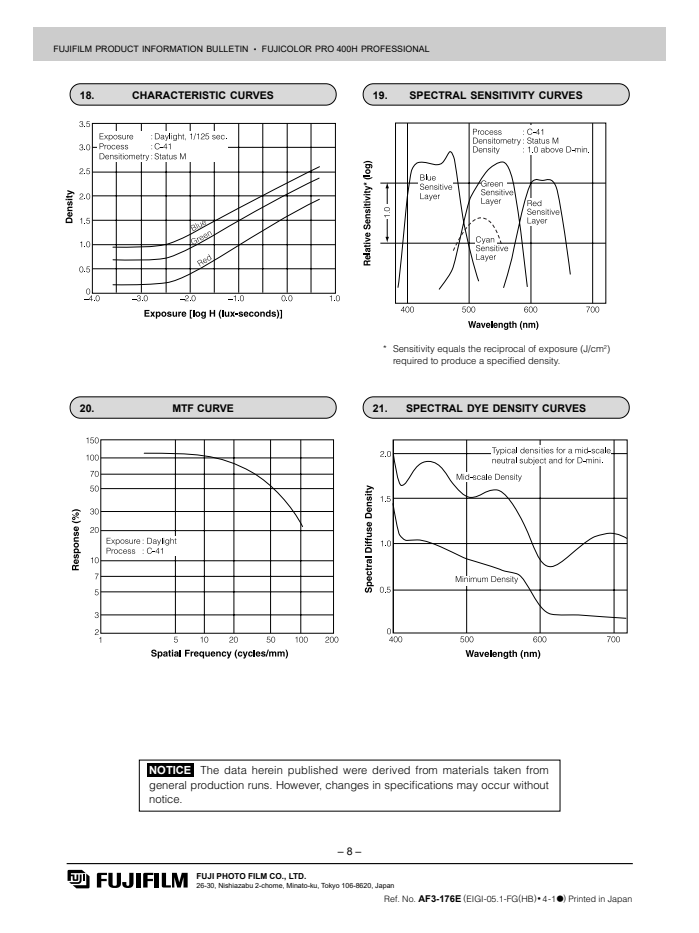
Fujicolor Pro 400H Professional is a daylight color negative film with an ISO speed of 400 intended for professional use. In addition to the conventional three RGB-sensitive layers, it features a fourth color-sensitive layer. The film is designed for ...
-
![]() Fujifilm (n.d.): Product Information Bulletin, Color Negative Films. Fujicolor Pro 400H Professional (AF3-176E), p. 8.
2 Images
Fujicolor Pro 160 S Professional is a daylight color negative film with an ISO speed of 160 intended for professional use. In addition to the conventional three RGB-sensitive layers, it features a fourth color-sensitive layer, combined with new ...
-
![]() Fujifilm (n.d.): Product Information Bulletin, Color Negative Films. Fujicolor Pro 160S Professional (AF3-203U), p. 8.

2 Images
Fujicolor Pro 160C Professional is a daylight color negative film with an ISO speed of 160 intended for professional use. In addition to the conventional three RGB-sensitive layers, it features a fourth color-sensitive layer, combined with new ...
-
![]() Fujifilm (n.d.): Product Information Bulletin, Color Negative Films. Fujicolor Pro 160 C Professional (AF3-204U), p. 8.

2 Images
 Timeline of Historical Film Colors by Barbara Flueckiger is licensed under a Creative Commons Attribution-NonCommercial-NoDerivatives 4.0 International License.
Quote as Flueckiger, Barbara (2012 ff.): Timeline of Historical Film Colors. (= https://filmcolors.org/).
Download BibTex