
Select Category▼×
- All Categories
- Bibliography
- Chromogenic monopack
- Chromolytic multilayer
- Color separation
- Double-coated / bi-pack
- Edge Codes and Identification
- Hand coloring
- Other
- Printing / dye-transfer
- Printing / pigment process
- Screen processes
- Spatial synthesis (multiple lenses, beam splitter)
- Stencil coloring (pochoir, Pathécolor)
- Temporal synthesis (rotary filters)
- Theory
- Tinting
- Toning
-
![]() Principle of capturing and projecting lenticular film. Credit: Joakim Reuteler and Rudolf Gschwind, Digital Humanities Lab, University of Basel, Switzerland. Illustration by Sarah Steinbacher, Multimedia & E-Learning-Services, University of Zurich.
Principle of capturing and projecting lenticular film. Credit: Joakim Reuteler and Rudolf Gschwind, Digital Humanities Lab, University of Basel, Switzerland. Illustration by Sarah Steinbacher, Multimedia & E-Learning-Services, University of Zurich.

1 Image
For more information on the Agfacolor process see the detail page Agfacolor Neu / Agfacolor.
-
![]() Agfacolor B original negative. Credit: Národní filmový archiv / National Film Archive, Prague. Film: Jan Roháč z Dubé (Czechoslovakia 1947, Vladimír Borsky).
Agfacolor B original negative. Credit: Národní filmový archiv / National Film Archive, Prague. Film: Jan Roháč z Dubé (Czechoslovakia 1947, Vladimír Borsky).
- Faded Agfacolor period nitrate print. Credit: Národní filmový archiv / National Film Archive, Prague. Film: Jan Roháč z Dubé (Czechoslovakia 1947, Vladimír Borský).
- Agfacolor B original negative. Credit: Národní filmový archiv / National Film Archive, Prague. Film: Jan Roháč z Dubé (Czechoslovakia 1947, Vladimír Borsky).
- Faded Agfacolor period nitrate print. Credit: Národní filmový archiv / National Film Archive, Prague. Film: Jan Roháč z Dubé (Czechoslovakia 1947, Vladimír Borský).
- Agfacolor B original negative. Credit: Národní filmový archiv / National Film Archive, Prague. Film: Jan Roháč z Dubé (Czechoslovakia 1947, Vladimír Borsky).
- Agfacolor B original negative. Credit: Národní filmový archiv / National Film Archive, Prague. Film: Kvítí z Čech (Czechoslovakia 1947, dir. Václav Jan Staněk).
- Agfacolor positive nitrate print. Credit: Národní filmový archiv / National Film Archive, Prague. Film: Kvítí z Čech (Czechoslovakia 1947, dir. Václav Jan Staněk).
- Agfacolor positive nitrate print. Credit: Národní filmový archiv / National Film Archive, Prague. Film: Kvítí z Čech (Czechoslovakia 1947, dir. Václav Jan Staněk).
- Agfacolor B original negative. Credit: Národní filmový archiv / National Film Archive, Prague. Film: Mistr třeboňský (Czechoslovakia 1950, dir. František Kudláč).
- Agfacolor B original negative. Credit: Národní filmový archiv / National Film Archive, Prague. Film: Mistr třeboňský (Czechoslovakia 1950, dir. František Kudláč).
- Agfacolor positive nitrate print. Credit: Národní filmový archiv / National Film Archive, Prague. Film: Mistr třeboňský (Czechoslovakia 1950, dir. František Kudláč).
- Agfacolor B original negative. Credit: Národní filmový archiv / National Film Archive, Prague. Film: Praha v říjnu (Czechoslovakia 1945, dir. František Sádek).
- Faded Agfacolor period nitrate print. Credit: Národní filmový archiv / National Film Archive, Prague. Film: Praha v říjnu (Czechoslovakia 1945, dir. František Sádek).
- Agfacolor B original negative. Credit: Národní filmový archiv / National Film Archive, Prague. Film: Praha v říjnu (Czechoslovakia 1945, dir. František Sádek).
- Agfacolor B original negative. Credit: Národní filmový archiv / National Film Archive, Prague. Film: Zasadil dědek řepu (Czechoslovakia 1945, dir. Jiří Trnka).
- Agfacolor positive nitrate print. Credit: Národní filmový archiv / National Film Archive, Prague. Film: Zasadil dědek řepu (Czechoslovakia 1945, Jiří Trnka).
- Agfacolor positive nitrate print. Credit: Národní filmový archiv / National Film Archive, Prague. Film: Zasadil dědek řepu (Czechoslovakia 1945, Jiří Trnka).
- Credit: By courtesy of Deutsche Kinemathek, Berlin. Photograph by Barbara Flueckiger. Film: 1/50 Sekunde, commercial for Niggemeyer Foto/Kino (1952).
- Schmidt, Richard / Kochs, Adolf (1943): Farbfilmtechnik. Eine Einführung für Filmschaffende. Berlin: Hesse, pp. 77-98. (Schriftenreihe der Reichsfilmkammer, 10.) (in German) [quote cite='35875']
- Schmidt, Richard / Kochs, Adolf (1943): Farbfilmtechnik. Eine Einführung für Filmschaffende. Berlin: Hesse, pp. 77-98. (Schriftenreihe der Reichsfilmkammer, 10.) (in German) [quote cite='35875']
- Schmidt, Richard / Kochs, Adolf (1943): Farbfilmtechnik. Eine Einführung für Filmschaffende. Berlin: Hesse, pp. 77-98. (Schriftenreihe der Reichsfilmkammer, 10.) (in German) [quote cite='35875']

21 Images
Agfacolor Negative type G was a chromogenic camera negative balanced for Tungsten illumination.
-
![]() Original Agfacolor negative G. Credit: Národní filmový archiv / National Film Archive, Prague. Film: Neposlušný zajíček (German title Klein, aber Oho!, Horst von Möllendorff, Czechoslovakia 1944).
Original Agfacolor negative G. Credit: Národní filmový archiv / National Film Archive, Prague. Film: Neposlušný zajíček (German title Klein, aber Oho!, Horst von Möllendorff, Czechoslovakia 1944).
- Schmidt, Richard / Kochs, Adolf (1943): Farbfilmtechnik. Eine Einführung für Filmschaffende. Berlin: Hesse, pp. 77-98. (Schriftenreihe der Reichsfilmkammer, 10.) (in German) [quote cite='35875']
- Schmidt, Richard / Kochs, Adolf (1943): Farbfilmtechnik. Eine Einführung für Filmschaffende. Berlin: Hesse, pp. 77-98. (Schriftenreihe der Reichsfilmkammer, 10.) (in German) [quote cite='35875']

14 Images in 2 Galleries
For more information on the Agfacolor chromogenic process see Agfacolor Neu / Agfacolor.
-
![]() Agfacolor B negative on Agfacolor positive. Credit: Národní filmový archiv / National Film Archive, Prague. Film: Tábor (Oldřich Mirad, Czechoslovakia 1953). Photograph by Barbara Flueckiger.
Agfacolor B negative on Agfacolor positive. Credit: Národní filmový archiv / National Film Archive, Prague. Film: Tábor (Oldřich Mirad, Czechoslovakia 1953). Photograph by Barbara Flueckiger.

37 Images in 2 Galleries
-
![]() Cross section of Inducolor-print, leader only, title unknown. Credit: Carsta Knaack, HTW Berlin.
Cross section of Inducolor-print, leader only, title unknown. Credit: Carsta Knaack, HTW Berlin.
- Leader of print, title and age unknown. Credit: Carsta Knaack, HTW Berlin.

2 Images
-
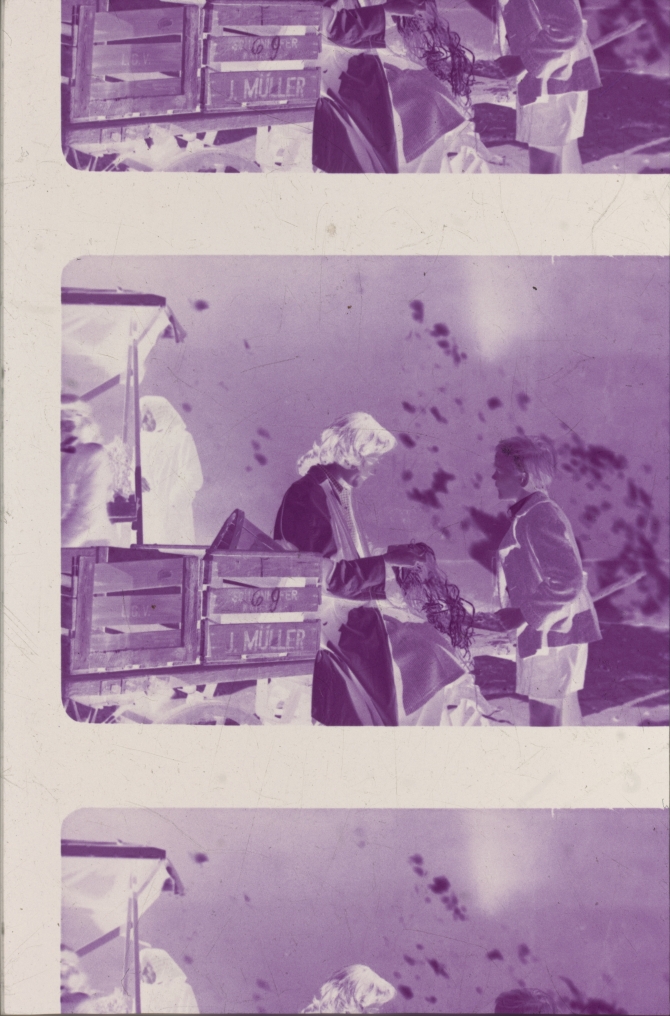
![]() No masking in the negative. Credit: Collection Gert Koshofer, Bergisch Gladbach (Germany).
No masking in the negative. Credit: Collection Gert Koshofer, Bergisch Gladbach (Germany).
4 Images in 1 Gallery
“The Fujicolor process is a three-color subtractive negative/positive process introduced in 1955 by the Fuji Photo Film Co., Ltd., Tokyo, Japan.
When the process was introduced it consisted of two elements that could be used singly or together. ...
-
![]() Don't Look Now (GBR / ITA 1973, Nicolas Roeg). Credit: BFI National Film Archive. Photographs of the faded Fujicolor HP Positive Film Type 8813 by Joëlle Kost, ERC Advanced Grant FilmColors.
Don't Look Now (GBR / ITA 1973, Nicolas Roeg). Credit: BFI National Film Archive. Photographs of the faded Fujicolor HP Positive Film Type 8813 by Joëlle Kost, ERC Advanced Grant FilmColors.

141 Images in 7 Galleries
 Timeline of Historical Film Colors by Barbara Flueckiger is licensed under a Creative Commons Attribution-NonCommercial-NoDerivatives 4.0 International License.
Quote as Flueckiger, Barbara (2012 ff.): Timeline of Historical Film Colors. (= https://filmcolors.org/).
Download BibTex