
-
![]() Credit: Brian Pritchard.
Credit: Brian Pritchard.
Select Category▼×
- All Categories
- Bibliography
- Chromogenic monopack
- Chromolytic multilayer
- Color separation
- Double-coated / bi-pack
- Edge Codes and Identification
- Hand coloring
- Other
- Printing / dye-transfer
- Printing / pigment process
- Screen processes
- Spatial synthesis (multiple lenses, beam splitter)
- Stencil coloring (pochoir, Pathécolor)
- Temporal synthesis (rotary filters)
- Theory
- Tinting
- Toning

-
![]() Source: Klein, Adrian Bernhard (Cornwell-Clyne) (1940): Colour Cinematography. Boston: American Photographic Pub. Co.
Source: Klein, Adrian Bernhard (Cornwell-Clyne) (1940): Colour Cinematography. Boston: American Photographic Pub. Co.
- Source: Klein, Adrian Bernhard (Cornwell-Clyne) (1940): Colour Cinematography. Boston: American Photographic Pub. Co.
- Source: Coe, Brian (1981): The History of Movie Photography. Westfield, N.J.: Eastview Editions.
- Schmidt, Richard / Kochs, Adolf (1943): Farbfilmtechnik. Eine Einführung für Filmschaffende. Berlin: Hesse, pp. 54-72. (Schriftenreihe der Reichsfilmkammer, 10.) (in German) [quote id='5']
- Schmidt, Richard / Kochs, Adolf (1943): Farbfilmtechnik. Eine Einführung für Filmschaffende. Berlin: Hesse, pp. 54-72. (Schriftenreihe der Reichsfilmkammer, 10.) (in German) [quote id='5']

9 Images in 1 Gallery
“Harmonicoior was developed by French chemist Maurice Combes. It was first formally demonstrated in London by Harmonicoior Films Ltd, of 4 Great Winchester Street, on the 23 March 1936 at the Curzon Soho with the film Talking Hands, produced at ...
“The New Agfacolor Process;
Agfa Ansco Corp., Binghamton, N. Y.
A survey of the history of monopack or multilayer photographic color processes is given, including the coloring methods of greatest importance at the present time. These are: (a) ...
-
![]() Münchhausen (Josef von Báky, Germany 1943). Credit: Bundesarchiv Filmarchiv and Friedrich-Wilhelm-Murnau-Stiftung. Photographs of the Agfacolor safety print (acetate) by Barbara Flueckiger.
Münchhausen (Josef von Báky, Germany 1943). Credit: Bundesarchiv Filmarchiv and Friedrich-Wilhelm-Murnau-Stiftung. Photographs of the Agfacolor safety print (acetate) by Barbara Flueckiger.
- Opfergang (GER 1944, Veit Harlan), magnification. Credit: Print from the Filmmuseum Düsseldorf. © Friedrich Wilhelm Murnau Foundation, Wiesbaden. Photograph by Barbara Flueckiger.
- Paper print. Source: Serda, Charlott (1941): Das Farbfoto-Buch vom Film. Breitkopf & Härtel: Leipzig.
- Parade (1960). Credit: Harvard Film Archive, Brandon Film Library Collection, item no. 14303. Photographs of Agfacolor negative on Orwocolor reversal print by Barbara Flueckiger.
- Parade (1960). Credit: Harvard Film Archive, Brandon Film Library Collection, item no. 14303. Photographs of Agfacolor negative on Orwocolor reversal print by Barbara Flueckiger.
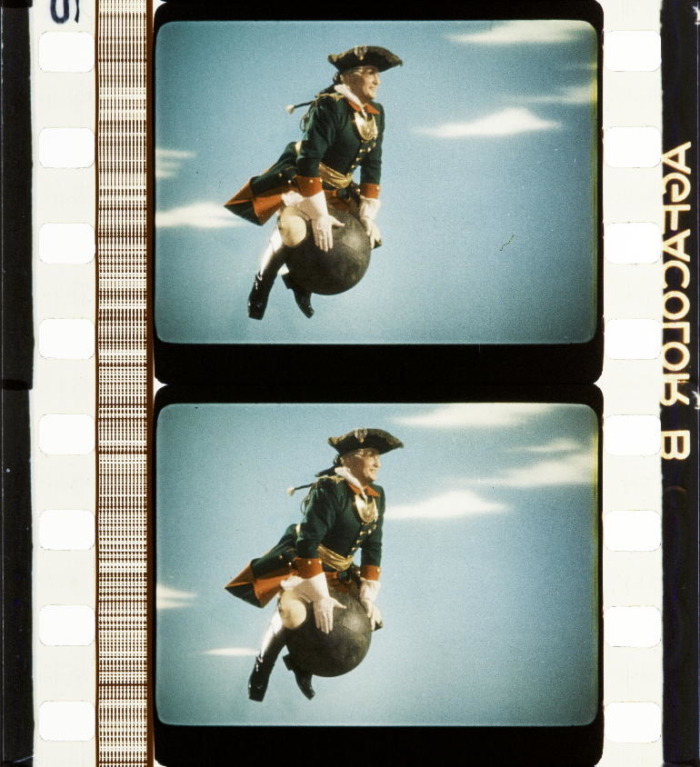
640 Images in 21 Galleries
-
![]() Credit: Geo. Willeman, Nitrate Film Vault Manager, Library of Congress. Film: Captain Calamity (1936)
Credit: Geo. Willeman, Nitrate Film Vault Manager, Library of Congress. Film: Captain Calamity (1936)
- Credit: Geo. Willeman, Nitrate Film Vault Manager, Library of Congress. Film: Captain Calamity (1936)

2 Images
-
![]() Zaveshchanie/The Testament (7 June 1937). Credit: Courtesy of Nikolai Mayorov.
Zaveshchanie/The Testament (7 June 1937). Credit: Courtesy of Nikolai Mayorov.
- Zaveshchanie/The Testament (7 June 1937). Credit: Courtesy of Nikolai Mayorov. Credit: Courtesy of Nikolai Mayorov.
- The Miraculous Traffic Light (1938). Credit: courtesy of Nikolai Mayorov
- The Wolf and Seven Goat-Kids (1938). Credit: Courtesy of Nikolai Mayorov.
- The Fox and the Wolf (1937). Credit: Courtesy of Nikolai Mayorov.
- The Fox and the Wolf (1937). Credit: Courtesy of Nikolai Mayorov.

6 Images
-
![]() Principle of capturing and projecting lenticular film. Credit: Joakim Reuteler and Rudolf Gschwind, Digital Humanities Lab, University of Basel, Switzerland. Illustration by Sarah Steinbacher, Multimedia & E-Learning-Services, University of Zurich.
Principle of capturing and projecting lenticular film. Credit: Joakim Reuteler and Rudolf Gschwind, Digital Humanities Lab, University of Basel, Switzerland. Illustration by Sarah Steinbacher, Multimedia & E-Learning-Services, University of Zurich.
- Principle of capturing and projecting lenticular film. Credit: Joakim Reuteler and Rudolf Gschwind, Digital Humanities Lab, University of Basel, Switzerland. Illustration by Sarah Steinbacher, Multimedia & E-Learning-Services, University of Zurich.
- Principle of capturing and projecting lenticular film. Credit: Joakim Reuteler and Rudolf Gschwind, Digital Humanities Lab, University of Basel, Switzerland. Illustration by Sarah Steinbacher, Multimedia & E-Learning-Services, University of Zurich.
- Credit: Illustration by Sarah Steinbacher, Multimedia & E-Learning-Services, University of Zurich. Source: Ede, François (1994): Jour de fête ou la couleur retrouvée. Cahiers du Cinéma: Paris.
- Schmidt, Richard / Kochs, Adolf (1943): Farbfilmtechnik. Eine Einführung für Filmschaffende. Berlin: Hesse, pp. 54-72. (Schriftenreihe der Reichsfilmkammer, 10.) (in German) [quote id='6']

5 Images
“Agfacolor Ultra Plate (1936–1938): colored particles very small and not visible to the naked eye, but clumps of particles of the same color give the image a pointillist effect (Fig. 2.65). Unlike with the autochromes, in which the grains are ...
-
![]() Pénichon, Sylvie (2013): Twentieth Century Colour Photographs. The Complete Guide to Processes, Identification & Preservation. London, Los Angeles: Thames & Hudson, p. 74.
Pénichon, Sylvie (2013): Twentieth Century Colour Photographs. The Complete Guide to Processes, Identification & Preservation. London, Los Angeles: Thames & Hudson, p. 74.

1 Image
Although Kodachrome 16mm reversal film was introduced as an amateur film format, rapidly after its introduction it became a format frequently used by (semi-)professional film makers. The reason was that Kodachrome was a relatively easy to use film ...
“In October, Eggert of the Agfa Research Department, read a paper at the Berlin meeting of the Deutsche Gesellschaft für photographische Forschung, on the Pantochrom subtractive lenticular bipack tricolor process. (Fig. 1) The green and blue ...
-
![]() Agfa Pantachrom. Source: Arens, Hans; Heymer, Gerd (1939): Die „Agfa-Farbentafel für Farbenphotographie“. In: Veröffentlichungen des wissenschaftlichen Zentral-Laboratoriums der photographischen Abteilung Agfa, Vol. 6, 1939, pp. 225-229. Leipzig: Hirzel. Photograph by Martin Weiss, ERC Advanced Grant FilmColors.
Agfa Pantachrom. Source: Arens, Hans; Heymer, Gerd (1939): Die „Agfa-Farbentafel für Farbenphotographie“. In: Veröffentlichungen des wissenschaftlichen Zentral-Laboratoriums der photographischen Abteilung Agfa, Vol. 6, 1939, pp. 225-229. Leipzig: Hirzel. Photograph by Martin Weiss, ERC Advanced Grant FilmColors.

19 Images in 3 Galleries
-
![]() Source: Ryan, Roderick T. (1977): A History of Motion Picture Color Technology. London: Focal Press.
Source: Ryan, Roderick T. (1977): A History of Motion Picture Color Technology. London: Focal Press.
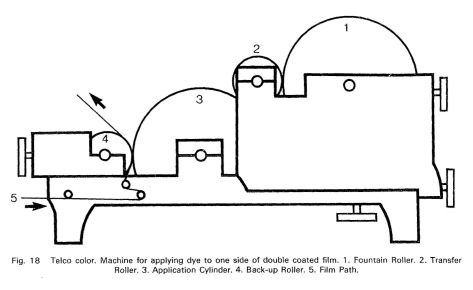
1 Image
Similar to Technicolor, the Iriscolor process needed a special beam-splitter camera for exposing three black-and-white negatives on Kodak film stock. These negatives were used for imbibition printing.
Between 1940 and 1942, Tobis Tonbild-Syndikat AG ...
Duplicating stock for reversal film. Replaced Kodachrome duplicating stock type 5262. Contrary to its predecessor the new stock was not suited as camera material. Type 5265 could only be used for duplication.
During the 1940s Kodachrome was used as camera material for films that were blown up to 35mm Technicolor projection prints. Technicolor used this technology from 1942 until the mid-1950s when Eastman Kodak introduced the Eastmancolor ...
For more information on the Agfacolor process see the detail page Agfacolor Neu / Agfacolor.
-
![]() Agfacolor B original negative. Credit: Národní filmový archiv / National Film Archive, Prague. Film: Jan Roháč z Dubé (Czechoslovakia 1947, Vladimír Borsky).
Agfacolor B original negative. Credit: Národní filmový archiv / National Film Archive, Prague. Film: Jan Roháč z Dubé (Czechoslovakia 1947, Vladimír Borsky).
- Faded Agfacolor period nitrate print. Credit: Národní filmový archiv / National Film Archive, Prague. Film: Jan Roháč z Dubé (Czechoslovakia 1947, Vladimír Borský).
- Agfacolor B original negative. Credit: Národní filmový archiv / National Film Archive, Prague. Film: Jan Roháč z Dubé (Czechoslovakia 1947, Vladimír Borsky).
- Faded Agfacolor period nitrate print. Credit: Národní filmový archiv / National Film Archive, Prague. Film: Jan Roháč z Dubé (Czechoslovakia 1947, Vladimír Borský).
- Agfacolor B original negative. Credit: Národní filmový archiv / National Film Archive, Prague. Film: Jan Roháč z Dubé (Czechoslovakia 1947, Vladimír Borsky).
- Agfacolor B original negative. Credit: Národní filmový archiv / National Film Archive, Prague. Film: Kvítí z Čech (Czechoslovakia 1947, dir. Václav Jan Staněk).
- Agfacolor positive nitrate print. Credit: Národní filmový archiv / National Film Archive, Prague. Film: Kvítí z Čech (Czechoslovakia 1947, dir. Václav Jan Staněk).
- Agfacolor positive nitrate print. Credit: Národní filmový archiv / National Film Archive, Prague. Film: Kvítí z Čech (Czechoslovakia 1947, dir. Václav Jan Staněk).
- Agfacolor B original negative. Credit: Národní filmový archiv / National Film Archive, Prague. Film: Mistr třeboňský (Czechoslovakia 1950, dir. František Kudláč).
- Agfacolor B original negative. Credit: Národní filmový archiv / National Film Archive, Prague. Film: Mistr třeboňský (Czechoslovakia 1950, dir. František Kudláč).
- Agfacolor positive nitrate print. Credit: Národní filmový archiv / National Film Archive, Prague. Film: Mistr třeboňský (Czechoslovakia 1950, dir. František Kudláč).
- Agfacolor B original negative. Credit: Národní filmový archiv / National Film Archive, Prague. Film: Praha v říjnu (Czechoslovakia 1945, dir. František Sádek).
- Faded Agfacolor period nitrate print. Credit: Národní filmový archiv / National Film Archive, Prague. Film: Praha v říjnu (Czechoslovakia 1945, dir. František Sádek).
- Agfacolor B original negative. Credit: Národní filmový archiv / National Film Archive, Prague. Film: Praha v říjnu (Czechoslovakia 1945, dir. František Sádek).
- Agfacolor B original negative. Credit: Národní filmový archiv / National Film Archive, Prague. Film: Zasadil dědek řepu (Czechoslovakia 1945, dir. Jiří Trnka).
- Agfacolor positive nitrate print. Credit: Národní filmový archiv / National Film Archive, Prague. Film: Zasadil dědek řepu (Czechoslovakia 1945, Jiří Trnka).
- Agfacolor positive nitrate print. Credit: Národní filmový archiv / National Film Archive, Prague. Film: Zasadil dědek řepu (Czechoslovakia 1945, Jiří Trnka).
- Credit: By courtesy of Deutsche Kinemathek, Berlin. Photograph by Barbara Flueckiger. Film: 1/50 Sekunde, commercial for Niggemeyer Foto/Kino (1952).
- Schmidt, Richard / Kochs, Adolf (1943): Farbfilmtechnik. Eine Einführung für Filmschaffende. Berlin: Hesse, pp. 77-98. (Schriftenreihe der Reichsfilmkammer, 10.) (in German) [quote cite='35875']
- Schmidt, Richard / Kochs, Adolf (1943): Farbfilmtechnik. Eine Einführung für Filmschaffende. Berlin: Hesse, pp. 77-98. (Schriftenreihe der Reichsfilmkammer, 10.) (in German) [quote cite='35875']
- Schmidt, Richard / Kochs, Adolf (1943): Farbfilmtechnik. Eine Einführung für Filmschaffende. Berlin: Hesse, pp. 77-98. (Schriftenreihe der Reichsfilmkammer, 10.) (in German) [quote cite='35875']

21 Images
Agfacolor Negative type G was a chromogenic camera negative balanced for Tungsten illumination.
-
![]() Original Agfacolor negative G. Credit: Národní filmový archiv / National Film Archive, Prague. Film: Neposlušný zajíček (German title Klein, aber Oho!, Horst von Möllendorff, Czechoslovakia 1944).
Original Agfacolor negative G. Credit: Národní filmový archiv / National Film Archive, Prague. Film: Neposlušný zajíček (German title Klein, aber Oho!, Horst von Möllendorff, Czechoslovakia 1944).
- Schmidt, Richard / Kochs, Adolf (1943): Farbfilmtechnik. Eine Einführung für Filmschaffende. Berlin: Hesse, pp. 77-98. (Schriftenreihe der Reichsfilmkammer, 10.) (in German) [quote cite='35875']
- Schmidt, Richard / Kochs, Adolf (1943): Farbfilmtechnik. Eine Einführung für Filmschaffende. Berlin: Hesse, pp. 77-98. (Schriftenreihe der Reichsfilmkammer, 10.) (in German) [quote cite='35875']

14 Images in 2 Galleries
For more information on the Agfacolor chromogenic process see Agfacolor Neu / Agfacolor.
-
![]() Agfacolor B negative on Agfacolor positive. Credit: Národní filmový archiv / National Film Archive, Prague. Film: Tábor (Oldřich Mirad, Czechoslovakia 1953). Photograph by Barbara Flueckiger.
Agfacolor B negative on Agfacolor positive. Credit: Národní filmový archiv / National Film Archive, Prague. Film: Tábor (Oldřich Mirad, Czechoslovakia 1953). Photograph by Barbara Flueckiger.

37 Images in 2 Galleries
Kodachrome Professional was introduced in 1942 to be used as camera material. It was the Kodachrome material that was blown up to 35mm Technicolor dye transfer prints, which was the Technicolor Monopack system.
According to Norris Pope this material ...
“Ansco Color Printon
In 1943 Ansco followed suit and launched a printing material on white-pigmented acetate base called Ansco Color Printon (Fig. 5.7). Initially, Printon was made accessible only to the military. After 1945 it became available to ...
-
![]() Pénichon, Sylvie (2013): Twentieth Century Colour Photographs. The Complete Guide to Processes, Identification & Preservation. London, Los Angeles: Thames & Hudson, p. 167.
Pénichon, Sylvie (2013): Twentieth Century Colour Photographs. The Complete Guide to Processes, Identification & Preservation. London, Los Angeles: Thames & Hudson, p. 167.
- Pénichon, Sylvie (2013): Twentieth Century Colour Photographs. The Complete Guide to Processes, Identification & Preservation. London, Los Angeles: Thames & Hudson, p. 166.

2 Images
-
![]() Skleněné varhany (Stěklanna je garmonika, Andrej Chržanovskij, USSR 1968). Credit: Národní filmový archiv / National Film Archive, Prague. Photograph by Barbara Flueckiger
Skleněné varhany (Stěklanna je garmonika, Andrej Chržanovskij, USSR 1968). Credit: Národní filmový archiv / National Film Archive, Prague. Photograph by Barbara Flueckiger

15 Images in 3 Galleries
-
![]() Source: Cornwell-Clyne, Adrian (1951): Colour Cinematography. London: Chapman & Hall.
Source: Cornwell-Clyne, Adrian (1951): Colour Cinematography. London: Chapman & Hall.
- Credit: Illustration by Sarah Steinbacher, Multimedia & E-Learning-Services, University of Zurich. Source: Cornwell-Clyne, Adrian (1951): Colour Cinematography. London: Chapman & Hall.
- Credit: Illustration by Sarah Steinbacher, Multimedia & E-Learning-Services, University of Zurich. Source: Cornwell-Clyne, Adrian (1951): Colour Cinematography. London: Chapman & Hall.
- Credit: Illustration by Sarah Steinbacher, Multimedia & E-Learning-Services, University of Zurich. Source: Cornwell-Clyne, Adrian (1951): Colour Cinematography. London: Chapman & Hall.
- Credit: Illustration by Sarah Steinbacher, Multimedia & E-Learning-Services, University of Zurich. Source: Cornwell-Clyne, Adrian (1951): Colour Cinematography. London: Chapman & Hall.
- Coote, Jack (1948): New Three-Color Camera, In: Journal of the Society of Motion Picture Engineers, vol. 50, June 1948, pp. 543-553.
- Coote, Jack (1948): New Three-Color Camera, In: Journal of the Society of Motion Picture Engineers, vol. 50, June 1948, pp. 543-553.
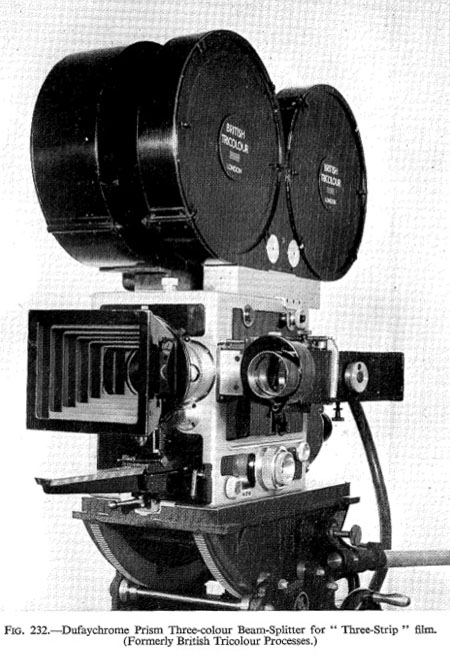
19 Images in 3 Galleries
 Timeline of Historical Film Colors by Barbara Flueckiger is licensed under a Creative Commons Attribution-NonCommercial-NoDerivatives 4.0 International License.
Quote as Flueckiger, Barbara (2012 ff.): Timeline of Historical Film Colors. (= https://filmcolors.org/).
Download BibTex