
- All Categories
- Bibliography
- Chromogenic monopack
- Chromolytic multilayer
- Color separation
- Double-coated / bi-pack
- Edge Codes and Identification
- Hand coloring
- Other
- Printing / dye-transfer
- Printing / pigment process
- Screen processes
- Spatial synthesis (multiple lenses, beam splitter)
- Stencil coloring (pochoir, Pathécolor)
- Temporal synthesis (rotary filters)
- Theory
- Tinting
- Toning
-
![]() Source: Pénichon, Sylvie (2013): Twentieth Century Colour Photographs. The Complete Guide to Processes, Identification & Preservation. London, Los Angeles: Thames & Hudson, p. 218.
Source: Pénichon, Sylvie (2013): Twentieth Century Colour Photographs. The Complete Guide to Processes, Identification & Preservation. London, Los Angeles: Thames & Hudson, p. 218.

1 Image
-
![]() Source: Pénichon, Sylvie (2013): Twentieth Century Colour Photographs. The Complete Guide to Processes, Identification & Preservation. London, Los Angeles: Thames & Hudson, p. 73.
Source: Pénichon, Sylvie (2013): Twentieth Century Colour Photographs. The Complete Guide to Processes, Identification & Preservation. London, Los Angeles: Thames & Hudson, p. 73.

1 Image
-
![]() Source: Pénichon, Sylvie (2013): Twentieth Century Colour Photographs. The Complete Guide to Processes, Identification & Preservation. London, Los Angeles: Thames & Hudson, p. 72.
Source: Pénichon, Sylvie (2013): Twentieth Century Colour Photographs. The Complete Guide to Processes, Identification & Preservation. London, Los Angeles: Thames & Hudson, p. 72.

1 Image
-
![]() Source: Pénichon, Sylvie (2013): Twentieth Century Colour Photographs. The Complete Guide to Processes, Identification & Preservation. London, Los Angeles: Thames & Hudson, p. 76.
Source: Pénichon, Sylvie (2013): Twentieth Century Colour Photographs. The Complete Guide to Processes, Identification & Preservation. London, Los Angeles: Thames & Hudson, p. 76.

1 Image
-
![]() Pénichon, Sylvie (2013): Twentieth Century Colour Photographs. The Complete Guide to Processes, Identification & Preservation. London, Los Angeles: Thames & Hudson, p. 76.
Pénichon, Sylvie (2013): Twentieth Century Colour Photographs. The Complete Guide to Processes, Identification & Preservation. London, Los Angeles: Thames & Hudson, p. 76.

1 Image
-
![]() Pénichon, Sylvie (2013): Twentieth Century Colour Photographs. The Complete Guide to Processes, Identification & Preservation. London, Los Angeles: Thames & Hudson, p. 74.
Pénichon, Sylvie (2013): Twentieth Century Colour Photographs. The Complete Guide to Processes, Identification & Preservation. London, Los Angeles: Thames & Hudson, p. 74.

1 Image
-
![]() Source: U.S.P. 730454
Source: U.S.P. 730454

1 Image
-
![]() Polychromide samples from the Kodak Film Samples Collection at the National Science and Media Museum in Bradford.
Credit: National Science and Media Museum Bradford.
Photographs by Barbara Flueckiger in collaboration with Noemi Daugaard.
Polychromide samples from the Kodak Film Samples Collection at the National Science and Media Museum in Bradford.
Credit: National Science and Media Museum Bradford.
Photographs by Barbara Flueckiger in collaboration with Noemi Daugaard.
- Credit: Brian Pritchard
- Source: Pénichon, Sylvie (2013): Twentieth Century Colour Photographs. The Complete Guide to Processes, Identification & Preservation. London, Los Angeles: Thames & Hudson, p. 279.

66 Images in 2 Galleries
-
![]() Credit: Illustration by Sarah Steinbacher, Multimedia & E-Learning-Services, University of Zurich. Source: Klein, Adrian Bernhard (Cornwell-Clyne) (1940): Colour Cinematography. Boston: American Photographic Pub. Co.
Credit: Illustration by Sarah Steinbacher, Multimedia & E-Learning-Services, University of Zurich. Source: Klein, Adrian Bernhard (Cornwell-Clyne) (1940): Colour Cinematography. Boston: American Photographic Pub. Co.
- Source: Klein, Adrian Bernhard (Cornwell-Clyne) (1940): Colour Cinematography. Boston: American Photographic Pub. Co.
- Source: Klein, Adrian Bernhard (Cornwell-Clyne) (1940): Colour Cinematography. Boston: American Photographic Pub. Co.
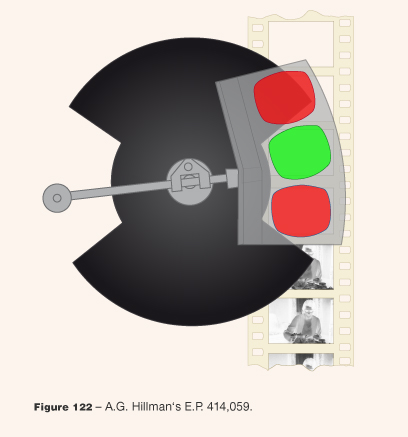
3 Images
-
![]() Credit: EYE Film Institute Amsterdam. Photograph by Barbara Flueckiger.
Credit: EYE Film Institute Amsterdam. Photograph by Barbara Flueckiger.

12 Images in 1 Gallery
-
![]() NEW!
Soon negative color FOTON daylight films will be available.
FOTONKOLOR NS
roll film 120
FOTONKOLOR NS
roll film 620
FOTONCOLOR NS
roll film 127
FOTONCOLOR NS
35mm (in cartridge)
FOTONCOLOR NS
sheet film
Fotoncolor NS will be possible to expose like 16° DIN, 32 ASA black and white negative film.
NEW!
Soon negative color FOTON daylight films will be available.
FOTONKOLOR NS
roll film 120
FOTONKOLOR NS
roll film 620
FOTONCOLOR NS
roll film 127
FOTONCOLOR NS
35mm (in cartridge)
FOTONCOLOR NS
sheet film
Fotoncolor NS will be possible to expose like 16° DIN, 32 ASA black and white negative film.

1 Image
-
![]() Credit: Geo. Willeman, Nitrate Film Vault Manager, Library of Congress. Film: The Magic Isle.
Credit: Geo. Willeman, Nitrate Film Vault Manager, Library of Congress. Film: The Magic Isle.
- Credit: Geo. Willeman, Nitrate Film Vault Manager, Library of Congress. Film: The Magic Isle.
- Credit: Geo. Willeman, Nitrate Film Vault Manager, Library of Congress. Film: The Magic Isle.
- Credit: Geo. Willeman, Nitrate Film Vault Manager, Library of Congress. Film: The Magic Isle.
- Credit: Geo. Willeman, Nitrate Film Vault Manager, Library of Congress. Film: The Magic Isle.
- Credit: Geo. Willeman, Nitrate Film Vault Manager, Library of Congress. Film: The Magic Isle.
- Credit: Geo. Willeman, Nitrate Film Vault Manager, Library of Congress. Film: The Magic Isle.
- Credit: Geo. Willeman, Nitrate Film Vault Manager, Library of Congress. Film: The Magic Isle.
- Credit: Geo. Willeman, Nitrate Film Vault Manager, Library of Congress. Film: The Magic Isle.
- Credit: Geo. Willeman, Nitrate Film Vault Manager, Library of Congress. Film: The Magic Isle.
- Credit: Geo. Willeman, Nitrate Film Vault Manager, Library of Congress. Film: The Magic Isle.
- Credit: Geo. Willeman, Nitrate Film Vault Manager, Library of Congress. Film: The Magic Isle.
- Credit: Geo. Willeman, Nitrate Film Vault Manager, Library of Congress. Film: The Magic Isle.
- Credit: Geo. Willeman, Nitrate Film Vault Manager, Library of Congress. Film: The Magic Isle.
- Credit: Geo. Willeman, Nitrate Film Vault Manager, Library of Congress. Film: The Magic Isle.
- Credit: Geo. Willeman, Nitrate Film Vault Manager, Library of Congress. Film: The Magic Isle.
- Credit: Geo. Willeman, Nitrate Film Vault Manager, Library of Congress. Film: The Magic Isle.
- Credit: Geo. Willeman, Nitrate Film Vault Manager, Library of Congress. Film: The Magic Isle.
- Credit: Geo. Willeman, Nitrate Film Vault Manager, Library of Congress. Film: The Magic Isle.
- Credit: Geo. Willeman, Nitrate Film Vault Manager, Library of Congress. Film: The Magic Isle.
- Credit: Geo. Willeman, Nitrate Film Vault Manager, Library of Congress. Film: The Magic Isle.
- Credit: Geo. Willeman, Nitrate Film Vault Manager, Library of Congress. Film: The Magic Isle.
- Credit: Geo. Willeman, Nitrate Film Vault Manager, Library of Congress. Film: The Magic Isle.
- Credit: Geo. Willeman, Nitrate Film Vault Manager, Library of Congress. Film: The Magic Isle.
- Credit: Geo. Willeman, Nitrate Film Vault Manager, Library of Congress. Film: The Magic Isle.
- Credit: Geo. Willeman, Nitrate Film Vault Manager, Library of Congress. Film: The Magic Isle.
- Credit: Geo. Willeman, Nitrate Film Vault Manager, Library of Congress. Film: The Magic Isle.
- Credit: Geo. Willeman, Nitrate Film Vault Manager, Library of Congress. Film: The Magic Isle.
- Credit: Geo. Willeman, Nitrate Film Vault Manager, Library of Congress. Film: The Magic Isle.
- Credit: Geo. Willeman, Nitrate Film Vault Manager, Library of Congress. Film: The Magic Isle.
- Credit: Geo. Willeman, Nitrate Film Vault Manager, Library of Congress. Film: The Magic Isle.
- Credit: Geo. Willeman, Nitrate Film Vault Manager, Library of Congress. Film: The Magic Isle.
- Credit: Geo. Willeman, Nitrate Film Vault Manager, Library of Congress. Film: The Magic Isle.
- Credit: Geo. Willeman, Nitrate Film Vault Manager, Library of Congress. Film: The Magic Isle.
- Credit: Geo. Willeman, Nitrate Film Vault Manager, Library of Congress. Film: The Magic Isle.
- Credit: Geo. Willeman, Nitrate Film Vault Manager, Library of Congress. Film: The Magic Isle.
- Credit: Geo. Willeman, Nitrate Film Vault Manager, Library of Congress. Film: The Magic Isle.
- Credit: Geo. Willeman, Nitrate Film Vault Manager, Library of Congress. Film: The Magic Isle.
- Credit: Geo. Willeman, Nitrate Film Vault Manager, Library of Congress. Film: The Magic Isle.
- Credit: Geo. Willeman, Nitrate Film Vault Manager, Library of Congress. Film: The Magic Isle.

40 Images
-
![]() Frauenschicksale (GDR 1952, Slatan Dudow). Credit: Bundesarchiv Filmarchiv. Photographs of the Orwocolor safety print by Michelle Beutler, ERC Advanced Grant FilmColors.
Frauenschicksale (GDR 1952, Slatan Dudow). Credit: Bundesarchiv Filmarchiv. Photographs of the Orwocolor safety print by Michelle Beutler, ERC Advanced Grant FilmColors.
- Cross section of Orwo positive print. Credit: Carsta Knaack, HTW Berlin. Film: L'Ours (J.-J. Annaud, 1988).
- Cross section schemes of different materials by Orwo. Source: Kaufmann, Siegfried (1976): Vom ersten Farbumkehrfilm zum Orwochrom-System. In: Bild und Ton, 3/1976, p. 88-93.

1026 Images in 27 Galleries
-
![]() Cross section scheme of different Orwo materials. Source: Kaufmann, Siegfried (1976): Vom ersten Umkehrfilm zum Orwochrom-System. In: Bild und Ton 3/1976, pp. 88-93.
Cross section scheme of different Orwo materials. Source: Kaufmann, Siegfried (1976): Vom ersten Umkehrfilm zum Orwochrom-System. In: Bild und Ton 3/1976, pp. 88-93.

84 Images in 3 Galleries
-
![]() Negative. Credit: Národní filmový archiv / National Film Archive, Prague. Film: Princezna se zlatou hvězdou (Martin Frič, Czechoslovakia 1959).
Negative. Credit: Národní filmový archiv / National Film Archive, Prague. Film: Princezna se zlatou hvězdou (Martin Frič, Czechoslovakia 1959).
- Negative. Credit: Národní filmový archiv / National Film Archive, Prague. Film: Princezna se zlatou hvězdou (Martin Frič, Czechoslovakia 1959).
- Negative. Credit: Národní filmový archiv / National Film Archive, Prague. Film: Princezna se zlatou hvězdou (Martin Frič, Czechoslovakia 1959).
- Negative. Credit: Národní filmový archiv / National Film Archive, Prague. Film: Princezna se zlatou hvězdou (Martin Frič, Czechoslovakia 1959).
- Princezna se zlatou hvězdou (CZE 1959, Martin Frič). Credit: Národní filmový archiv / National Film Archive, Prague. Photographs of the Agfacolor B negative on Orwocolor positive by Barbara Flueckiger.
- Princezna se zlatou hvězdou (CZE 1959, Martin Frič). Credit: Národní filmový archiv / National Film Archive, Prague. Photographs of the Agfacolor B negative on Orwocolor positive by Barbara Flueckiger.
- Princezna se zlatou hvězdou (CZE 1959, Martin Frič). Credit: Národní filmový archiv / National Film Archive, Prague. Photographs of the Agfacolor B negative on Orwocolor positive by Barbara Flueckiger.
- Princezna se zlatou hvězdou (CZE 1959, Martin Frič). Credit: Národní filmový archiv / National Film Archive, Prague. Photographs of the Agfacolor B negative on Orwocolor positive by Barbara Flueckiger.
- Princezna se zlatou hvězdou (CZE 1959, Martin Frič). Credit: Národní filmový archiv / National Film Archive, Prague. Photographs of the Agfacolor B negative on Orwocolor positive by Barbara Flueckiger.
- Princezna se zlatou hvězdou (CZE 1959, Martin Frič). Credit: Národní filmový archiv / National Film Archive, Prague. Photographs of the Agfacolor B negative on Orwocolor positive by Barbara Flueckiger.
- Princezna se zlatou hvězdou (CZE 1959, Martin Frič). Credit: Národní filmový archiv / National Film Archive, Prague. Photographs of the Agfacolor B negative on Orwocolor positive by Barbara Flueckiger.

11 Images
Coloring of individual frames by the use of very fine brushes. The process was previously applied to lantern slides. Any water based translucent dye was suited for the process, most often the coloring was done with acid dyes.
-
![]() Loïe Fuller (FRA 1905, Anonymous). Credit: BFI National Archive. Photographs of the hand colored nitrate print by Olivia Kristina Stutz, ERC Advanced Grant FilmColors.
Loïe Fuller (FRA 1905, Anonymous). Credit: BFI National Archive. Photographs of the hand colored nitrate print by Olivia Kristina Stutz, ERC Advanced Grant FilmColors.
- Métamorphoses du papillon (FRA 1904, Gaston Velle). Credit: Library of Congress. Photograph of the nitrate prints by Barbara Flueckiger.
- Credit: Turconi Collection by courtesy of George Eastman Museum, Moving Image Collection. Film: Zara.
- Credit: Paolo Cherchi Usai. Source: Cherchi Usai, Paolo (2000): Silent Cinema. London: BFI.
- Source: Coe, Brian (1981): The History of Movie Photography. Westfield, N.J.: Eastview Editions.
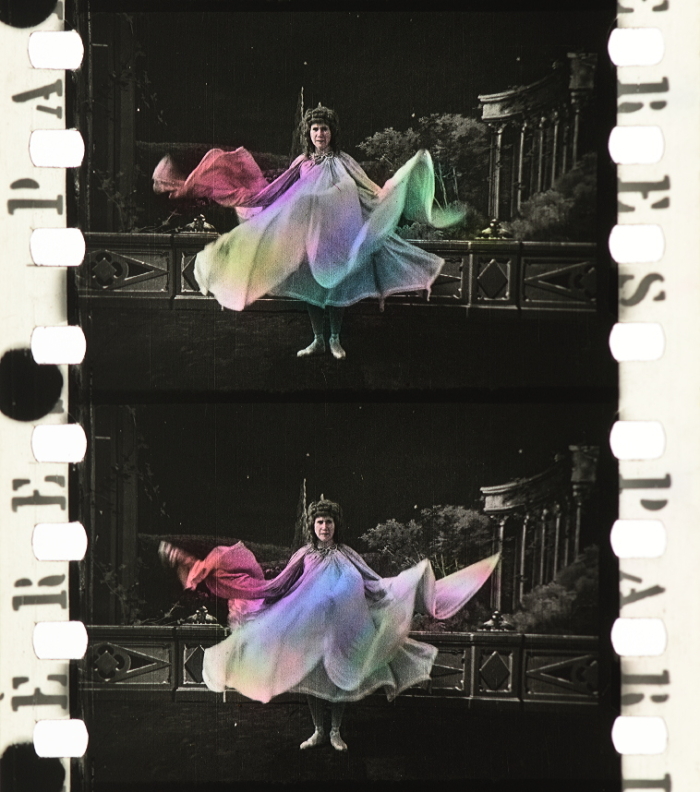
250 Images in 18 Galleries
-
![]() [U-Boot]. Credit: Deutsches Filminstitut DIF. Photograph of the chromolithographic nitrate print by Barbara Flueckiger.
[U-Boot]. Credit: Deutsches Filminstitut DIF. Photograph of the chromolithographic nitrate print by Barbara Flueckiger.
- Box Der Film fürs Heimkino. Credit: Deutsches Filminstitut DIF. iPhone photo by Barbara Flueckiger.
- Box "Film for Home Cinema". Credit: Deutsches Filminstitut DIF. iPhone photo by Barbara Flueckiger.
- Box "Attention! Celluloid Film". Credit: Deutsches Filminstitut DIF. iPhone photo by Barbara Flueckiger.
- Boxes and loops. Credit: Deutsches Filminstitut DIF. iPhone photo by Barbara Flueckiger.
- Box and loops. Credit: Deutsches Filminstitut DIF. iPhone photo by Barbara Flueckiger.
- Film can for Chromolithographic Loop. Credit: Deutsches Filminstitut DIF. iPhone photo by Noemi Daugaard, SNSF Filmcolors
- Film can for Chromolithographic Loop. Credit: Deutsches Filminstitut DIF. iPhone photo by Noemi Daugaard, SNSF Filmcolors

119 Images in 3 Galleries
The first subtractive 2 color process introduced by Technicolor captured the incoming light through a beam splitter with red and green filters also. However, in contrast to the first Technicolor process, the two b/w images were recorded on one negative strip. This was achieved by the pull-down of two frames simultaneously, a process that required the double speed in the camera. These two frames were arranged in pairs, whereby the green record was inverted up-side down (see image).
-
![]() The Phantom of the Opera (USA 1925, Rupert Julian). Credit: UCLA Film & Television Archive. Photographs of the nitrate print by Barbara Flueckiger.
The Phantom of the Opera (USA 1925, Rupert Julian). Credit: UCLA Film & Television Archive. Photographs of the nitrate print by Barbara Flueckiger.
- Credit: Images courtesy of the Margaret Herrick Library. Photograph by Barbara Flueckiger.
- Source: Coe, Brian (1981): The History of Movie Photography. Westfield, N.J.: Eastview Editions.
- Apparently test pieces, these clippings may well be the oldest surviving samples of the process in existence. Ruedel (2009: 55). Credit: George Eastman House Motion Picture Department Collection. Source: Ruedel, Ulrich (2009): The Technicolor Notebooks at the George Eastman House. In: Film History, Volume 21, Number 1, 2009, pp. 47-60.
- Apparently test pieces, these clippings may well be the oldest surviving samples of the process in existence. Ruedel (2009: 55); color reconstruction of the images shown above. Credit: George Eastman House Motion Picture Department Collection. Source: Ruedel, Ulrich (2009): The Technicolor Notebooks at the George Eastman House. In: Film History, Volume 21, Number 1, 2009, pp. 47-60.
- Apparently test pieces, these clippings may well be the oldest surviving samples of the process in existence. Ruedel (2009: 55). Credit: George Eastman House Motion Picture Department Collection. Source: Ruedel, Ulrich (2009): The Technicolor Notebooks at the George Eastman House. In: Film History, Volume 21, Number 1, 2009, pp. 47-60.
- Arrangement of the two records on the camera negative. Credit: Geo. Willeman, Nitrate Film Vault Manager, Library of Congress.
- Film: Stage Struck (USA 1925, Allan Dwan). Credit: Nitrate Frame Collection. George Eastman House Moving Image Collection. Photograph by Barbara Flueckiger.
- Film: Irene (USA 1926, Alfred E. Green). Credit: Nitrate Frame Collection. George Eastman House Moving Image Collection. Photograph by Barbara Flueckiger.
- Film: Irene (USA 1926, Alfred E. Green). Credit: Library of Congress. Photograph by Barbara Flueckiger.
- Film: Irene (USA 1926, Alfred E. Green). Credit: Library of Congress. Photograph by Barbara Flueckiger.
- Film: Irene (USA 1926, Alfred E. Green). Credit: Library of Congress. Photograph by Barbara Flueckiger.
- Film: Irene (USA 1926, Alfred E. Green). Credit: Library of Congress. Photograph by Barbara Flueckiger.
- Film: Irene (USA 1926, Alfred E. Green). Credit: Library of Congress. Photograph by Barbara Flueckiger.

133 Images in 8 Galleries
The third Technicolor process used the same camera as process no. II to combine a pair of frames of the red and green record respectively on the b/w negative (see image). In contrast to the former process, however, the two images were printed on one side of the positive by the dye transfer or imbibition process.
-
![]() King of Jazz (USA 1930, John Murray Anderson). Credit: Library of Congress. Photographs of the Technicolor No. III dye-tranfer nitrate print from 1930 and 1931 by Olivia Kristina Stutz, ERC Advanced Grant FilmColors.
King of Jazz (USA 1930, John Murray Anderson). Credit: Library of Congress. Photographs of the Technicolor No. III dye-tranfer nitrate print from 1930 and 1931 by Olivia Kristina Stutz, ERC Advanced Grant FilmColors.
- Credit: Images courtesy of the Margaret Herrick Library. Film: Corrine Griffith in The Garden of Eden. Photograph: Barbara Flueckiger.
- Credit: George Eastman House Motion Picture Department Collection. Film: Buffalo Bill’s Last Fight (USA 1927, John W. Noble).
- Technicolor ad in Photoplay, 1930. Source: Photoplay, 1930, see Media History Digital Library
- Technicolor ad in Photoplay, 1930. Source: Photoplay, 1930, see Media History Digital Library
- Photomicrograph, 10x. Credit: Silvana Konermann.
- Photomicrograph, 20x. Credit: Silvana Konermann.
- Doctor X (USA 1932, Michael Curtiz). Credit: UCLA Film & Television Archive. Photographs of the Technicolor No. III dye-tranfer nitrate print by Barbara Flueckiger.
- Doctor X (USA 1932, Michael Curtiz). Credit: UCLA Film & Television Archive. Photographs of the Technicolor No. III dye-tranfer nitrate print by Barbara Flueckiger.

1298 Images in 38 Galleries
-
![]() Credit: Image courtesy of the Academy Film Archive. Film: Gone with the Wind (USA 1939, Victor Fleming). Photograph by Barbara Flueckiger.
Credit: Image courtesy of the Academy Film Archive. Film: Gone with the Wind (USA 1939, Victor Fleming). Photograph by Barbara Flueckiger.
- Film: Samson and Delilah (US 1949, Cecil B. DeMille), trailer.
- Photomicrograph, 50x. Credit: Norbert Wey, Institute of Pathology, University of Zurich.
- Photomicrograph, 100x. Credit: Norbert Wey, Institute of Pathology, University of Zurich.

1881 Images in 65 Galleries
-
![]() Technichrome, three-color print of bi-pack negatives, 1948. Credit: Gert Koshofer Collection. Sample No. 89. Photograph by Barbara Flueckiger
Technichrome, three-color print of bi-pack negatives, 1948. Credit: Gert Koshofer Collection. Sample No. 89. Photograph by Barbara Flueckiger

4 Images in 1 Gallery
-
![]() Written on the Wind (1956). Credit: Harvard Film Archive, item no. 3663. Photograph by Barbara Flueckiger.
Written on the Wind (1956). Credit: Harvard Film Archive, item no. 3663. Photograph by Barbara Flueckiger.
- Credit: Harvard Film Archive, item no. 1781. Film: Le Ballon rouge (1956). Photograph by Barbara Flueckiger.
- Credit: Harvard Film Archive, item no. 1781. Film: Le Ballon rouge (1956). Photograph by Barbara Flueckiger.
- Surface emulsion side, raking light (tungsten). Credit: Carsta Knaack, HTW Berlin. Film: Robin Hood, 1973.
- Photomicrograph 16x, raking light. Credit: Carsta Knaack, HTW Berlin. Film: Robin Hood, 1973.
- Photomicrograph, toplight on white background. Credit: Carsta Knaack, HTW Berlin. Film: Robin Hood, 1973.
- Photomicrograph 6,4x, top light on white background: picture and perforation area with spots of dye, yellow edge. Credit: Carsta Knaack, HTW Berlin. Film: Ssssss (1973).
- Photomicrograph 10x, top light on white background: picture and perforation area with spots of dye, yellow edge, yellow dye in frame line. Credit: Carsta Knaack, HTW Berlin. Film: Ssssss (1973).
- Photomicrograph 16x, top light on white background: sound track and perforation area with spots of dye, yellow edge. Credit: Carsta Knaack, HTW Berlin. Film: Ssssss (1973).
- Raking light: surface of picture and perforation area with small spots of dye, yellow edge. Credit: Carsta Knaack, HTW Berlin. Film: Ssssss (1973).
- Surface emulsion side, raking light (tungsten). Credit: Carsta Knaack, HTW Berlin. Film: Robin Hood, 1973.
- Vertigo (USA 1958, Alfred Hitchcock). Credit: Harvard Film Archive, item no. 246. HDR photograph by Barbara Flueckiger.
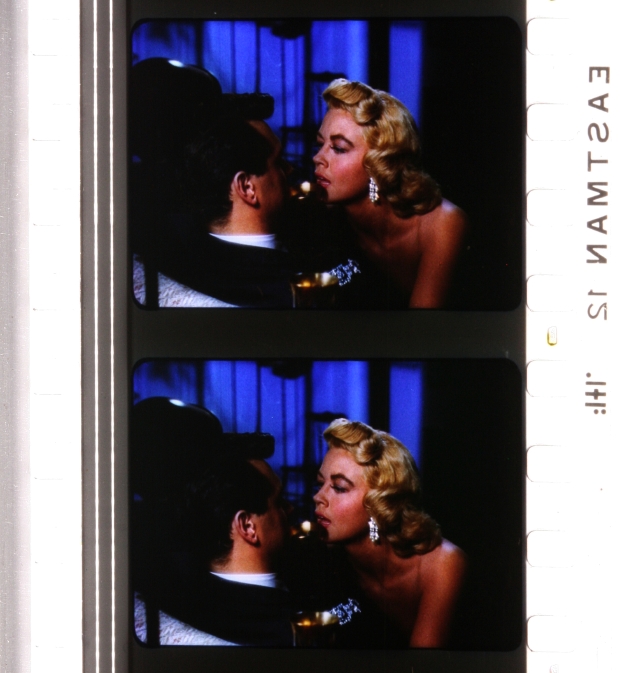
2261 Images in 41 Galleries
 Timeline of Historical Film Colors by Barbara Flueckiger is licensed under a Creative Commons Attribution-NonCommercial-NoDerivatives 4.0 International License.
Quote as Flueckiger, Barbara (2012 ff.): Timeline of Historical Film Colors. (= https://filmcolors.org/).
Download BibTex