
Select Category▼×
- All Categories
- Bibliography
- Chromogenic monopack
- Chromolytic multilayer
- Color separation
- Double-coated / bi-pack
- Edge Codes and Identification
- Hand coloring
- Other
- Printing / dye-transfer
- Printing / pigment process
- Screen processes
- Spatial synthesis (multiple lenses, beam splitter)
- Stencil coloring (pochoir, Pathécolor)
- Temporal synthesis (rotary filters)
- Theory
- Tinting
- Toning
“Gilmore’s two-color additive process was based on a patent granted to F. E. Ives in 1918. A unique optical system exposed two images in pairs, and quarter-turned them lengthwise side by side on standard 35 mm film stock. One of the images was ...
-
![]() Source: U.S.P. 1,262,954 (Ives, Frederic Eugene; filed Feb. 18, 1914; granted Apr. 16, 1918)
Source: U.S.P. 1,262,954 (Ives, Frederic Eugene; filed Feb. 18, 1914; granted Apr. 16, 1918)

1 Image
-
![]() No masking in the negative. Credit: Collection Gert Koshofer, Bergisch Gladbach (Germany).
No masking in the negative. Credit: Collection Gert Koshofer, Bergisch Gladbach (Germany).
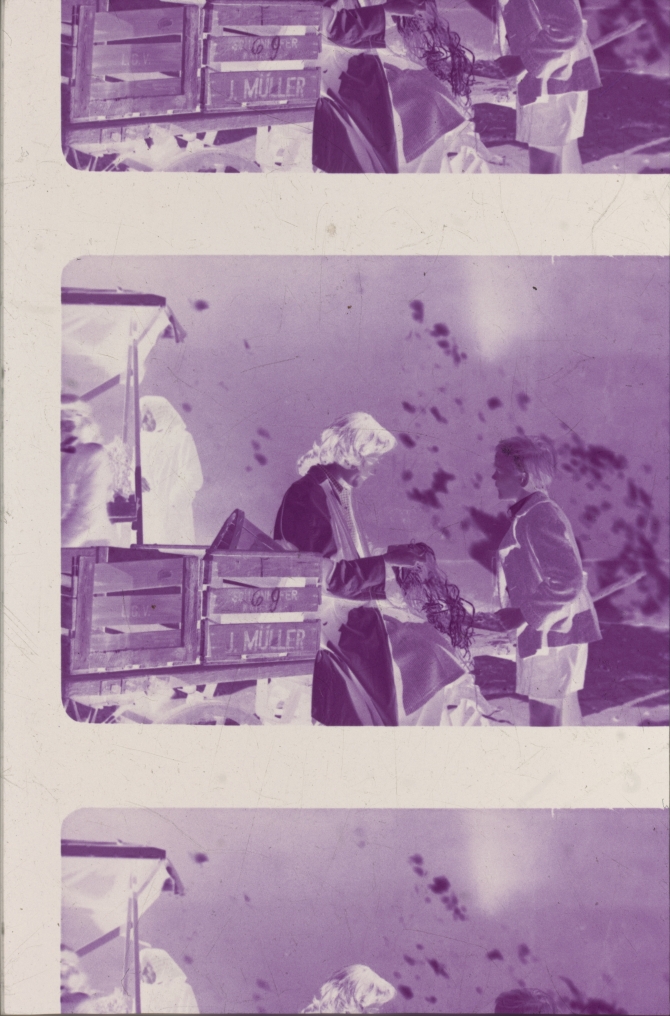
4 Images in 1 Gallery
-
![]() Comparing cross section schemes of different Gevachrome types. Scource: Verbrugghe, R. G. L. (1967): A Sharp Reversal Color Print Film. In: Journal SMPTE, Vol. 76, Dec. 1967, p. 1198.
Comparing cross section schemes of different Gevachrome types. Scource: Verbrugghe, R. G. L. (1967): A Sharp Reversal Color Print Film. In: Journal SMPTE, Vol. 76, Dec. 1967, p. 1198.

10 Images in 1 Gallery
“The competition between Kinemacolor and other rival systems was partially stimulated by a Utopian faith in the potential of film technology to achieve ‘natural colour’, reality ‘as it is’ being the goal of the cinematic ...
-
![]() Credit: Cinémathèque française, conservatoire des techniques, Paris.
Credit: Cinémathèque française, conservatoire des techniques, Paris.
- Source: Ede, François (1994): Jour de fête ou la couleur retrouvée. Cahiers du Cinéma: Paris.
- Credit: Paolo Cherchi Usai. Source: Cherchi Usai, Paolo (2000): Silent Cinema. London: BFI.
- Credit: Illustration by Sarah Steinbacher, Multimedia & E-Learning-Services, University of Zurich. Source: Ede, François (1994): Jour de fête ou la couleur retrouvée. Cahiers du Cinéma: Paris.
- Credit: Cinémathèque française, conservatoire des techniques, Paris.
- Source: Gaumont, Léon (1959): Gaumont Chronochrome Process Described by the Inventor. In: Raymond Fielding (ed.): A Technological History of Motion Pictures and Television. An Anthology from the Pages of The Journal of the Society of Motion Picture and Television Engineers. Berkeley; Los Angeles: University of California Press, 1967, pp. 65-67.
- Source: Gaumont, Léon (1959): Gaumont Chronochrome Process Described by the Inventor. In: Raymond Fielding (ed.): A Technological History of Motion Pictures and Television. An Anthology from the Pages of The Journal of the Society of Motion Picture and Television Engineers. Berkeley; Los Angeles: University of California Press, 1967, pp. 65-67.
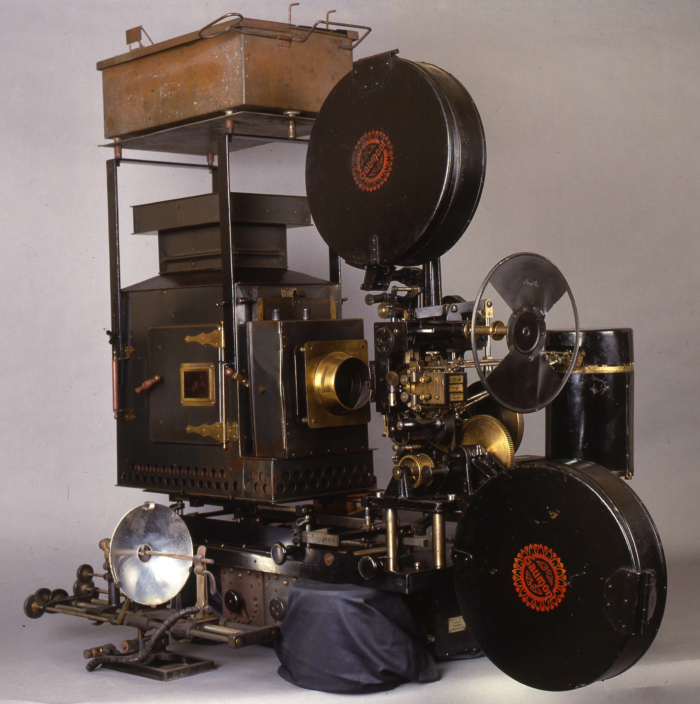
12 Images in 2 Galleries
Gasparcolor was the first three-color multi-layer monopack film available for practical use. It was a double-coated print film with a cyan layer on one side and two layers dyed magenta and yellow on the other side (see illustrations).
-
![]() Uit het rijk der kristallen (NDL 1927?, J.C. Mol). Credit: EYE Film Museum. Photographs of the Dufaycolor and Gasparcolor nitrate print by Barbara Flueckiger.
Uit het rijk der kristallen (NDL 1927?, J.C. Mol). Credit: EYE Film Museum. Photographs of the Dufaycolor and Gasparcolor nitrate print by Barbara Flueckiger.
- Kreise (English title Circles) (Oskar Fischinger, GER 1933-34) Oskar Fischinger's own nitrate print. Credit: Library of Congress, (c) Fischinger Trust, courtesy Center for Visual Music. Photograph Fischinger's own nitrate print by Barbara Flueckiger.
- Credit: (c) Fischinger Trust, courtesy Center for Visual Music. Film: Allegretto by Oskar Fischinger (1936-1943).
- Credit: (c) Fischinger Trust, courtesy Center for Visual Music. Film: Gasparcolor tests by Oskar Fischinger, c. 1933-34.
- Credit: Cinémathèque suisse. Film: Komposition in Blau (Composition in Blue) AKA Lichtkonzert Nr. 1 (Light-Concert No. 1) (GER 1935, Oskar Fischinger).
- Credit: Cinémathèque suisse. © Fischinger Trust, courtesy Center for Visual Music. Film: Komposition in Blau (Composition in Blue) AKA Lichtkonzert Nr. 1 (Light-Concert No. 1) (GER 1935, Oskar Fischinger).
- Credit: Cinémathèque suisse. © Fischinger Trust, courtesy Center for Visual Music. Film: Komposition in Blau (Composition in Blue) AKA Lichtkonzert Nr. 1 (Light-Concert No. 1) (GER 1935, Oskar Fischinger).
- Source: Coe, Brian (1981): The History of Movie Photography. Westfield, N.J.: Eastview Editions.
- Color chart on Agfa Tripofilm. This was the raw stock used for Gasparcolor in Germany until about 1939. Source: Arens, Hans; Heymer, Gerd (1939): Die „Agfa-Farbentafel für Farbenphotographie“. In: Veröffentlichungen des wissenschaftlichen Zentral-Laboratoriums der photographischen Abteilung Agfa, Vol. 6, 1939, pp. 225-229. Leipzig: Hirzel. Photograph by Barbara Flueckiger.
- Source: Pénichon, Sylvie (2013): Twentieth Century Colour Photographs. The Complete Guide to Processes, Identification & Preservation. London, Los Angeles: Thames & Hudson, p. 213.

398 Images in 24 Galleries
 Timeline of Historical Film Colors by Barbara Flueckiger is licensed under a Creative Commons Attribution-NonCommercial-NoDerivatives 4.0 International License.
Quote as Flueckiger, Barbara (2012 ff.): Timeline of Historical Film Colors. (= https://filmcolors.org/).
Download BibTex