
Select Category▼×
- All Categories
- Bibliography
- Chromogenic monopack
- Chromolytic multilayer
- Color separation
- Double-coated / bi-pack
- Edge Codes and Identification
- Hand coloring
- Other
- Printing / dye-transfer
- Printing / pigment process
- Screen processes
- Spatial synthesis (multiple lenses, beam splitter)
- Stencil coloring (pochoir, Pathécolor)
- Temporal synthesis (rotary filters)
- Theory
- Tinting
- Toning
“The Fujicolor process is a three-color subtractive negative/positive process introduced in 1955 by the Fuji Photo Film Co., Ltd., Tokyo, Japan.
When the process was introduced it consisted of two elements that could be used singly or together. ...
-
![]() Don't Look Now (GBR / ITA 1973, Nicolas Roeg). Credit: BFI National Film Archive. Photographs of the faded Fujicolor HP Positive Film Type 8813 by Joëlle Kost, ERC Advanced Grant FilmColors.
Don't Look Now (GBR / ITA 1973, Nicolas Roeg). Credit: BFI National Film Archive. Photographs of the faded Fujicolor HP Positive Film Type 8813 by Joëlle Kost, ERC Advanced Grant FilmColors.

141 Images in 7 Galleries
“In 1898 William Friese-Greene, a professional portrait photographer by trade, demonstrated in London ‘the first process of true natural-color cinematography.’ His program consisted of ‘a series of animated natural-color pictures,’ and although this demonstration aroused considerable interest at the time, Friese-Greene was unable to exploit this system on a profitable basis. Undaunted, he eventually developed a total of four different color methods.”
-
![]() Credit: Courtesy of BFI National Archive. Photograph by Barbara Flueckiger. Film: Kino the Girl of Colour (GB 1920, William Friese-Greene, Claude Friese-Greene).
Credit: Courtesy of BFI National Archive. Photograph by Barbara Flueckiger. Film: Kino the Girl of Colour (GB 1920, William Friese-Greene, Claude Friese-Greene).
- Credit: Cinémathèque française, conservatoire des techniques, Paris.
- Credit: Paolo Cherchi Usai. Source: Cherchi Usai, Paolo (2000): Silent Cinema. London: BFI.

112 Images in 2 Galleries
-
![]() Source: Klein, Adrian Bernhard (Cornwell-Clyne) (1940): Colour Cinematography. Boston: American Photographic Pub. Co.
Source: Klein, Adrian Bernhard (Cornwell-Clyne) (1940): Colour Cinematography. Boston: American Photographic Pub. Co.
- Source: Klein, Adrian Bernhard (Cornwell-Clyne) (1940): Colour Cinematography. Boston: American Photographic Pub. Co.
- Source: Coe, Brian (1981): The History of Movie Photography. Westfield, N.J.: Eastview Editions.
- Schmidt, Richard / Kochs, Adolf (1943): Farbfilmtechnik. Eine Einführung für Filmschaffende. Berlin: Hesse, pp. 54-72. (Schriftenreihe der Reichsfilmkammer, 10.) (in German) [quote id='5']
- Schmidt, Richard / Kochs, Adolf (1943): Farbfilmtechnik. Eine Einführung für Filmschaffende. Berlin: Hesse, pp. 54-72. (Schriftenreihe der Reichsfilmkammer, 10.) (in German) [quote id='5']

9 Images in 1 Gallery
-
![]() NEW!
Soon negative color FOTON daylight films will be available.
FOTONKOLOR NS
roll film 120
FOTONKOLOR NS
roll film 620
FOTONCOLOR NS
roll film 127
FOTONCOLOR NS
35mm (in cartridge)
FOTONCOLOR NS
sheet film
Fotoncolor NS will be possible to expose like 16° DIN, 32 ASA black and white negative film.
NEW!
Soon negative color FOTON daylight films will be available.
FOTONKOLOR NS
roll film 120
FOTONKOLOR NS
roll film 620
FOTONCOLOR NS
roll film 127
FOTONCOLOR NS
35mm (in cartridge)
FOTONCOLOR NS
sheet film
Fotoncolor NS will be possible to expose like 16° DIN, 32 ASA black and white negative film.

1 Image
A chromogenic process based on Agfacolor, see detail page Agfacolor Neu / Agfacolor.
-
![]() Credit: Národní filmový archiv / National Film Archive, Prague. Film: Jen počkej X (Nu, pogodi!) (Vjačeslav Kotěnočkin, USSR, 1976).
Credit: Národní filmový archiv / National Film Archive, Prague. Film: Jen počkej X (Nu, pogodi!) (Vjačeslav Kotěnočkin, USSR, 1976).
- Credit: Národní filmový archiv / National Film Archive, Prague. Film: Jen počkej X (Nu, pogodi!) (Vjačeslav Kotěnočkin, USSR, 1976).
- Credit: Národní filmový archiv / National Film Archive, Prague. Film: Jen počkej X (Nu, pogodi!) (Vjačeslav Kotěnočkin, USSR, 1976).
- Credit: Národní filmový archiv / National Film Archive, Prague. Film: Jen počkej X (Nu, pogodi!) (Vjačeslav Kotěnočkin, USSR, 1976).
- Credit: Národní filmový archiv / National Film Archive, Prague. Film: Jen počkej X (Nu, pogodi!) (Vjačeslav Kotěnočkin, USSR, 1976).
- Credit: Národní filmový archiv / National Film Archive, Prague. Film: Jen počkej X (Nu, pogodi!) (Vjačeslav Kotěnočkin, USSR, 1976).
- Credit: Národní filmový archiv / National Film Archive, Prague. Film: Jak se Žofka postarala o svatbu (Adolf Born, Jaroslav Doubrava, Miloš Macourek, Czechoslovakia 1988).
- Credit: Národní filmový archiv / National Film Archive, Prague. Film: Jak se Žofka postarala o svatbu (Adolf Born, Jaroslav Doubrava, Miloš Macourek, Czechoslovakia 1988).
- Credit: Národní filmový archiv / National Film Archive, Prague. Film: Jak se Žofka postarala o svatbu (Adolf Born, Jaroslav Doubrava, Miloš Macourek, Czechoslovakia 1988).
- Credit: Národní filmový archiv / National Film Archive, Prague. Film: Jak se Žofka postarala o svatbu (Adolf Born, Jaroslav Doubrava, Miloš Macourek, Czechoslovakia 1988).
- Credit: Národní filmový archiv / National Film Archive, Prague. Film: Jak se Žofka postarala o svatbu (Adolf Born, Jaroslav Doubrava, Miloš Macourek, Czechoslovakia 1988).
- Credit: Národní filmový archiv / National Film Archive, Prague. Film: Jak se Žofka postarala o svatbu (Adolf Born, Jaroslav Doubrava, Miloš Macourek, Czechoslovakia 1988).
- Credit: Národní filmový archiv / National Film Archive, Prague. Film: Jak se Žofka postarala o svatbu (Adolf Born, Jaroslav Doubrava, Miloš Macourek, Czechoslovakia 1988).
- Eastmancolor negative on Fomacolor positive. Credit: Národní filmový archiv / National Film Archive, Prague. Film: Slunečná laguna (Mirko Kačena, Czechoslovakia 1990).
- Eastmancolor negative on Fomacolor positive. Credit: Národní filmový archiv / National Film Archive, Prague. Film: Slunečná laguna (Mirko Kačena, Czechoslovakia 1990).
- Eastmancolor negative on Fomacolor positive. Credit: Národní filmový archiv / National Film Archive, Prague. Film: Slunečná laguna (Mirko Kačena, Czechoslovakia 1990).
- Eastmancolor negative on Fomacolor positive. Credit: Národní filmový archiv / National Film Archive, Prague. Film: Slunečná laguna (Mirko Kačena, Czechoslovakia 1990).
- Eastmancolor negative on Fomacolor positive. Credit: Národní filmový archiv / National Film Archive, Prague. Film: Slunečná laguna (Mirko Kačena, Czechoslovakia 1990).

18 Images
-
![]() Source: Pénichon, Sylvie (2013): Twentieth Century Colour Photographs. The Complete Guide to Processes, Identification & Preservation. London, Los Angeles: Thames & Hudson, p. 70.
Source: Pénichon, Sylvie (2013): Twentieth Century Colour Photographs. The Complete Guide to Processes, Identification & Preservation. London, Los Angeles: Thames & Hudson, p. 70.
- Source: Pénichon, Sylvie (2013): Twentieth Century Colour Photographs. The Complete Guide to Processes, Identification & Preservation. London, Los Angeles: Thames & Hudson, p. 70.
- Photomicrograph (20x) of a Finlay screen. Credit: Courtesy of George Eastman House, International Museum of Photography and Film.
- Finlay box. Photograph by Barbara Flueckiger.
- Source: Pénichon, Sylvie (2013): Twentieth Century Colour Photographs. The Complete Guide to Processes, Identification & Preservation. London, Los Angeles: Thames & Hudson, p. 39.
- Source: Pénichon, Sylvie (2013): Twentieth Century Colour Photographs. The Complete Guide to Processes, Identification & Preservation. London, Los Angeles: Thames & Hudson, p. 39.
- Source: Pénichon, Sylvie (2013): Twentieth Century Colour Photographs. The Complete Guide to Processes, Identification & Preservation. London, Los Angeles: Thames & Hudson, p. 40.

9 Images in 1 Gallery
-
![]() Faded Ferraniacolor positive from Eastmancolor negative, anamorphic (1:2,35). Credit: Národní filmový archiv / National Film Archive, Prague. Film: Smrt v sedle (Jindřich Polák, Czechoslovakia 1958).
Faded Ferraniacolor positive from Eastmancolor negative, anamorphic (1:2,35). Credit: Národní filmový archiv / National Film Archive, Prague. Film: Smrt v sedle (Jindřich Polák, Czechoslovakia 1958).
- Faded Ferraniacolor positive from Eastmancolor negative, anamorphic (1:2,35). Credit: Národní filmový archiv / National Film Archive, Prague. Film: Smrt v sedle (Jindřich Polák, Czechoslovakia 1958).
- Faded Ferraniacolor positive from Eastmancolor negative, anamorphic (1:2,35). Credit: Národní filmový archiv / National Film Archive, Prague. Film: Smrt v sedle (Jindřich Polák, Czechoslovakia 1958).
- Faded Ferraniacolor positive from Eastmancolor negative, anamorphic (1:2,35). Credit: Národní filmový archiv / National Film Archive, Prague. Film: Smrt v sedle (Jindřich Polák, Czechoslovakia 1958).
- Faded Ferraniacolor positive from Eastmancolor negative, anamorphic (1:2,35). Credit: Národní filmový archiv / National Film Archive, Prague. Film: Smrt v sedle (Jindřich Polák, Czechoslovakia 1958).
- Faded Ferraniacolor positive from Eastmancolor negative, anamorphic (1:2,35). Credit: Národní filmový archiv / National Film Archive, Prague. Film: Smrt v sedle (Jindřich Polák, Czechoslovakia 1958).
- Faded Ferraniacolor positive from Eastmancolor negative, anamorphic (1:2,35). Credit: Národní filmový archiv / National Film Archive, Prague. Film: Smrt v sedle (Jindřich Polák, Czechoslovakia 1958).

217 Images in 8 Galleries
-
![]() Cross section of Ektachrome Commercial, Type 7255. Scource: Groet, N. H./Liberman, M./ Richey, F. (1959): An Improved Professional 16mm Reversal Camera Film. In: JSMPTE, Vol. 68, January 1959, p. 9.
Cross section of Ektachrome Commercial, Type 7255. Scource: Groet, N. H./Liberman, M./ Richey, F. (1959): An Improved Professional 16mm Reversal Camera Film. In: JSMPTE, Vol. 68, January 1959, p. 9.

1 Image
-
![]() Didone abbandonata (ITA 1910, Luigi Maggi).
Credit: Cineteca di Bologna.
Photographs of the tinted nitrate print by Barbara Flueckiger.
Didone abbandonata (ITA 1910, Luigi Maggi).
Credit: Cineteca di Bologna.
Photographs of the tinted nitrate print by Barbara Flueckiger.
Frame characteristics / features of margins: Ambrosio. Cf.: Brown, Harold (1990): Physical Characteristics of Early Films as Aids to Identification. Brussels: FIAF, on p. 24.

91 Images in 6 Galleries
Eastman Kodak reversal film duplication stock for (semi)professional use. Replaced Type 5265. Type 7387 introduced in 1964 as improved version. Difficult to see the difference (BL).
-
![]() Recording of a color video signal onto lenticular film.
Recording of a color video signal onto lenticular film.
- Playback of the color image on the lenticular film as a television signal.
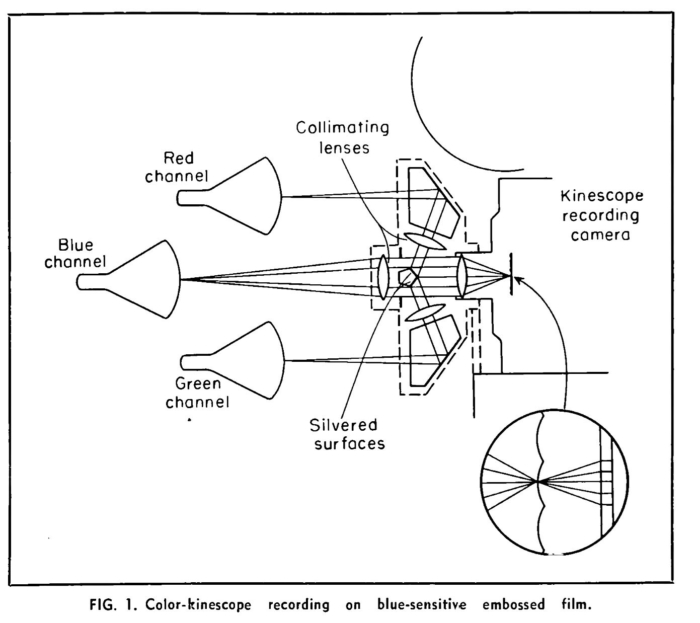
2 Images
-
![]() cross section scheme of Ektachrome Type 5257 (and 5258). Scource: Groet, N.H./Murray, T.J./Osborne, C.E. (1960): Two High-Speed Color Films and a Reversal Print Film for Motion Picture Use. In: JSMPTE Vol. 69, p. 816.
cross section scheme of Ektachrome Type 5257 (and 5258). Scource: Groet, N.H./Murray, T.J./Osborne, C.E. (1960): Two High-Speed Color Films and a Reversal Print Film for Motion Picture Use. In: JSMPTE Vol. 69, p. 816.

1 Image
 Timeline of Historical Film Colors by Barbara Flueckiger is licensed under a Creative Commons Attribution-NonCommercial-NoDerivatives 4.0 International License.
Quote as Flueckiger, Barbara (2012 ff.): Timeline of Historical Film Colors. (= https://filmcolors.org/).
Download BibTex