
- All Categories
- Bibliography
- Chromogenic monopack
- Chromolytic multilayer
- Color separation
- Double-coated / bi-pack
- Edge Codes and Identification
- Hand coloring
- Other
- Printing / dye-transfer
- Printing / pigment process
- Screen processes
- Spatial synthesis (multiple lenses, beam splitter)
- Stencil coloring (pochoir, Pathécolor)
- Temporal synthesis (rotary filters)
- Theory
- Tinting
- Toning
-
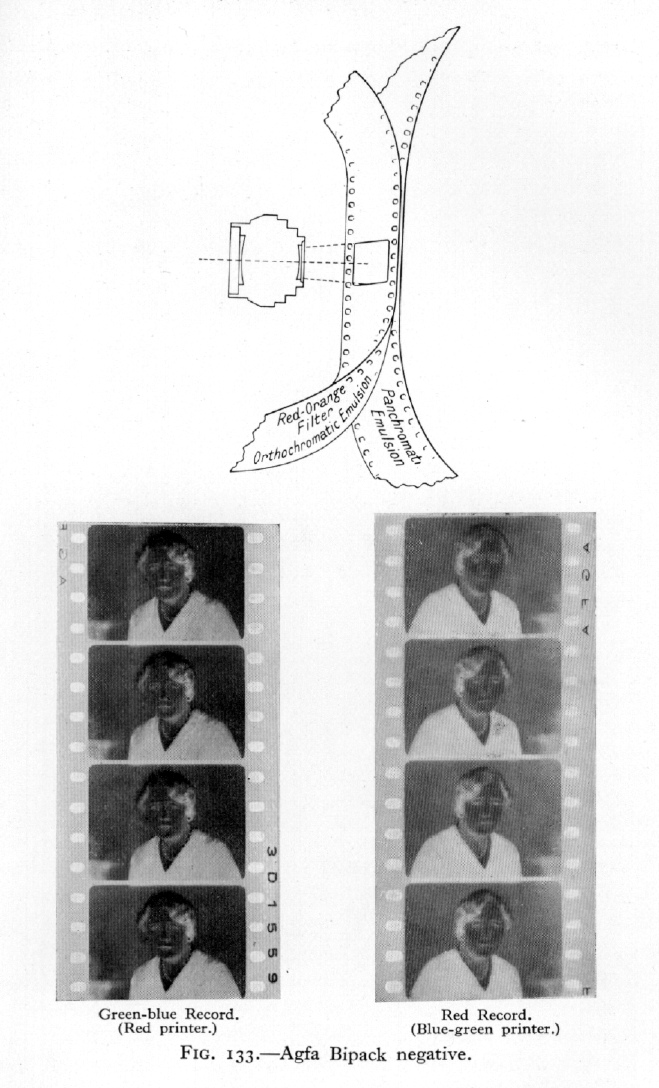
![]() Source: Klein, Adrian Bernhard (Cornwell-Clyne) (1940): Colour Cinematography. Boston: American Photographic Pub. Co.
Source: Klein, Adrian Bernhard (Cornwell-Clyne) (1940): Colour Cinematography. Boston: American Photographic Pub. Co.
11 Images in 1 Gallery
-
![]() Magnification. Source: Coe, Brian (1978): Colour Photography. The First Hundred Years 1840-1940. London: Ash & Grant.
Magnification. Source: Coe, Brian (1978): Colour Photography. The First Hundred Years 1840-1940. London: Ash & Grant.
- Source: Coote, Jack H. (1993): The Illustrated History of Colour Photography. Surbiton, Surrey: Fountain Press.
- Source: Heymer, Gerd (1943): Die neuere Entwicklung der Farbphotographie. In: Ergänzungswerk zum Handbuch der wissenschaftlichen und angewandten Photographie. Wien: Julius Springer 1943, pp. 337-463.
- Source: Finger, Ehrhard (1998): Die Pioniere des Wolfener Farbfilms. In: Industrie- und Filmmuseum Wolfen e. V. (ed.), Die Filmfabrik Wolfen. Aus der Geschichte, Heft 2, pp. 16-36. (in German) [quote id='4']
- Source: Finger, Ehrhard (1998): Die Pioniere des Wolfener Farbfilms. In: Industrie- und Filmmuseum Wolfen e. V. (ed.), Die Filmfabrik Wolfen. Aus der Geschichte, Heft 2, pp. 16-36. (in German) [quote id='4']
- Source: Finger, Ehrhard (1998): Die Pioniere des Wolfener Farbfilms. In: Industrie- und Filmmuseum Wolfen e. V. (ed.), Die Filmfabrik Wolfen. Aus der Geschichte, Heft 2, pp. 16-36. (in German) [quote id='4']
- Source: Pénichon, Sylvie (2013): Twentieth Century Colour Photographs. The Complete Guide to Processes, Identification & Preservation. London, Los Angeles: Thames & Hudson, p. 73.
- Source: Pénichon, Sylvie (2013): Twentieth Century Colour Photographs. The Complete Guide to Processes, Identification & Preservation. London, Los Angeles: Thames & Hudson, p. 73.
- Source: Pénichon, Sylvie (2013): Twentieth Century Colour Photographs. The Complete Guide to Processes, Identification & Preservation. London, Los Angeles: Thames & Hudson, p. 72.
- Source: Pénichon, Sylvie (2013): Twentieth Century Colour Photographs. The Complete Guide to Processes, Identification & Preservation. London, Los Angeles: Thames & Hudson, p. 76.
- Source: Pénichon, Sylvie (2013): Twentieth Century Colour Photographs. The Complete Guide to Processes, Identification & Preservation. London, Los Angeles: Thames & Hudson, p. 42.

11 Images
-
![]() Comparing cross section schemes of different Gevachrome types. Scource: Verbrugghe, R. G. L. (1967): A Sharp Reversal Color Print Film. In: Journal SMPTE, Vol. 76, Dec. 1967, p. 1198.
Comparing cross section schemes of different Gevachrome types. Scource: Verbrugghe, R. G. L. (1967): A Sharp Reversal Color Print Film. In: Journal SMPTE, Vol. 76, Dec. 1967, p. 1198.

10 Images in 1 Gallery
-
![]() Skleněné varhany (Stěklanna je garmonika, Andrej Chržanovskij, USSR 1968). Credit: Národní filmový archiv / National Film Archive, Prague. Photograph by Barbara Flueckiger
Skleněné varhany (Stěklanna je garmonika, Andrej Chržanovskij, USSR 1968). Credit: Národní filmový archiv / National Film Archive, Prague. Photograph by Barbara Flueckiger

15 Images in 3 Galleries
-
![]() Photomicrograph 1000x, Agfachrome cross section. Credit: Carsta Knaack.
Photomicrograph 1000x, Agfachrome cross section. Credit: Carsta Knaack.
- Photomicrograph 500x, Agfachrome cross section. Credit: Carsta Knaack.

2 Images
-
![]() Photomicrograph 500x, faded 3M print, cross section. Credit: Karsta Knaack.
Photomicrograph 500x, faded 3M print, cross section. Credit: Karsta Knaack.
- Photomicrograph 500x, faded 3M print, cross section. Credit: Karsta Knaack.
- Faded 3M positive. Credit: Carsta Knaack, HTW Berlin.
- Faded 3M positive. Credit: Carsta Knaack, HTW Berlin.

4 Images
-
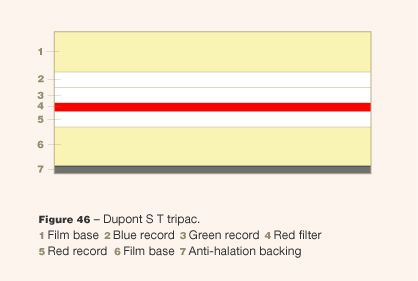
![]() Credit: Illustration by Sarah Steinbacher, Multimedia & E-Learning-Services, University of Zurich. Source: Ryan, Roderick T. (1977): A History of Motion Picture Color Technology. London: Focal Press.
Credit: Illustration by Sarah Steinbacher, Multimedia & E-Learning-Services, University of Zurich. Source: Ryan, Roderick T. (1977): A History of Motion Picture Color Technology. London: Focal Press.
- Source: Ryan, Roderick T. (1977): A History of Motion Picture Color Technology. London: Focal Press.
2 Images
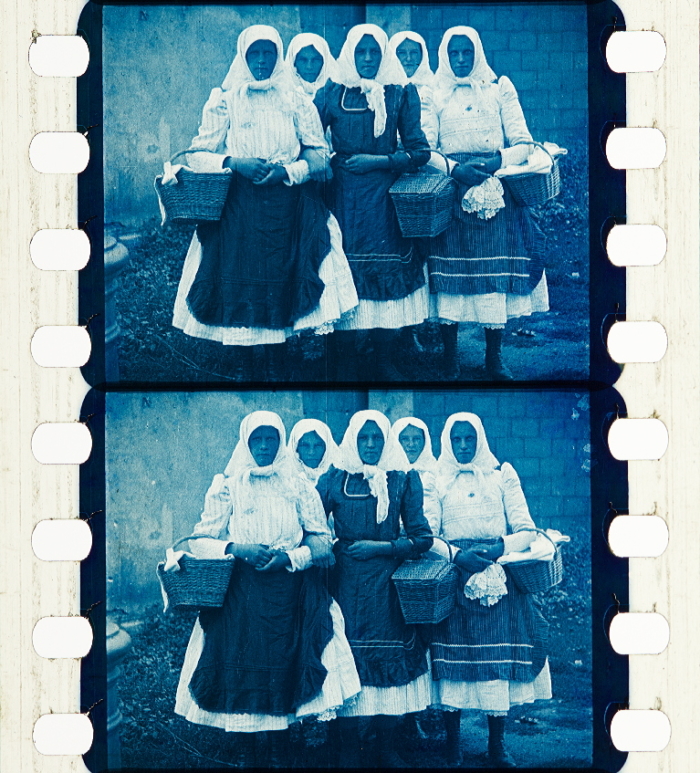
In contrast to tinting, toning is not the simple immersion of a film into a dye bath but involves a chemical reaction converting the silver image. In this reaction the neutral silver image in the emulsion of the positive film is replaced by one consisting of colored metal compounds. These were usually iron ferrocyanide (Prussian Blue) for blue, copper ferrocyanide for red/brown, silver sulfide for sepia or rarely uranium ferrocyanide for reddish brown. Toning had been used in still photography before. But since film was projected on the screen it required translucent toning compounds.
-
![]() Hongarije (FRA 1926, Anonymous). Credit: EYE Film Museum. Photographs of the tinted, toned and stencil colored nitrate print by Olivia Kristina Stutz, ERC Advanced Grant FilmColors.
Hongarije (FRA 1926, Anonymous). Credit: EYE Film Museum. Photographs of the tinted, toned and stencil colored nitrate print by Olivia Kristina Stutz, ERC Advanced Grant FilmColors.
- Virages sur films à support teinté Pathé, Film teinté lavande (virage bleu) lavender tinted stock with blue toning, the same image from a different copy of the book, combination of tungsten backlight with daylight toplight. Photograph by Barbara Flueckiger. Source: Didiée, L. (1926): Le Film vierge Pathé. Manuel de développement et de tirage. Paris: Pathé. [quote id='16']
- Photomicrograph, 25x. Credit: Norbert Wey, Institute of Pathology, University of Zurich.
- Photomicrograph, 50x. Credit: Norbert Wey, Institute of Pathology, University of Zurich.
- Photomicrograph, 100x. Credit: Norbert Wey, Institute of Pathology, University of Zurich.
- Toning samples from the Tinting and Toning Workshop by Ulrich Ruedel, Seminar "Materiality of Film" by Barbara Flueckiger and Bregt Lameris, Department of Film Studies, University of Zurich, in collaboration with Lichtspiel / Kinemathek Bern, David Landolf and Brigitte Paulowitz.
- Toning samples from the Tinting and Toning Workshop by Ulrich Ruedel, Seminar "Materiality of Film" by Barbara Flueckiger and Bregt Lameris, Department of Film Studies, University of Zurich, in collaboration with Lichtspiel / Kinemathek Bern, David Landolf and Brigitte Paulowitz.
1549 Images in 62 Galleries
For tinting, the positive print is immersed into a variety of dye baths, scene by scene. To this end, the print has to be cut into the corresponding fragments and reassembled after the dyeing process. The dye homogeneously attaches over the entire image’s gelatin including the perforation area. Usually synthetic dyes were dissolved in a weak acid solution to form a chemical bond with the gelatin.
-
![]() Salomé (USA 1922, Charles Bryant). Credit: George Eastman Museum. Photographs of the tinted, toned and Handschiegl nitrate print by Barbara Flueckiger.
Salomé (USA 1922, Charles Bryant). Credit: George Eastman Museum. Photographs of the tinted, toned and Handschiegl nitrate print by Barbara Flueckiger.
- Photograph by Barbara Flueckiger. Source: Agfa Kine-Handbuch. Berlin: Actien-Gesellschaft für Anilin-Fabrikation. (around 1927, estimated).
- See Mazzanti (2009: 71). Credit: Cineteca di Bologna. Film: Lyda Borelli in Malombra (Italy, 1917).
- As coloured for South America, see Mazzanti (2009: 71). Credit: Cineteca di Bologna.
- As coloured for the domestic Italian market, see Mazzanti (2009: 71). Credit: Cineteca di Bologna.
- Photomicrograph, 25x. Credit: Norbert Wey, Institute of Pathology, University of Zurich.
- Photomicrograph, 50x. Credit: Norbert Wey, Institute of Pathology, University of Zurich.
- Photomicrograph, 50x. Credit: Norbert Wey, Institute of Pathology, University of Zurich.
- Credit: Lichtspiel / Kinemathek Bern. Film: Dagli Appennini alle Ande (ITA 1916, Umberto Paradisi). Photograph by Barbara Flueckiger.
- Credit: Lichtspiel / Kinemathek Bern. Film: Dagli Appennini alle Ande (ITA 1916, Umberto Paradisi). Photograph by Barbara Flueckiger.
- Credit: Lichtspiel / Kinemathek Bern. Film: Dagli Appennini alle Ande (ITA 1916, Umberto Paradisi). Photograph by Barbara Flueckiger.
- Credit: Lichtspiel / Kinemathek Bern. Film: Dagli Appennini alle Ande (ITA 1916, Umberto Paradisi). Photograph by Barbara Flueckiger.
- Credit: Lichtspiel / Kinemathek Bern. Film: Dagli Appennini alle Ande (ITA 1916, Umberto Paradisi). Photograph by Barbara Flueckiger.
- Credit: Lichtspiel / Kinemathek Bern. Film: Dagli Appennini alle Ande (ITA 1916, Umberto Paradisi). Photograph by Barbara Flueckiger.
- Credit: Lichtspiel / Kinemathek Bern. Film: Gaumont Woche.
- Credit: Lichtspiel / Kinemathek Bern. Film: Gaumont Woche.
- Credit: Lichtspiel / Kinemathek Bern. Film: Gaumont Woche.
- Credit: Lichtspiel / Kinemathek Bern. Film: Gaumont Woche.
- Credit: Lichtspiel / Kinemathek Bern. Film: Selznick News.

4492 Images in 111 Galleries
-
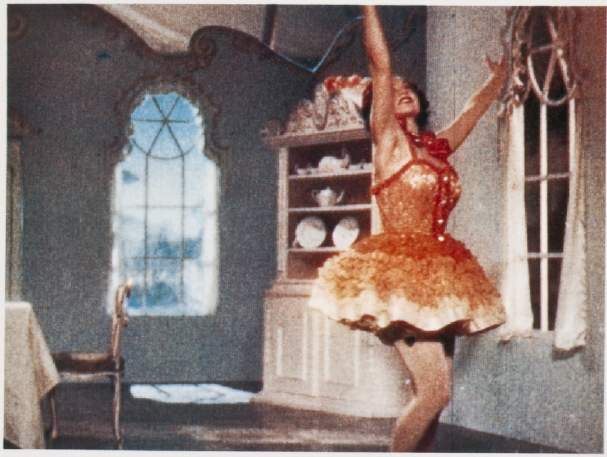
![]() Source: Coe, Brian (1981): The History of Movie Photography. Westfield, N.J.: Eastview Editions. Film: Pagliacci (1937).
Source: Coe, Brian (1981): The History of Movie Photography. Westfield, N.J.: Eastview Editions. Film: Pagliacci (1937).
9 Images in 2 Galleries
-
![]() Rouxcolor, four-color, black and white negative and positive, ca. 1948. Credit: Gert Koshofer Collection. Sample No. 83. Photograph by Barbara Flueckiger
Rouxcolor, four-color, black and white negative and positive, ca. 1948. Credit: Gert Koshofer Collection. Sample No. 83. Photograph by Barbara Flueckiger
- Credit: Cinémathèque française, conservatoire des techniques, Paris.

7 Images in 1 Gallery
-
![]() Credit: Illustration by Sarah Steinbacher, Multimedia & E-Learning-Services, University of Zurich. Source: Cornwell-Clyne, Adrian (1951): Colour Cinematography. London: Chapman & Hall.
Credit: Illustration by Sarah Steinbacher, Multimedia & E-Learning-Services, University of Zurich. Source: Cornwell-Clyne, Adrian (1951): Colour Cinematography. London: Chapman & Hall.
- Source: Cornwell-Clyne, Adrian (1951): Colour Cinematography. London: Chapman & Hall.
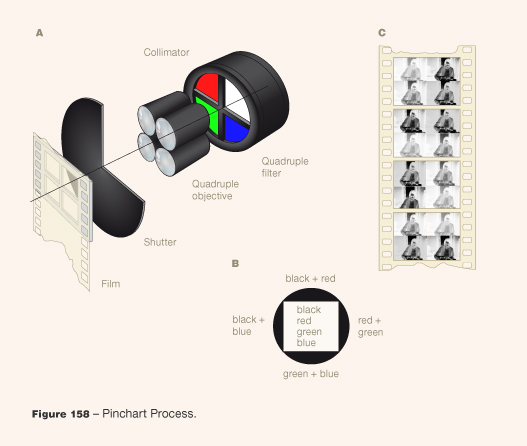
2 Images
-
![]() Source: Coe, Brian (1981): The History of Movie Photography. Westfield, N.J.: Eastview Editions.
Source: Coe, Brian (1981): The History of Movie Photography. Westfield, N.J.: Eastview Editions.

1 Image
-
![]() Rota Farbenfilm Samples (Kodak Film Samples Collection). Credit: National Science and Media Museum Bradford. Photographs of the Rotacolor Prints by Josephine Diecke, SNSF project Film Colors. Technologies, Cultures, Institutions and Joëlle Kost, ERC Advanced Grant FilmColors.
Rota Farbenfilm Samples (Kodak Film Samples Collection). Credit: National Science and Media Museum Bradford. Photographs of the Rotacolor Prints by Josephine Diecke, SNSF project Film Colors. Technologies, Cultures, Institutions and Joëlle Kost, ERC Advanced Grant FilmColors.

13 Images in 2 Galleries

-
![]() Source: Jacobson, Egbert (1942): The Color Harmony Manual and How to Use It. Chicago: Color Laboratories Division, Container Corp. of America. Credit: Faber Birren Collection, Yale University. Photograph by Barbara Flueckiger.
Source: Jacobson, Egbert (1942): The Color Harmony Manual and How to Use It. Chicago: Color Laboratories Division, Container Corp. of America. Credit: Faber Birren Collection, Yale University. Photograph by Barbara Flueckiger.
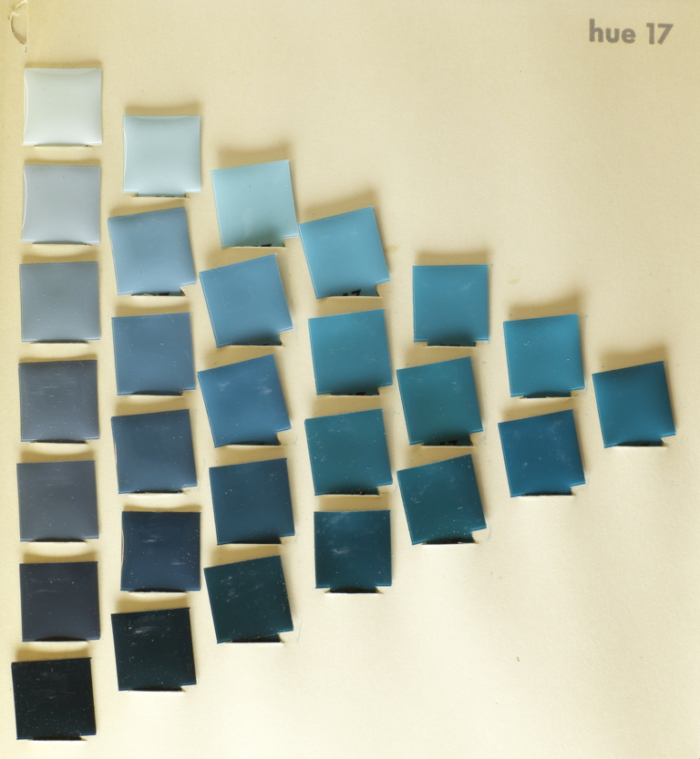
1 Image
-
![]() Didone abbandonata (ITA 1910, Luigi Maggi).
Credit: Cineteca di Bologna.
Photographs of the tinted nitrate print by Barbara Flueckiger.
Didone abbandonata (ITA 1910, Luigi Maggi).
Credit: Cineteca di Bologna.
Photographs of the tinted nitrate print by Barbara Flueckiger.
Frame characteristics / features of margins: Ambrosio. Cf.: Brown, Harold (1990): Physical Characteristics of Early Films as Aids to Identification. Brussels: FIAF, on p. 24.

91 Images in 6 Galleries
 Timeline of Historical Film Colors by Barbara Flueckiger is licensed under a Creative Commons Attribution-NonCommercial-NoDerivatives 4.0 International License.
Quote as Flueckiger, Barbara (2012 ff.): Timeline of Historical Film Colors. (= https://filmcolors.org/).
Download BibTex