
- All Categories
- Bibliography
- Chromogenic monopack
- Chromolytic multilayer
- Color separation
- Double-coated / bi-pack
- Edge Codes and Identification
- Hand coloring
- Other
- Printing / dye-transfer
- Printing / pigment process
- Screen processes
- Spatial synthesis (multiple lenses, beam splitter)
- Stencil coloring (pochoir, Pathécolor)
- Temporal synthesis (rotary filters)
- Theory
- Tinting
- Toning
-
![]() Faded Ferraniacolor positive from Eastmancolor negative, anamorphic (1:2,35). Credit: Národní filmový archiv / National Film Archive, Prague. Film: Smrt v sedle (Jindřich Polák, Czechoslovakia 1958).
Faded Ferraniacolor positive from Eastmancolor negative, anamorphic (1:2,35). Credit: Národní filmový archiv / National Film Archive, Prague. Film: Smrt v sedle (Jindřich Polák, Czechoslovakia 1958).
- Faded Ferraniacolor positive from Eastmancolor negative, anamorphic (1:2,35). Credit: Národní filmový archiv / National Film Archive, Prague. Film: Smrt v sedle (Jindřich Polák, Czechoslovakia 1958).
- Faded Ferraniacolor positive from Eastmancolor negative, anamorphic (1:2,35). Credit: Národní filmový archiv / National Film Archive, Prague. Film: Smrt v sedle (Jindřich Polák, Czechoslovakia 1958).
- Faded Ferraniacolor positive from Eastmancolor negative, anamorphic (1:2,35). Credit: Národní filmový archiv / National Film Archive, Prague. Film: Smrt v sedle (Jindřich Polák, Czechoslovakia 1958).
- Faded Ferraniacolor positive from Eastmancolor negative, anamorphic (1:2,35). Credit: Národní filmový archiv / National Film Archive, Prague. Film: Smrt v sedle (Jindřich Polák, Czechoslovakia 1958).
- Faded Ferraniacolor positive from Eastmancolor negative, anamorphic (1:2,35). Credit: Národní filmový archiv / National Film Archive, Prague. Film: Smrt v sedle (Jindřich Polák, Czechoslovakia 1958).
- Faded Ferraniacolor positive from Eastmancolor negative, anamorphic (1:2,35). Credit: Národní filmový archiv / National Film Archive, Prague. Film: Smrt v sedle (Jindřich Polák, Czechoslovakia 1958).

217 Images in 8 Galleries
-
![]() Source: Pénichon, Sylvie (2013): Twentieth Century Colour Photographs. The Complete Guide to Processes, Identification & Preservation. London, Los Angeles: Thames & Hudson, p. 70.
Source: Pénichon, Sylvie (2013): Twentieth Century Colour Photographs. The Complete Guide to Processes, Identification & Preservation. London, Los Angeles: Thames & Hudson, p. 70.
- Source: Pénichon, Sylvie (2013): Twentieth Century Colour Photographs. The Complete Guide to Processes, Identification & Preservation. London, Los Angeles: Thames & Hudson, p. 70.
- Photomicrograph (20x) of a Finlay screen. Credit: Courtesy of George Eastman House, International Museum of Photography and Film.
- Finlay box. Photograph by Barbara Flueckiger.
- Source: Pénichon, Sylvie (2013): Twentieth Century Colour Photographs. The Complete Guide to Processes, Identification & Preservation. London, Los Angeles: Thames & Hudson, p. 39.
- Source: Pénichon, Sylvie (2013): Twentieth Century Colour Photographs. The Complete Guide to Processes, Identification & Preservation. London, Los Angeles: Thames & Hudson, p. 39.
- Source: Pénichon, Sylvie (2013): Twentieth Century Colour Photographs. The Complete Guide to Processes, Identification & Preservation. London, Los Angeles: Thames & Hudson, p. 40.

9 Images in 1 Gallery
-
![]() Credit: Národní filmový archiv / National Film Archive, Prague. Film: Jen počkej X (Nu, pogodi!) (Vjačeslav Kotěnočkin, USSR, 1976).
Credit: Národní filmový archiv / National Film Archive, Prague. Film: Jen počkej X (Nu, pogodi!) (Vjačeslav Kotěnočkin, USSR, 1976).
- Credit: Národní filmový archiv / National Film Archive, Prague. Film: Jen počkej X (Nu, pogodi!) (Vjačeslav Kotěnočkin, USSR, 1976).
- Credit: Národní filmový archiv / National Film Archive, Prague. Film: Jen počkej X (Nu, pogodi!) (Vjačeslav Kotěnočkin, USSR, 1976).
- Credit: Národní filmový archiv / National Film Archive, Prague. Film: Jen počkej X (Nu, pogodi!) (Vjačeslav Kotěnočkin, USSR, 1976).
- Credit: Národní filmový archiv / National Film Archive, Prague. Film: Jen počkej X (Nu, pogodi!) (Vjačeslav Kotěnočkin, USSR, 1976).
- Credit: Národní filmový archiv / National Film Archive, Prague. Film: Jen počkej X (Nu, pogodi!) (Vjačeslav Kotěnočkin, USSR, 1976).
- Credit: Národní filmový archiv / National Film Archive, Prague. Film: Jak se Žofka postarala o svatbu (Adolf Born, Jaroslav Doubrava, Miloš Macourek, Czechoslovakia 1988).
- Credit: Národní filmový archiv / National Film Archive, Prague. Film: Jak se Žofka postarala o svatbu (Adolf Born, Jaroslav Doubrava, Miloš Macourek, Czechoslovakia 1988).
- Credit: Národní filmový archiv / National Film Archive, Prague. Film: Jak se Žofka postarala o svatbu (Adolf Born, Jaroslav Doubrava, Miloš Macourek, Czechoslovakia 1988).
- Credit: Národní filmový archiv / National Film Archive, Prague. Film: Jak se Žofka postarala o svatbu (Adolf Born, Jaroslav Doubrava, Miloš Macourek, Czechoslovakia 1988).
- Credit: Národní filmový archiv / National Film Archive, Prague. Film: Jak se Žofka postarala o svatbu (Adolf Born, Jaroslav Doubrava, Miloš Macourek, Czechoslovakia 1988).
- Credit: Národní filmový archiv / National Film Archive, Prague. Film: Jak se Žofka postarala o svatbu (Adolf Born, Jaroslav Doubrava, Miloš Macourek, Czechoslovakia 1988).
- Credit: Národní filmový archiv / National Film Archive, Prague. Film: Jak se Žofka postarala o svatbu (Adolf Born, Jaroslav Doubrava, Miloš Macourek, Czechoslovakia 1988).
- Eastmancolor negative on Fomacolor positive. Credit: Národní filmový archiv / National Film Archive, Prague. Film: Slunečná laguna (Mirko Kačena, Czechoslovakia 1990).
- Eastmancolor negative on Fomacolor positive. Credit: Národní filmový archiv / National Film Archive, Prague. Film: Slunečná laguna (Mirko Kačena, Czechoslovakia 1990).
- Eastmancolor negative on Fomacolor positive. Credit: Národní filmový archiv / National Film Archive, Prague. Film: Slunečná laguna (Mirko Kačena, Czechoslovakia 1990).
- Eastmancolor negative on Fomacolor positive. Credit: Národní filmový archiv / National Film Archive, Prague. Film: Slunečná laguna (Mirko Kačena, Czechoslovakia 1990).
- Eastmancolor negative on Fomacolor positive. Credit: Národní filmový archiv / National Film Archive, Prague. Film: Slunečná laguna (Mirko Kačena, Czechoslovakia 1990).

18 Images
-
![]() NEW!
Soon negative color FOTON daylight films will be available.
FOTONKOLOR NS
roll film 120
FOTONKOLOR NS
roll film 620
FOTONCOLOR NS
roll film 127
FOTONCOLOR NS
35mm (in cartridge)
FOTONCOLOR NS
sheet film
Fotoncolor NS will be possible to expose like 16° DIN, 32 ASA black and white negative film.
NEW!
Soon negative color FOTON daylight films will be available.
FOTONKOLOR NS
roll film 120
FOTONKOLOR NS
roll film 620
FOTONCOLOR NS
roll film 127
FOTONCOLOR NS
35mm (in cartridge)
FOTONCOLOR NS
sheet film
Fotoncolor NS will be possible to expose like 16° DIN, 32 ASA black and white negative film.

1 Image
-
![]() Source: Klein, Adrian Bernhard (Cornwell-Clyne) (1940): Colour Cinematography. Boston: American Photographic Pub. Co.
Source: Klein, Adrian Bernhard (Cornwell-Clyne) (1940): Colour Cinematography. Boston: American Photographic Pub. Co.
- Source: Klein, Adrian Bernhard (Cornwell-Clyne) (1940): Colour Cinematography. Boston: American Photographic Pub. Co.
- Source: Coe, Brian (1981): The History of Movie Photography. Westfield, N.J.: Eastview Editions.
- Schmidt, Richard / Kochs, Adolf (1943): Farbfilmtechnik. Eine Einführung für Filmschaffende. Berlin: Hesse, pp. 54-72. (Schriftenreihe der Reichsfilmkammer, 10.) (in German) [quote id='5']
- Schmidt, Richard / Kochs, Adolf (1943): Farbfilmtechnik. Eine Einführung für Filmschaffende. Berlin: Hesse, pp. 54-72. (Schriftenreihe der Reichsfilmkammer, 10.) (in German) [quote id='5']

9 Images in 1 Gallery
“In 1898 William Friese-Greene, a professional portrait photographer by trade, demonstrated in London ‘the first process of true natural-color cinematography.’ His program consisted of ‘a series of animated natural-color pictures,’ and although this demonstration aroused considerable interest at the time, Friese-Greene was unable to exploit this system on a profitable basis. Undaunted, he eventually developed a total of four different color methods.”
-
![]() Credit: Courtesy of BFI National Archive. Photograph by Barbara Flueckiger. Film: Kino the Girl of Colour (GB 1920, William Friese-Greene, Claude Friese-Greene).
Credit: Courtesy of BFI National Archive. Photograph by Barbara Flueckiger. Film: Kino the Girl of Colour (GB 1920, William Friese-Greene, Claude Friese-Greene).
- Credit: Cinémathèque française, conservatoire des techniques, Paris.
- Credit: Paolo Cherchi Usai. Source: Cherchi Usai, Paolo (2000): Silent Cinema. London: BFI.

112 Images in 2 Galleries
-
![]() Don't Look Now (GBR / ITA 1973, Nicolas Roeg). Credit: BFI National Film Archive. Photographs of the faded Fujicolor HP Positive Film Type 8813 by Joëlle Kost, ERC Advanced Grant FilmColors.
Don't Look Now (GBR / ITA 1973, Nicolas Roeg). Credit: BFI National Film Archive. Photographs of the faded Fujicolor HP Positive Film Type 8813 by Joëlle Kost, ERC Advanced Grant FilmColors.

141 Images in 7 Galleries
Gasparcolor was the first three-color multi-layer monopack film available for practical use. It was a double-coated print film with a cyan layer on one side and two layers dyed magenta and yellow on the other side (see illustrations).
-
![]() Uit het rijk der kristallen (NDL 1927?, J.C. Mol). Credit: EYE Film Museum. Photographs of the Dufaycolor and Gasparcolor nitrate print by Barbara Flueckiger.
Uit het rijk der kristallen (NDL 1927?, J.C. Mol). Credit: EYE Film Museum. Photographs of the Dufaycolor and Gasparcolor nitrate print by Barbara Flueckiger.
- Kreise (English title Circles) (Oskar Fischinger, GER 1933-34) Oskar Fischinger's own nitrate print. Credit: Library of Congress, (c) Fischinger Trust, courtesy Center for Visual Music. Photograph Fischinger's own nitrate print by Barbara Flueckiger.
- Credit: (c) Fischinger Trust, courtesy Center for Visual Music. Film: Allegretto by Oskar Fischinger (1936-1943).
- Credit: (c) Fischinger Trust, courtesy Center for Visual Music. Film: Gasparcolor tests by Oskar Fischinger, c. 1933-34.
- Credit: Cinémathèque suisse. Film: Komposition in Blau (Composition in Blue) AKA Lichtkonzert Nr. 1 (Light-Concert No. 1) (GER 1935, Oskar Fischinger).
- Credit: Cinémathèque suisse. © Fischinger Trust, courtesy Center for Visual Music. Film: Komposition in Blau (Composition in Blue) AKA Lichtkonzert Nr. 1 (Light-Concert No. 1) (GER 1935, Oskar Fischinger).
- Credit: Cinémathèque suisse. © Fischinger Trust, courtesy Center for Visual Music. Film: Komposition in Blau (Composition in Blue) AKA Lichtkonzert Nr. 1 (Light-Concert No. 1) (GER 1935, Oskar Fischinger).
- Source: Coe, Brian (1981): The History of Movie Photography. Westfield, N.J.: Eastview Editions.
- Color chart on Agfa Tripofilm. This was the raw stock used for Gasparcolor in Germany until about 1939. Source: Arens, Hans; Heymer, Gerd (1939): Die „Agfa-Farbentafel für Farbenphotographie“. In: Veröffentlichungen des wissenschaftlichen Zentral-Laboratoriums der photographischen Abteilung Agfa, Vol. 6, 1939, pp. 225-229. Leipzig: Hirzel. Photograph by Barbara Flueckiger.
- Source: Pénichon, Sylvie (2013): Twentieth Century Colour Photographs. The Complete Guide to Processes, Identification & Preservation. London, Los Angeles: Thames & Hudson, p. 213.

398 Images in 24 Galleries
-
![]() Credit: Cinémathèque française, conservatoire des techniques, Paris.
Credit: Cinémathèque française, conservatoire des techniques, Paris.
- Source: Ede, François (1994): Jour de fête ou la couleur retrouvée. Cahiers du Cinéma: Paris.
- Credit: Paolo Cherchi Usai. Source: Cherchi Usai, Paolo (2000): Silent Cinema. London: BFI.
- Credit: Illustration by Sarah Steinbacher, Multimedia & E-Learning-Services, University of Zurich. Source: Ede, François (1994): Jour de fête ou la couleur retrouvée. Cahiers du Cinéma: Paris.
- Credit: Cinémathèque française, conservatoire des techniques, Paris.
- Source: Gaumont, Léon (1959): Gaumont Chronochrome Process Described by the Inventor. In: Raymond Fielding (ed.): A Technological History of Motion Pictures and Television. An Anthology from the Pages of The Journal of the Society of Motion Picture and Television Engineers. Berkeley; Los Angeles: University of California Press, 1967, pp. 65-67.
- Source: Gaumont, Léon (1959): Gaumont Chronochrome Process Described by the Inventor. In: Raymond Fielding (ed.): A Technological History of Motion Pictures and Television. An Anthology from the Pages of The Journal of the Society of Motion Picture and Television Engineers. Berkeley; Los Angeles: University of California Press, 1967, pp. 65-67.
12 Images in 2 Galleries
-
![]() Comparing cross section schemes of different Gevachrome types. Scource: Verbrugghe, R. G. L. (1967): A Sharp Reversal Color Print Film. In: Journal SMPTE, Vol. 76, Dec. 1967, p. 1198.
Comparing cross section schemes of different Gevachrome types. Scource: Verbrugghe, R. G. L. (1967): A Sharp Reversal Color Print Film. In: Journal SMPTE, Vol. 76, Dec. 1967, p. 1198.

10 Images in 1 Gallery
-
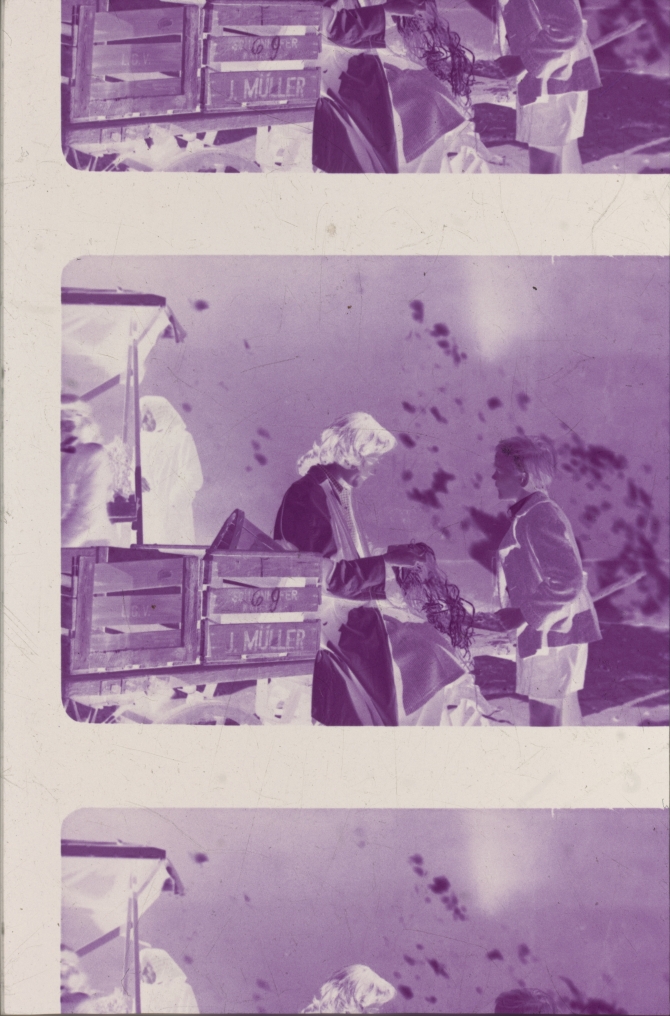
![]() No masking in the negative. Credit: Collection Gert Koshofer, Bergisch Gladbach (Germany).
No masking in the negative. Credit: Collection Gert Koshofer, Bergisch Gladbach (Germany).
4 Images in 1 Gallery
-
![]() Source: U.S.P. 1,262,954 (Ives, Frederic Eugene; filed Feb. 18, 1914; granted Apr. 16, 1918)
Source: U.S.P. 1,262,954 (Ives, Frederic Eugene; filed Feb. 18, 1914; granted Apr. 16, 1918)

1 Image
-
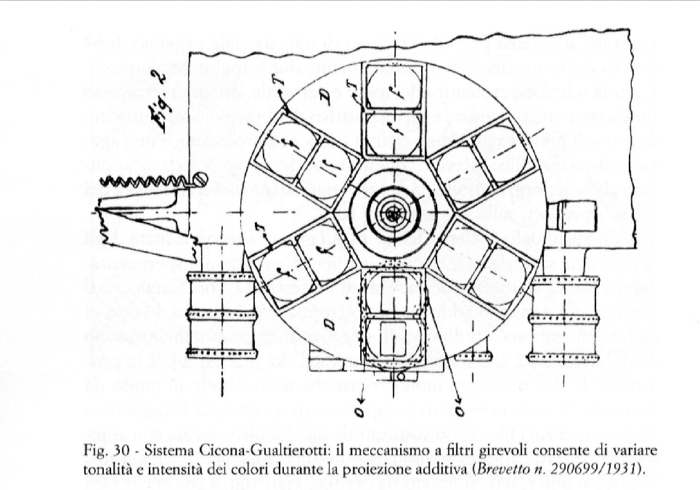
![]() Rotating filters permitting to adjust tonality and intensity of the colors. Source: Pierotti, Federico (2016): Un'archeologia del colore nel cinema italiano. Dal Technicolor ad Antonioni. Pisa: Edizioni ETS, p. 62
Rotating filters permitting to adjust tonality and intensity of the colors. Source: Pierotti, Federico (2016): Un'archeologia del colore nel cinema italiano. Dal Technicolor ad Antonioni. Pisa: Edizioni ETS, p. 62
1 Image
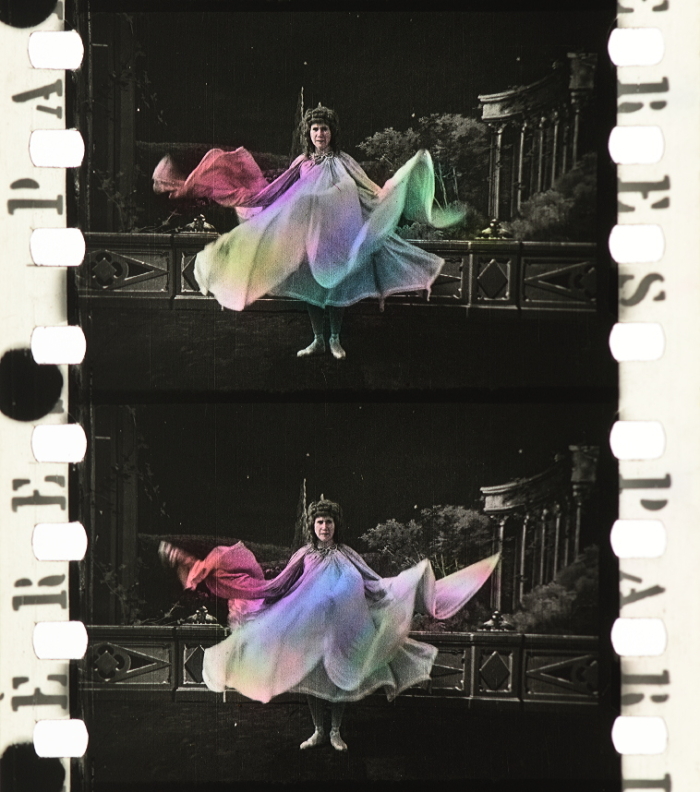
Coloring of individual frames by the use of very fine brushes. The process was previously applied to lantern slides. Any water based translucent dye was suited for the process, most often the coloring was done with acid dyes.
-
![]() Loïe Fuller (FRA 1905, Anonymous). Credit: BFI National Archive. Photographs of the hand colored nitrate print by Olivia Kristina Stutz, ERC Advanced Grant FilmColors.
Loïe Fuller (FRA 1905, Anonymous). Credit: BFI National Archive. Photographs of the hand colored nitrate print by Olivia Kristina Stutz, ERC Advanced Grant FilmColors.
- Métamorphoses du papillon (FRA 1904, Gaston Velle). Credit: Library of Congress. Photograph of the nitrate prints by Barbara Flueckiger.
- Credit: Turconi Collection by courtesy of George Eastman Museum, Moving Image Collection. Film: Zara.
- Credit: Paolo Cherchi Usai. Source: Cherchi Usai, Paolo (2000): Silent Cinema. London: BFI.
- Source: Coe, Brian (1981): The History of Movie Photography. Westfield, N.J.: Eastview Editions.
250 Images in 18 Galleries
-
![]() Black-and-white with Handschiegl in Lights of Old Broadway (USA 1925, Monta Bell). Credit: Library of Congress. Photograph of the nitrate print by Barbara Flueckiger.
Black-and-white with Handschiegl in Lights of Old Broadway (USA 1925, Monta Bell). Credit: Library of Congress. Photograph of the nitrate print by Barbara Flueckiger.
- Credit: Geo. Willeman, Nitrate Film Vault Manager, Library of Congress. Film: Trail of '98 (USA 1929, Clarence Brown).
- Credit: Geo. Willeman, Nitrate Film Vault Manager, Library of Congress. Film: Trail of '98 (USA 1929, Clarence Brown).
- Credit: Paolo Cherchi Usai. Source: Cherchi Usai, Paolo (2000): Silent Cinema. London: BFI. Film: Greed (USA 1925, Erich von Stroheim).
- Credit: Geo. Willeman, Nitrate Film Vault Manager, Library of Congress. Film: Forbidden Fruit (USA 1921, Cecil B. DeMille).
- Credit: Geo. Willeman, Nitrate Film Vault Manager, Library of Congress. Film: Forbidden Fruit (USA 1921, Cecil B. DeMille).
- Source: Ryan, Roderick T. (1977): A History of Motion Picture Color Technology. London: Focal Press, p. 24.
- Credit: Geo. Willeman, Nitrate Film Vault Manager, Library of Congress. Film: Trail of '98 (USA 1929, Clarence Brown).

141 Images in 8 Galleries
-
![]() Credit: Technicolor Collection. George Eastman House Moving Image Department. Photograph by Barbara Flueckiger.
Credit: Technicolor Collection. George Eastman House Moving Image Department. Photograph by Barbara Flueckiger.
- Credit: Technicolor Collection. George Eastman House Moving Image Department. Photograph by Barbara Flueckiger.
- Credit: Technicolor Collection. George Eastman House Moving Image Department. Photograph by Barbara Flueckiger.

3 Images
-
![]() Credit: EYE Film Institute Amsterdam. Photograph by Barbara Flueckiger.
Credit: EYE Film Institute Amsterdam. Photograph by Barbara Flueckiger.

12 Images in 1 Gallery
-
![]() Credit: Illustration by Sarah Steinbacher, Multimedia & E-Learning-Services, University of Zurich. Source: Klein, Adrian Bernhard (Cornwell-Clyne) (1940): Colour Cinematography. Boston: American Photographic Pub. Co.
Credit: Illustration by Sarah Steinbacher, Multimedia & E-Learning-Services, University of Zurich. Source: Klein, Adrian Bernhard (Cornwell-Clyne) (1940): Colour Cinematography. Boston: American Photographic Pub. Co.
- Source: Klein, Adrian Bernhard (Cornwell-Clyne) (1940): Colour Cinematography. Boston: American Photographic Pub. Co.
- Source: Klein, Adrian Bernhard (Cornwell-Clyne) (1940): Colour Cinematography. Boston: American Photographic Pub. Co.
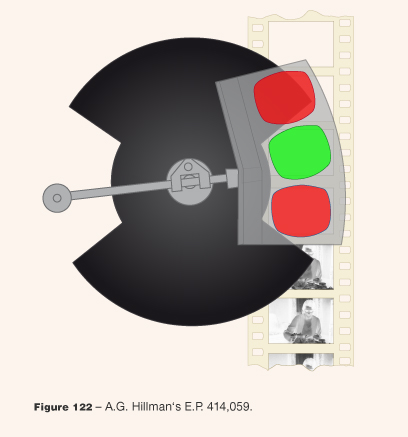
3 Images
-
![]() Credit: Geo. Willeman, Nitrate Film Vault Manager, Library of Congress. Film: Captain Calamity (1936)
Credit: Geo. Willeman, Nitrate Film Vault Manager, Library of Congress. Film: Captain Calamity (1936)
- Credit: Geo. Willeman, Nitrate Film Vault Manager, Library of Congress. Film: Captain Calamity (1936)

2 Images
-
![]() Source: Coe, Brian (1981): The History of Movie Photography. Westfield, N.J.: Eastview Editions.
Source: Coe, Brian (1981): The History of Movie Photography. Westfield, N.J.: Eastview Editions.
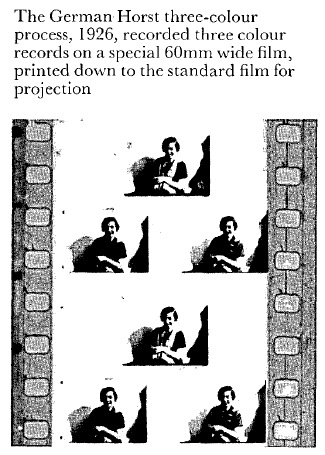
4 Images in 1 Gallery
-
![]() Cross section of Inducolor-print, leader only, title unknown. Credit: Carsta Knaack, HTW Berlin.
Cross section of Inducolor-print, leader only, title unknown. Credit: Carsta Knaack, HTW Berlin.
- Leader of print, title and age unknown. Credit: Carsta Knaack, HTW Berlin.

2 Images
-
![]() Source: D.R.P. 98,799, Dec. 17, 1897
Source: D.R.P. 98,799, Dec. 17, 1897
- Credit: Illustration by Sarah Steinbacher, Multimedia & E-Learning-Services, University of Zurich. Source: D.R.P. 98,799, Dec. 17, 1897

2 Images
-
![]() Photomicrograph (20x) of a Joly screen. Credit: Courtesy of George Eastman House, International Museum of Photography and Film.
Photomicrograph (20x) of a Joly screen. Credit: Courtesy of George Eastman House, International Museum of Photography and Film.
- Credit: Courtesy of George Eastman House, International Museum of Photography and Film.
- Source: Coe, Brian (1978): Colour Photography. The First Hundred Years 1840-1940. London: Ash & Grant.
- Credit: Gawain Weaver, Photograph Conservator, Gawain Weaver Art Conservation, San Anselmo, CA.
- Source: Pénichon, Sylvie (2013): Twentieth Century Colour Photographs. The Complete Guide to Processes, Identification & Preservation. London, Los Angeles: Thames & Hudson, p. 69.
- Source: Pénichon, Sylvie (2013): Twentieth Century Colour Photographs. The Complete Guide to Processes, Identification & Preservation. London, Los Angeles: Thames & Hudson, p. 22.
- Source: Pénichon, Sylvie (2013): Twentieth Century Colour Photographs. The Complete Guide to Processes, Identification & Preservation. London, Los Angeles: Thames & Hudson, p. 23.
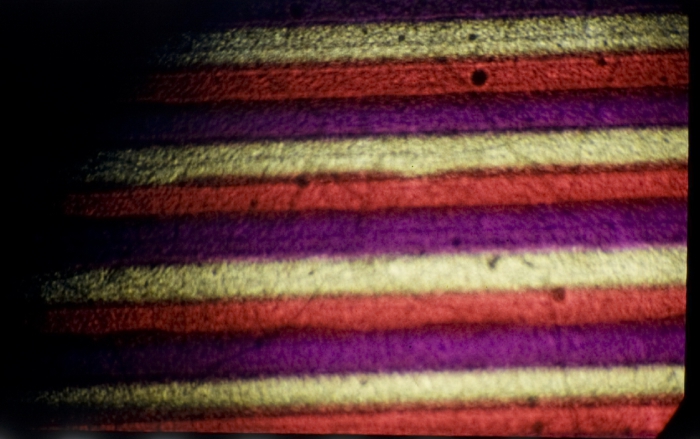
7 Images
-
![]() Credit: Cinémathèque française, conservatoire des techniques, Paris.
Credit: Cinémathèque française, conservatoire des techniques, Paris.
- Source: Wall, E.J. (1925): The History of Three-color Photography. Boston: American Photographic Pub. Co.

2 Images
-
![]() Credit: Cinémathèque française, conservatoire des techniques, Paris.
Credit: Cinémathèque française, conservatoire des techniques, Paris.
- Credit: Cinémathèque française, conservatoire des techniques, Paris.
- Credit: Cinémathèque française, conservatoire des techniques, Paris.
- Credit: Illustration by Sarah Steinbacher, Multimedia & E-Learning-Services, University of Zurich. Source: Ede, François (1994): Jour de fête ou la couleur retrouvée. Cahiers du Cinéma: Paris.
- Principle of capturing and projecting lenticular film. Credit: Joakim Reuteler and Rudolf Gschwind, Digital Humanities Lab, University of Basel, Switzerland. Illustration by Sarah Steinbacher, Multimedia & E-Learning-Services, University of Zurich.
- Principle of capturing and projecting lenticular film. Credit: Joakim Reuteler and Rudolf Gschwind, Digital Humanities Lab, University of Basel, Switzerland. Illustration by Sarah Steinbacher, Multimedia & E-Learning-Services, University of Zurich.
- Principle of capturing and projecting lenticular film. Credit: Joakim Reuteler and Rudolf Gschwind, Digital Humanities Lab, University of Basel, Switzerland. Illustration by Sarah Steinbacher, Multimedia & E-Learning-Services, University of Zurich.
- Microscopic image of a piece of Keller-Dorian lenticular film embedded in epoxide resin. The 3-dimensional structure of the lenticules is visible as well as the thin emulsion layer on the other side of the acetate base. Credit: Sample preparation and imaging by the Center for Microscopy and Image Analysis, University of Zurich.
- Lenticular surface of the acetate plastic base of Keller-Dorian lenticular film. On the back plane of the acetate layer and therefore out of focus in this image, structures defined by the silver image in the emulsion layer can be perceived. Credit: David Pfluger, ERC Advanced Grant FilmColors. Imaging was performed with support of the Center for Microscopy and Image Analysis, University of Zurich.
- Hexagonal structure of the lenticules of Keller-Dorian lenticular film. Credit: David Pfluger, ERC Advanced Grant FilmColors. Imaging was performed with support of the Center for Microscopy and Image Analysis, University of Zurich.
- Microscopic images of the Keller-Dorian lenticular structure with the focus set at different points. The images have been chained to show a travelling through the 3-dimensional structure of the bee-hive shaped lenticules. Credit: David Pfluger, conversion to video by Martin Weiss, ERC Advanced Grant FilmColors. Imaging was performed with support of the Center for Microscopy and Image Analysis, University of Zurich.

14 Images in 2 Galleries
-
![]() Credit: George Eastman House Motion Picture Department Collection. Film: The Old Family Toothbrush (USA 1925).
Credit: George Eastman House Motion Picture Department Collection. Film: The Old Family Toothbrush (USA 1925).

1 Image
-
![]() Source: Ryan, Roderick T. (1977): A History of Motion Picture Color Technology. London: Focal Press.
Source: Ryan, Roderick T. (1977): A History of Motion Picture Color Technology. London: Focal Press.

1 Image
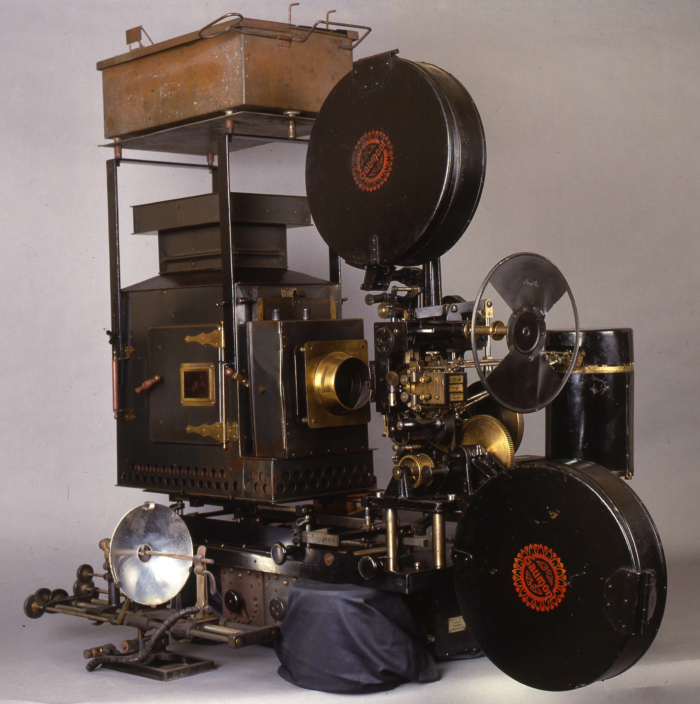
Kinemacolor was an additive process operated with alternating red and green filters that were applied to the shutter in front of the camera and in front of the projector. With at least 32 fps the frame rate was double the minimal frame rate of 16 fps. Time parallax with small differences between the red and green record resulted in color fringes that became visible when objects or scenes were moving.
-
![]() Kinemacolor projector used for David Cleveland's and Brian Pritchard's reconstruction. Credit: Brian Pritchard.
Kinemacolor projector used for David Cleveland's and Brian Pritchard's reconstruction. Credit: Brian Pritchard.

13 Images in 3 Galleries
-
![]() Principle of capturing and projecting lenticular film. Credit: Joakim Reuteler and Rudolf Gschwind, Digital Humanities Lab, University of Basel, Switzerland. Illustration by Sarah Steinbacher, Multimedia & E-Learning-Services, University of Zurich.
Principle of capturing and projecting lenticular film. Credit: Joakim Reuteler and Rudolf Gschwind, Digital Humanities Lab, University of Basel, Switzerland. Illustration by Sarah Steinbacher, Multimedia & E-Learning-Services, University of Zurich.

1 Image
“In 1930 Mannes and Godowsky were invited to join the staff of the Kodak Research Laboratory, where they concentrated on methods of processing multilayer films, while their colleagues worked out ways of manufacturing them. The result was the new Kodachrome film, launched in 1935. Three very thin emulsion layers were coated on film base, the emulsions being sensitised with non-wandering dyes to red, green and blue light, the red-sensitive layer being at the bottom.” (Coe, Brian (1978): Colour Photography. The First Hundred Years 1840-1940. London: Ash & Grant, pp. 121 ff.)
-
![]() Credit: Lichtspiel / Kinemathek Bern. Film: New York, Taufe und Ausflug (CH 1954, Donald Brun).
Credit: Lichtspiel / Kinemathek Bern. Film: New York, Taufe und Ausflug (CH 1954, Donald Brun).
- Surface emulsion side, raking light. Credit: Carsta Knaack, HTW Berlin. Film: Regular 8mm home movie, anonymous 1975.

92 Images in 6 Galleries
-
![]() La perception et l'imaginaire (FRA 1964, Éric Duvivier). Credit: Image'Est. Photographs of the Kodachrome II camera material by Bregt Lameris, ERC Advanced Grant FilmColors.
La perception et l'imaginaire (FRA 1964, Éric Duvivier). Credit: Image'Est. Photographs of the Kodachrome II camera material by Bregt Lameris, ERC Advanced Grant FilmColors.
- Les autopathes (FRA 1971, Éric Duvivier). Credit: Image'Est. Photographs of the kodachrome reversal by Bregt Lameris, ERC Advanced Grant FilmColors.
- Hallucinations: Images du monde visionnaire (FRA 1963, Éric Duvivier). Credit: Image'Est. Photographs of undated Kodachrome II projection print by Bregt Lameris, ERC Advanced Grant FilmColors.

84 Images in 5 Galleries
 Timeline of Historical Film Colors by Barbara Flueckiger is licensed under a Creative Commons Attribution-NonCommercial-NoDerivatives 4.0 International License.
Quote as Flueckiger, Barbara (2012 ff.): Timeline of Historical Film Colors. (= https://filmcolors.org/).
Download BibTex