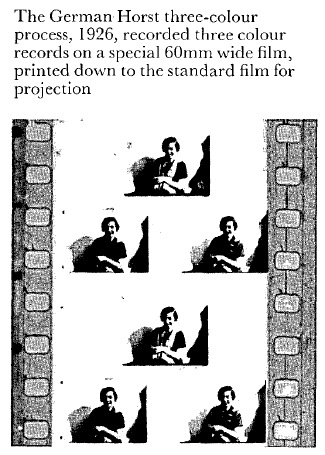
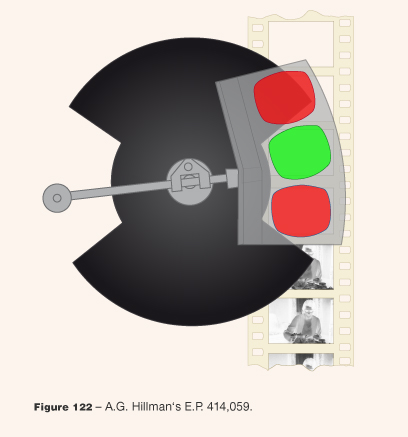
The Kodachrome process was invented in 1913 by John G. Capstaff for still photography and subsequently adapted to motion pictures. For the process two frames were advanced simultaneously, one located above the other. The light passed either through two lenses or through a beam-splitter, fitted with red and green filters. The release print was exposed through a beam-splitter whereby the alternate frames were projected onto either side of double-coated stock. After development by a usual b/w process, the film was tanned to harden the exposed areas. The soft areas were dyed red-orange and blue-green respectively.
“In 1930 Mannes and Godowsky were invited to join the staff of the Kodak Research Laboratory, where they concentrated on methods of processing multilayer films, while their colleagues worked out ways of manufacturing them. The result was the new Kodachrome film, launched in 1935. Three very thin emulsion layers were coated on film base, the emulsions being sensitised with non-wandering dyes to red, green and blue light, the red-sensitive layer being at the bottom.” (Coe, Brian (1978): Colour Photography. The First Hundred Years 1840-1940. London: Ash & Grant, pp. 121 ff.)
Kinemacolor was an additive process operated with alternating red and green filters that were applied to the shutter in front of the camera and in front of the projector. With at least 32 fps the frame rate was double the minimal frame rate of 16 fps. Time parallax with small differences between the red and green record resulted in color fringes that became visible when objects or scenes were moving.
Pénichon, Sylvie (2013): Twentieth Century Colour Photographs. The Complete Guide to Processes, Identification & Preservation. London, Los Angeles: Thames & Hudson, p. 148.
Kodacolor lenticular filter for the projector. Lichtspiel / Kinemathek Bern.
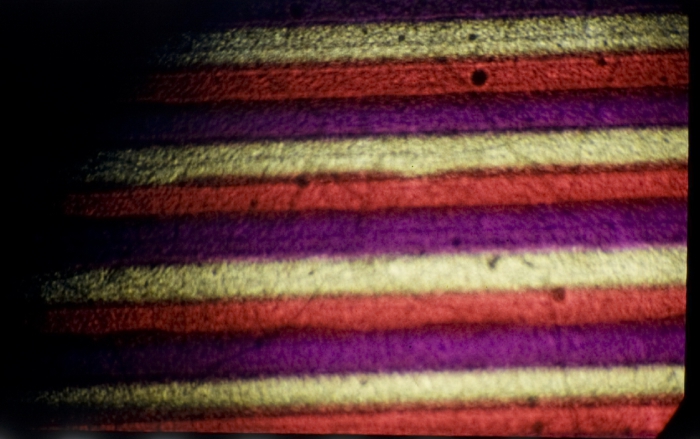
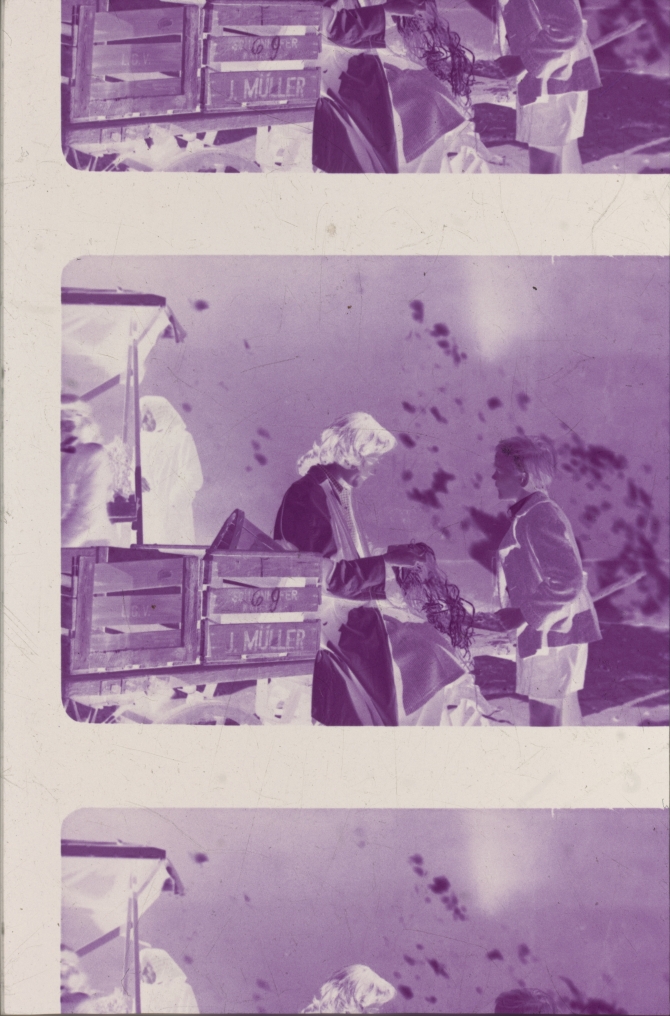
Two-Color Kodachrome Print (USA ca. 1925 to 1927, Anonymous). Credit: George Eastman Museum. Photographs of the Kodachrome two-color double coated stock from 1925 and 1927 by Olivia Kristina Stutz, ERC Advanced Grant FilmColors.
La perception et l'imaginaire (FRA 1964, Éric Duvivier). Credit: Image'Est. Photographs of the Kodachrome II camera material by Bregt Lameris, ERC Advanced Grant FilmColors.
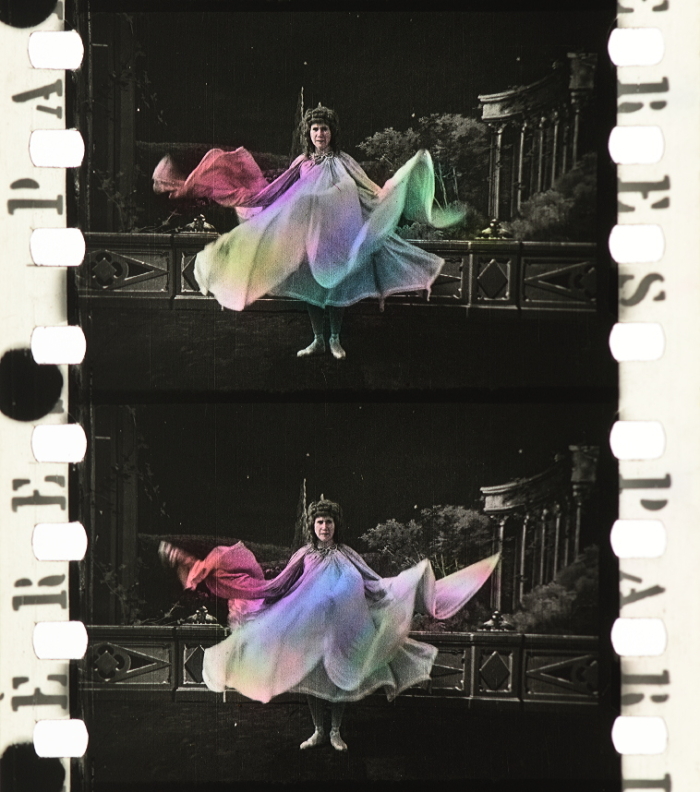
Credit: Lichtspiel / Kinemathek Bern. Film: New York, Taufe und Ausflug (CH 1954, Donald Brun).
Principle of capturing and projecting lenticular film. Credit: Joakim Reuteler and Rudolf Gschwind, Digital Humanities Lab, University of Basel, Switzerland. Illustration by Sarah Steinbacher, Multimedia & E-Learning-Services, University of Zurich.
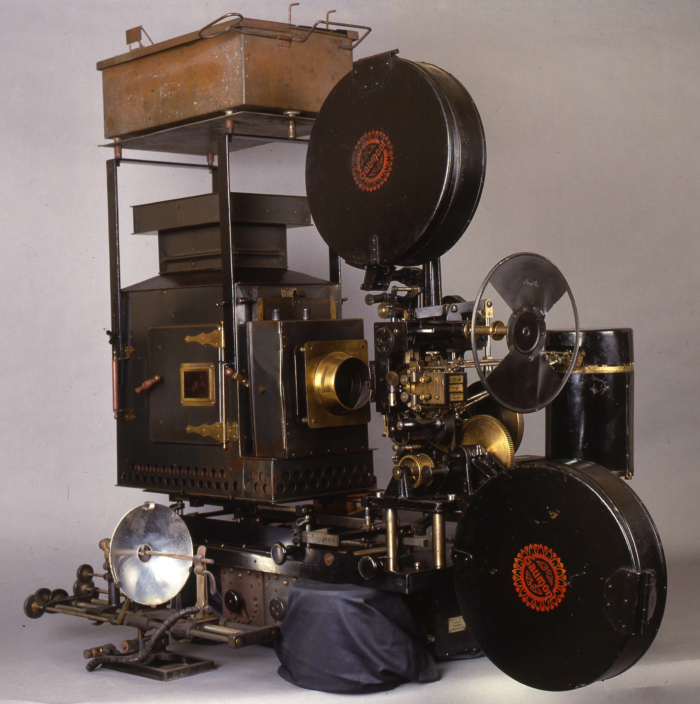
Kinemacolor projector used for David Cleveland's and Brian Pritchard's reconstruction. Credit: Brian Pritchard.
Source: Ryan, Roderick T. (1977): A History of Motion Picture Color Technology. London: Focal Press.
Credit: George Eastman House Motion Picture Department Collection. Film: The Old Family Toothbrush (USA 1925).
Credit: Cinémathèque française, conservatoire des techniques, Paris.
Pénichon, Sylvie (2013): Twentieth Century Colour Photographs. The Complete Guide to Processes, Identification & Preservation. London, Los Angeles: Thames & Hudson, p. 135.
Photomicrograph (20x) of a Joly screen. Credit: Courtesy of George Eastman House, International Museum of Photography and Film.
Pénichon, Sylvie (2013): Twentieth Century Colour Photographs. The Complete Guide to Processes, Identification & Preservation. London, Los Angeles: Thames & Hudson, p. 70.
Source: D.R.P. 98,799, Dec. 17, 1897
Cross section of Inducolor-print, leader only, title unknown. Credit: Carsta Knaack, HTW Berlin.
Pénichon, Sylvie (2013): Twentieth Century Colour Photographs. The Complete Guide to Processes, Identification & Preservation. London, Los Angeles: Thames & Hudson, p. 215.