
Select Category▼×
- All Categories
- Bibliography
- Chromogenic monopack
- Chromolytic multilayer
- Color separation
- Double-coated / bi-pack
- Edge Codes and Identification
- Hand coloring
- Other
- Printing / dye-transfer
- Printing / pigment process
- Screen processes
- Spatial synthesis (multiple lenses, beam splitter)
- Stencil coloring (pochoir, Pathécolor)
- Temporal synthesis (rotary filters)
- Theory
- Tinting
- Toning
A chromogenic process based on Agfacolor, see detail page Agfacolor Neu / Agfacolor.
-
![]() Credit: Národní filmový archiv / National Film Archive, Prague. Film: Jen počkej X (Nu, pogodi!) (Vjačeslav Kotěnočkin, USSR, 1976).
Credit: Národní filmový archiv / National Film Archive, Prague. Film: Jen počkej X (Nu, pogodi!) (Vjačeslav Kotěnočkin, USSR, 1976).
- Credit: Národní filmový archiv / National Film Archive, Prague. Film: Jen počkej X (Nu, pogodi!) (Vjačeslav Kotěnočkin, USSR, 1976).
- Credit: Národní filmový archiv / National Film Archive, Prague. Film: Jen počkej X (Nu, pogodi!) (Vjačeslav Kotěnočkin, USSR, 1976).
- Credit: Národní filmový archiv / National Film Archive, Prague. Film: Jen počkej X (Nu, pogodi!) (Vjačeslav Kotěnočkin, USSR, 1976).
- Credit: Národní filmový archiv / National Film Archive, Prague. Film: Jen počkej X (Nu, pogodi!) (Vjačeslav Kotěnočkin, USSR, 1976).
- Credit: Národní filmový archiv / National Film Archive, Prague. Film: Jen počkej X (Nu, pogodi!) (Vjačeslav Kotěnočkin, USSR, 1976).
- Credit: Národní filmový archiv / National Film Archive, Prague. Film: Jak se Žofka postarala o svatbu (Adolf Born, Jaroslav Doubrava, Miloš Macourek, Czechoslovakia 1988).
- Credit: Národní filmový archiv / National Film Archive, Prague. Film: Jak se Žofka postarala o svatbu (Adolf Born, Jaroslav Doubrava, Miloš Macourek, Czechoslovakia 1988).
- Credit: Národní filmový archiv / National Film Archive, Prague. Film: Jak se Žofka postarala o svatbu (Adolf Born, Jaroslav Doubrava, Miloš Macourek, Czechoslovakia 1988).
- Credit: Národní filmový archiv / National Film Archive, Prague. Film: Jak se Žofka postarala o svatbu (Adolf Born, Jaroslav Doubrava, Miloš Macourek, Czechoslovakia 1988).
- Credit: Národní filmový archiv / National Film Archive, Prague. Film: Jak se Žofka postarala o svatbu (Adolf Born, Jaroslav Doubrava, Miloš Macourek, Czechoslovakia 1988).
- Credit: Národní filmový archiv / National Film Archive, Prague. Film: Jak se Žofka postarala o svatbu (Adolf Born, Jaroslav Doubrava, Miloš Macourek, Czechoslovakia 1988).
- Credit: Národní filmový archiv / National Film Archive, Prague. Film: Jak se Žofka postarala o svatbu (Adolf Born, Jaroslav Doubrava, Miloš Macourek, Czechoslovakia 1988).
- Eastmancolor negative on Fomacolor positive. Credit: Národní filmový archiv / National Film Archive, Prague. Film: Slunečná laguna (Mirko Kačena, Czechoslovakia 1990).
- Eastmancolor negative on Fomacolor positive. Credit: Národní filmový archiv / National Film Archive, Prague. Film: Slunečná laguna (Mirko Kačena, Czechoslovakia 1990).
- Eastmancolor negative on Fomacolor positive. Credit: Národní filmový archiv / National Film Archive, Prague. Film: Slunečná laguna (Mirko Kačena, Czechoslovakia 1990).
- Eastmancolor negative on Fomacolor positive. Credit: Národní filmový archiv / National Film Archive, Prague. Film: Slunečná laguna (Mirko Kačena, Czechoslovakia 1990).
- Eastmancolor negative on Fomacolor positive. Credit: Národní filmový archiv / National Film Archive, Prague. Film: Slunečná laguna (Mirko Kačena, Czechoslovakia 1990).

18 Images
-
![]() Faded Ferraniacolor positive from Eastmancolor negative, anamorphic (1:2,35). Credit: Národní filmový archiv / National Film Archive, Prague. Film: Smrt v sedle (Jindřich Polák, Czechoslovakia 1958).
Faded Ferraniacolor positive from Eastmancolor negative, anamorphic (1:2,35). Credit: Národní filmový archiv / National Film Archive, Prague. Film: Smrt v sedle (Jindřich Polák, Czechoslovakia 1958).
- Faded Ferraniacolor positive from Eastmancolor negative, anamorphic (1:2,35). Credit: Národní filmový archiv / National Film Archive, Prague. Film: Smrt v sedle (Jindřich Polák, Czechoslovakia 1958).
- Faded Ferraniacolor positive from Eastmancolor negative, anamorphic (1:2,35). Credit: Národní filmový archiv / National Film Archive, Prague. Film: Smrt v sedle (Jindřich Polák, Czechoslovakia 1958).
- Faded Ferraniacolor positive from Eastmancolor negative, anamorphic (1:2,35). Credit: Národní filmový archiv / National Film Archive, Prague. Film: Smrt v sedle (Jindřich Polák, Czechoslovakia 1958).
- Faded Ferraniacolor positive from Eastmancolor negative, anamorphic (1:2,35). Credit: Národní filmový archiv / National Film Archive, Prague. Film: Smrt v sedle (Jindřich Polák, Czechoslovakia 1958).
- Faded Ferraniacolor positive from Eastmancolor negative, anamorphic (1:2,35). Credit: Národní filmový archiv / National Film Archive, Prague. Film: Smrt v sedle (Jindřich Polák, Czechoslovakia 1958).
- Faded Ferraniacolor positive from Eastmancolor negative, anamorphic (1:2,35). Credit: Národní filmový archiv / National Film Archive, Prague. Film: Smrt v sedle (Jindřich Polák, Czechoslovakia 1958).

217 Images in 8 Galleries
L stands for the Leverkusen brand of Agfacolor. N for negative, K for tungsten (Kunstlicht) and T for daylight (Tageslicht).
-
![]() Credit: By courtesy of Deutsche Kinemathek, Berlin. Photograph by Barbara Flueckiger. Film: Commercial Denkt rechtzeitig daran (GER 1952).
Credit: By courtesy of Deutsche Kinemathek, Berlin. Photograph by Barbara Flueckiger. Film: Commercial Denkt rechtzeitig daran (GER 1952).
- Credit: By courtesy of Deutsche Kinemathek, Berlin. Photograph by Barbara Flueckiger. Film: 1/50 Sekunde, commercial for Niggemeyer Foto/Kino (1952).

13 Images in 2 Galleries
“The Eastman Colour Films are multilayer films of the type in which the layers are not separated after exposure. Films of this class are known as Multilayer, Monopack or Integral Tripack. “Multilayer” is descriptive not only of this ...
-
![]() Alien (USA 1979, Ridley Scott). Credit: Library of Congress. Photographs of the Eastman Color Print Film from 1979 by Joëlle Kost, ERC Advanced Grant FilmColors.
Alien (USA 1979, Ridley Scott). Credit: Library of Congress. Photographs of the Eastman Color Print Film from 1979 by Joëlle Kost, ERC Advanced Grant FilmColors.
- Photomicrograph of modern chromogenic stock, . Credit: Silvana Konermann.
- Eastman Color chromogenic monopack. Source: Craig, G.J. (1953): Eastman Colour Films for Professional Motion Picture Work. In: British Kinematography, 22,5, 1953, pp. 146-158.
- Color fading of Eastmancolor stock. Credit: Collection Gert Koshofer, Bergisch Gladbach (Germany). Source: Schultze, Werner (1953): Farbenphotographie und Farbenfilm. Wissenschaftliche Grundlagen und technische Gestaltung. Berlin: Springer.
- Color reconstruction by Rudolf Gschwind, University of Basel. Credit: Collection Gert Koshofer, Bergisch Gladbach (Germany).
- Color fading of Eastmancolor stock.
- Source: Schultze, Werner (1953): Farbenphotographie und Farbenfilm. Wissenschaftliche Grundlagen und technische Gestaltung. Berlin/Göttingen /Heidelberg: Springer-Verlag. Photograph by Martin Weiss, ERC Advanced Grant FilmColors.
- Source: Schultze, Werner (1953): Farbenphotographie und Farbenfilm. Wissenschaftliche Grundlagen und technische Gestaltung. Berlin/Göttingen /Heidelberg: Springer-Verlag. Photograph by Martin Weiss, ERC Advanced Grant FilmColors.

707 Images in 23 Galleries
-
![]() Cross section of Ektachrome Commercial, Type 7255. Scource: Groet, N. H./Liberman, M./ Richey, F. (1959): An Improved Professional 16mm Reversal Camera Film. In: JSMPTE, Vol. 68, January 1959, p. 9.
Cross section of Ektachrome Commercial, Type 7255. Scource: Groet, N. H./Liberman, M./ Richey, F. (1959): An Improved Professional 16mm Reversal Camera Film. In: JSMPTE, Vol. 68, January 1959, p. 9.

1 Image
Kodak Sonochrome was a specially prepared tinted film for sound film that did not interfere with the spectral sensitivity of the photo-electric cell for the reading of the optical sound track.
The 17 Sonochrome tints were dyed in mainly light hues ...
-
![]() Credit: Paolo Cherchi Usai. Source: Cherchi Usai, Paolo (2000): Silent Cinema. London: BFI.
Credit: Paolo Cherchi Usai. Source: Cherchi Usai, Paolo (2000): Silent Cinema. London: BFI.
- Source: The International Photographer, July 1929
- Source: The International Photographer, July 1929
- Source: The International Photographer, July 1929
- Source: The International Photographer, July 1929
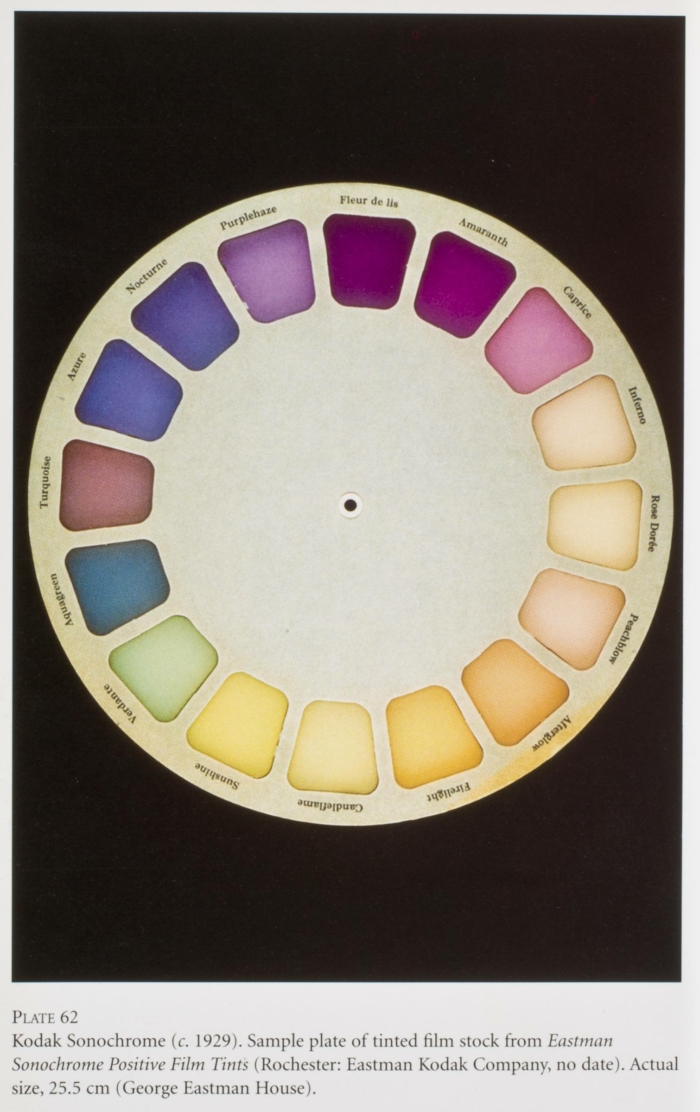
79 Images in 3 Galleries
-
![]() Recording of a color video signal onto lenticular film.
Recording of a color video signal onto lenticular film.
- Playback of the color image on the lenticular film as a television signal.
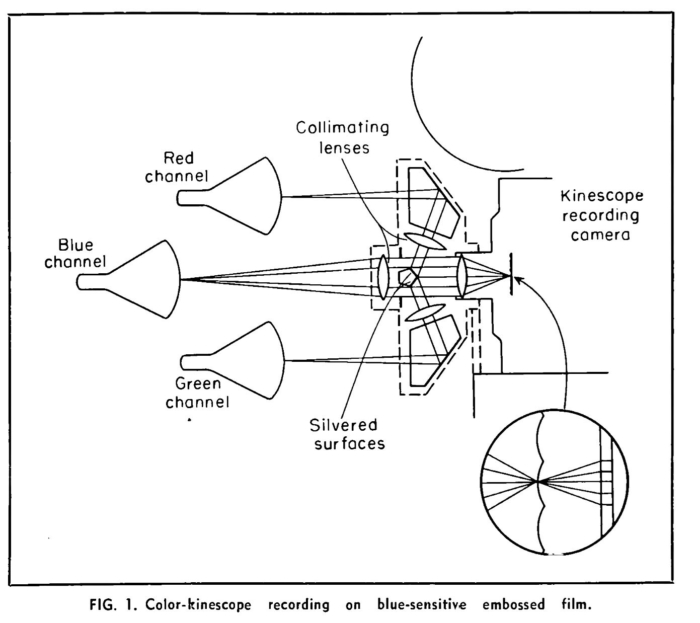
2 Images
-
![]() Cross section scheme of Eastman Color Type 5248. Scource: Hanson, W. T., Jr.; Kisner, W. I. (1953): Improved Color Films for Color Motion-Picture Production. In: Journal SMPTE, Vol. 61, Dec. 1953, p. 699.
Cross section scheme of Eastman Color Type 5248. Scource: Hanson, W. T., Jr.; Kisner, W. I. (1953): Improved Color Films for Color Motion-Picture Production. In: Journal SMPTE, Vol. 61, Dec. 1953, p. 699.
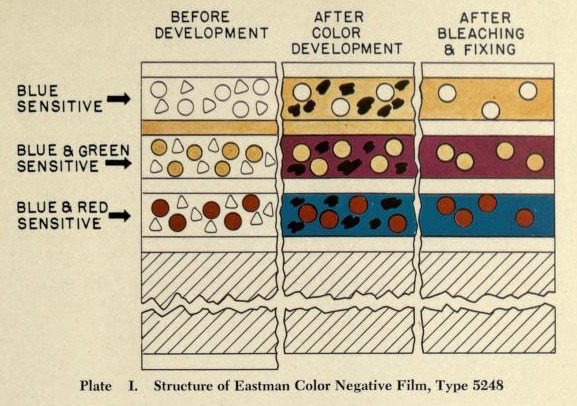
1 Image
-
![]() Cross section scheme of Eastman Color Negative, Type 5250. Scource: Dundon, Merle L./Zwick, Daan M. (1959): A High Speed Color Negative Film. In: JSMPTE Vol 68, p. 736.
Cross section scheme of Eastman Color Negative, Type 5250. Scource: Dundon, Merle L./Zwick, Daan M. (1959): A High Speed Color Negative Film. In: JSMPTE Vol 68, p. 736.

1 Image
-
![]() cross section scheme of Ektachrome Type 5257 (and 5258). Scource: Groet, N.H./Murray, T.J./Osborne, C.E. (1960): Two High-Speed Color Films and a Reversal Print Film for Motion Picture Use. In: JSMPTE Vol. 69, p. 816.
cross section scheme of Ektachrome Type 5257 (and 5258). Scource: Groet, N.H./Murray, T.J./Osborne, C.E. (1960): Two High-Speed Color Films and a Reversal Print Film for Motion Picture Use. In: JSMPTE Vol. 69, p. 816.

1 Image
Although Kodachrome 16mm reversal film was introduced as an amateur film format, rapidly after its introduction it became a format frequently used by (semi-)professional film makers. The reason was that Kodachrome was a relatively easy to use film ...
Duplicating stock for reversal film. Replaced Kodachrome duplicating stock type 5262. Contrary to its predecessor the new stock was not suited as camera material. Type 5265 could only be used for duplication.
Kodachrome Professional was introduced in 1942 to be used as camera material. It was the Kodachrome material that was blown up to 35mm Technicolor dye transfer prints, which was the Technicolor Monopack system.
According to Norris Pope this material ...
In 1946 Kodachrome Commercial camera film Type 5268 was introduced. This stock had a lower-contrast emulsion and became leading in the professional field until it was replaced by Ektachrome Commercial type 7255 in 1958. Both Commercial Kodachrome and ...
Kodachrome II was introduced in 1961. It was the first film stock since 1936 that was specifically meant for amateur use. Eastman Kodak presented the material as superior to the ‘regular Kodachrome’. It supposedly had a higher speed of 25 ...
-
![]() La perception et l'imaginaire (FRA 1964, Éric Duvivier). Credit: Image'Est. Photographs of the Kodachrome II camera material by Bregt Lameris, ERC Advanced Grant FilmColors.
La perception et l'imaginaire (FRA 1964, Éric Duvivier). Credit: Image'Est. Photographs of the Kodachrome II camera material by Bregt Lameris, ERC Advanced Grant FilmColors.
- Les autopathes (FRA 1971, Éric Duvivier). Credit: Image'Est. Photographs of the kodachrome reversal by Bregt Lameris, ERC Advanced Grant FilmColors.
- Hallucinations: Images du monde visionnaire (FRA 1963, Éric Duvivier). Credit: Image'Est. Photographs of undated Kodachrome II projection print by Bregt Lameris, ERC Advanced Grant FilmColors.

84 Images in 5 Galleries
-
![]() Credit: Illustration by Sarah Steinbacher, Multimedia & E-Learning-Services, University of Zurich. Source: Ryan, Roderick T. (1977): A History of Motion Picture Color Technology. London: Focal Press.
Credit: Illustration by Sarah Steinbacher, Multimedia & E-Learning-Services, University of Zurich. Source: Ryan, Roderick T. (1977): A History of Motion Picture Color Technology. London: Focal Press.
- Source: Ryan, Roderick T. (1977): A History of Motion Picture Color Technology. London: Focal Press.
- Source: Sease, V. B. (1949): DuPont's New Color Film. In:American Cinematographer, 30: 240, 257-258.
- Credit: Illustration by Sarah Steinbacher, Multimedia & E-Learning-Services, University of Zurich. Source: Sease, V. B. (1949): DuPont's New Color Film. In:American Cinematographer, 30: 240, 257-258.
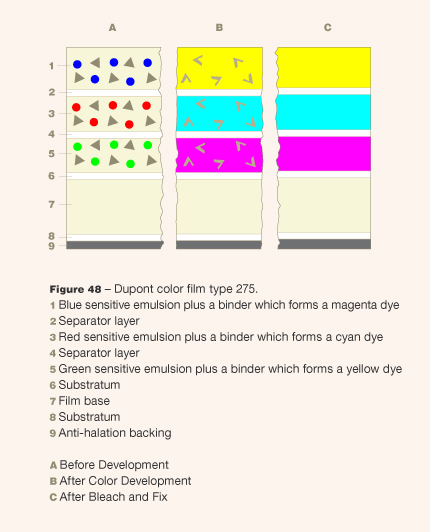
8 Images in 1 Gallery
“An American two-colour subtractive process still worked by the Consolidated Film Industries division of Republic Pictures Corporation. This concern was licensed by the owners of the “Prizma” patents, which it will be remembered was ...
-
![]() Mysore Yesterday and Tomorrow Credit: Image courtesy of the 20th Century Fox Collection at the Academy Film Archive. Photograph: Barbara Flueckiger.
Mysore Yesterday and Tomorrow Credit: Image courtesy of the 20th Century Fox Collection at the Academy Film Archive. Photograph: Barbara Flueckiger.

23 Images in 2 Galleries
“By the 1940s, most of the two-colour subtractive processes, apart from Cinecolor, were obsolete. The widespread use of the high-quality Technicolor process showed up the serious deficiencies in the simpler methods. The only significant new ...
-
![]() Russian Ideas in Clothes! (USA 1922). Credit: UCLA Film & Television Archive. Photographs of the nitrate print by Barbara Flueckiger.
Russian Ideas in Clothes! (USA 1922). Credit: UCLA Film & Television Archive. Photographs of the nitrate print by Barbara Flueckiger.

21 Images in 1 Gallery
-
![]() Credit: Geo. Willeman, Nitrate Film Vault Manager, Library of Congress.
Credit: Geo. Willeman, Nitrate Film Vault Manager, Library of Congress.
- Credit: Geo. Willeman, Nitrate Film Vault Manager, Library of Congress.

2 Images
-
![]() Source: Dubray, J.A. (1933): The Morgana Process In: Journal of the Society of Motion Picture Engineers 21,5, 1933, pp. 403-412.
Source: Dubray, J.A. (1933): The Morgana Process In: Journal of the Society of Motion Picture Engineers 21,5, 1933, pp. 403-412.
1 Image
-
![]() Ansco Color, positives of Ansco Color negative, ca. 1952. Credit: Gert Koshofer Collection. Sample No. 10. Photograph by Barbara Flueckiger.
Ansco Color, positives of Ansco Color negative, ca. 1952. Credit: Gert Koshofer Collection. Sample No. 10. Photograph by Barbara Flueckiger.
- Source: Schultze, Werner (1953): Farbenphotographie und Farbenfilm. Wissenschaftliche Grundlagen und technische Gestaltung. Berlin/Göttingen /Heidelberg: Springer.
- Source: Schultze, Werner (1953): Farbenphotographie und Farbenfilm. Wissenschaftliche Grundlagen und technische Gestaltung. Berlin/Göttingen /Heidelberg: Springer.
- Source: Society of Motion Picture and Television Engineers; ed. (1957): The Elements of Color in Professional Motion Pictures. Prepared by a special committee of the Society. Wilton R. Holm, chairman. New York: The Society.
- Credit: Cinémathèque française, conservatoire des techniques, Paris.
- Source: Schultze, Werner (1953): Farbenphotographie und Farbenfilm. Wissenschaftliche Grundlagen und technische Gestaltung. Berlin/Göttingen /Heidelberg: Springer-Verlag. Photograph by Martin Weiss, ERC Advanced Grant FilmColors.
- Source: Schultze, Werner (1953): Farbenphotographie und Farbenfilm. Wissenschaftliche Grundlagen und technische Gestaltung. Berlin/Göttingen /Heidelberg: Springer-Verlag. Photograph by Martin Weiss, ERC Advanced Grant FilmColors.

30 Images in 2 Galleries
-
![]() Cross section scheme of Anscochrome. Scource: Forrest; John L. (1955): Processing Anscochrome Motion-Picture Films for Industrial and Scientific Applications. In: Journal SMPTE, Vol. 64, Dec. 1955, p. 679.
Cross section scheme of Anscochrome. Scource: Forrest; John L. (1955): Processing Anscochrome Motion-Picture Films for Industrial and Scientific Applications. In: Journal SMPTE, Vol. 64, Dec. 1955, p. 679.

3 Images in 1 Gallery
-
![]() Werbung Ansco, 4 Typen, in JSMPTE 1965
Werbung Ansco, 4 Typen, in JSMPTE 1965

1 Image
 Timeline of Historical Film Colors by Barbara Flueckiger is licensed under a Creative Commons Attribution-NonCommercial-NoDerivatives 4.0 International License.
Quote as Flueckiger, Barbara (2012 ff.): Timeline of Historical Film Colors. (= https://filmcolors.org/).
Download BibTex